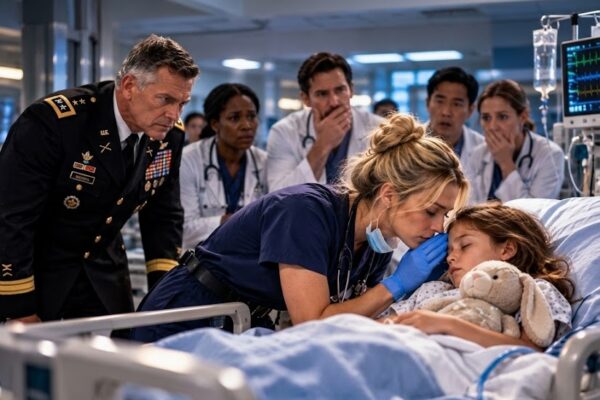
The Chief Surgeon Saw Her Stitch the Wound — Then Asked, “Who Trained You?” She Said, “JSOC”

The Chief Surgeon Saw Her Stitch the Wound — Then Asked, “Who Trained You?” She Said, “JSOC”

The emergency room was chaos.
An ambulance had just brought in a critically injured man following a serious highway accident. Blood covered his clothing, his blood pressure was dropping, and the medical team was struggling to stabilize him.
“Get me another surgical kit!” shouted Dr. Richard Hayes, the hospital’s chief surgeon.
He had spent more than twenty-five years in medicine. He had operated on thousands of patients and was known for remaining calm when everyone else panicked.
But tonight, even he was running out of time.
“His condition is deteriorating,” one of the residents announced.
“Then we move faster!”
Across the room, a young nurse named Emily Carter stood quietly, preparing medical supplies.
She was new to the hospital. She rarely spoke about her past, never participated in office gossip and seemed perfectly comfortable working under pressure.
Most of the staff assumed she was simply another young nurse trying to build her career.
They had no idea who she had been before arriving at the hospital.
The Moment Everything Changed

As the doctors worked to stabilize the patient, a sudden complication required immediate attention.
Dr. Hayes turned toward his team.
“Where is the person responsible for wound closure?”
A resident stepped forward, but before he could begin, Emily noticed something that made her alert the surgeon.
“Doctor, I think you should look at the wound again.”
Hayes turned sharply.
“You’re the nurse, Carter. Let the surgical team handle it.”
Emily didn’t argue.
She simply pointed out what she had noticed and waited for the physician to assess it.
Hayes examined the patient again.
His expression changed.
“Good catch,” he said.
The team adjusted its approach, and the patient was stabilized enough for the surgical team to proceed.
Later, during the procedure, Emily assisted under the surgeon’s direction.
When Hayes observed her careful handling of the instruments and her remarkable composure, he began paying closer attention.
There was something unusual about the way she carried herself.
She didn’t look frightened.
She didn’t look impressed by the chaos.
She looked as though she had seen situations far worse than this one.
“Who Trained You?”

Once the patient was stable, Dr. Hayes reviewed the work and turned toward Emily.
“How long have you been working in emergency medicine?”
“Not very long here, Doctor.”
“Where did you receive your previous training?”
Emily hesitated.
For a moment, she seemed unsure whether she should answer.
Then she calmly replied:
“Before nursing school, I worked in military medicine.”
Hayes raised an eyebrow.
“Military medicine?”
“Yes, sir.”
He looked at her again.
“Who trained you?”
Emily met his eyes.
“JSOC.”
The room suddenly became quiet.
One of the younger doctors stopped writing.
Hayes stared at her.
“Joint Special Operations Command?”
Emily nodded.
“Yes, sir.”
For several seconds, the chief surgeon said nothing.
He had heard stories about medical personnel supporting special operations units, but he had never expected to encounter someone with that background in his own emergency department.
The Past She Never Talked About

The following afternoon, Hayes invited Emily into his office.
He had reviewed her employment records, but there was very little information about her previous military experience.
“Why didn’t you tell anyone about your background?” he asked.
Emily looked down at her hands.
“Because I didn’t come here to be recognized for what I did before.”
Hayes leaned back.
“What did you do before?”
Emily took a slow breath.
She explained that she had worked as a military medical professional supporting demanding operational environments.
She had seen frightened young soldiers, exhausted medics and families waiting for news that could change their lives forever.
She had learned that remaining calm was not about having no fear.
It was about understanding that someone else’s life might depend on your ability to think clearly.
“But eventually,” she continued, “I wanted a different life.”
“Why?”
Emily looked toward the window.
“Because I wanted to help people without having to say goodbye to them afterward.”
Hayes was silent.
For the first time, he understood why she had never spoken about her past.
She wasn’t trying to impress anyone.
She was trying to move forward.
The Chief Surgeon Makes an Unexpected Decision
A week later, another difficult emergency case arrived.
The medical team was overwhelmed, and the younger staff members were struggling with the pressure.
Hayes looked across the room.
“Carter, I need you assisting the trauma team.”
Emily immediately stepped forward.
Throughout the case, she remained focused, communicated clearly and supported the team under the surgeon’s supervision.
After the patient had been transferred for further treatment, Hayes gathered the staff.
“I want everyone to understand something,” he said.
“Experience isn’t always measured by how long you’ve worn a hospital badge. Sometimes, the person standing quietly in the corner has already faced challenges most of us will never experience.”
He looked toward Emily.
“And sometimes, the best thing we can do is learn from each other.”
Emily lowered her eyes, slightly embarrassed by the attention.
She hadn’t come to the hospital looking for recognition.
She had come because she wanted to save lives.
A Different Kind of Respect

Several months later, Emily had become one of the most trusted members of the emergency department.
She still arrived early.
She still spoke quietly.
And she still avoided discussing her military past unless someone genuinely needed to know.
One evening, Hayes passed her in the corridor.
“Carter?”
“Yes, Doctor?”
He smiled.
“I’ve been thinking about something you said.”
“What was that?”
“You said you wanted a life where you could help people without having to say goodbye afterward.”
Emily nodded.
Hayes continued:
“I think you’re doing exactly that.”
For a moment, Emily struggled to find an answer.
Then she smiled.
“Thank you, Doctor.”
As she walked away, Hayes watched her disappear down the corridor.
He had spent decades believing that the best medical professionals were those with the most impressive qualifications.
Emily had reminded him of something much more important.
A person’s greatest strength is not always written on their résumé. Sometimes, it is hidden in the experiences they never talk about, the battles they never describe, and the lives they quietly help save.
And that night, when the chief surgeon asked, “Who trained you?”, he discovered that the quiet young nurse had a story far bigger than anyone in the hospital could have imagined.
You Might Also Enjoy



Manchester United finalising deal to appoint Mauricio Pochettino as Carrick replacement

Single Dad Took Two Bullets Saving the Army General’s Daughter — “Move, I’ll Handle This!”

They Tried to Take the Stray Puppy—Then the Quiet Nurse Realized Why the K9 Needed Him