Poor Café Girl Helped a Mafia Mother — Next Morning, Four Bodyguards Came For Her
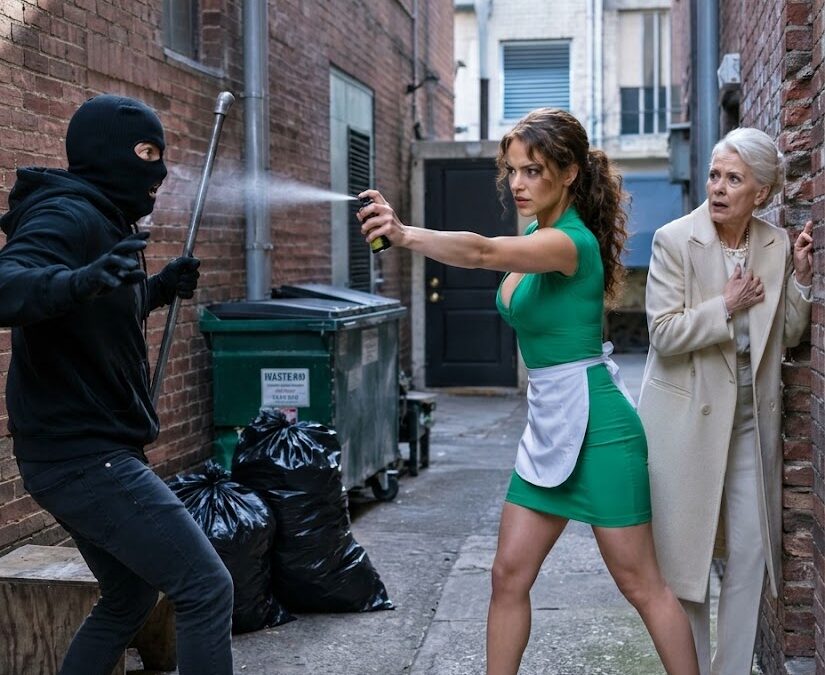
Poor Waitress Saves an Old Woman — The Next Morning, Four Bodyguards Appear to Take Her Away
Maya had always lived by a cold and simple philosophy: bow her head, serve coffee, and turn a blind eye to the violence in the alleyways. Her survival depended on not attracting attention.
But everything changed the moment she decided to help an old woman the night before.
Now, as four men in impeccably tailored suits entered the diner and locked the back door, she realized that breaking her survival rules had come at a very high price.
The neon sign outside Lou’s diner hadn’t fully illuminated a single word since 2019. It only flickered the three letters DNR, casting a sickly red light onto the wet asphalt.
Maya used her teeth to tighten the tape wrapped around the sole of her left boot for the third time this week.
It was 2:14 a.m.
The air inside the shop reeked of old grease, repeatedly brewed coffee, and the pungent smell of ammonia she used to clean the linoleum floor.
She was tired.
Not the kind of tiredness that could be cured by a good night’s sleep, but a deep-seated exhaustion, the kind you feel when you work two jobs for minimum wage just to keep your landlord from throwing your mattress out on the street.
“Take out the trash, Maya.”
Lou grumbled from behind the grill. He didn’t even look up, still scraping the burnt grease off the grill.
She lifted two heavy black garbage bags. The filthy liquid inside seeped out, wetting the hem of her apron.
Maya pushed open the heavy metal door at the back of the shop and stepped into the alley.
The cold October wind lashed against her like a wet towel, piercing through her thin flannel shirt.
And then she heard it.
It wasn’t a scream.
Screams are usually loud and dramatic.
This was a gasp, wet, broken breath, followed by the sound of a heavy body slamming against a trash can.
Maya froze in place.
The wisest thing she could do, and what any city dweller would do, was drop the trash bag, go back inside, and lock the door.
Don’t look into the darkness.
Don’t ask questions.
But then she heard a second sound: the click of a switchblade, chillingly clear.
“Give me the ring, old woman.”
The voice was young, trembling and agitated.
Maya leaned over to look at the rusty edge of the commercial trash can.
A young man, no older than twenty, was pinning a woman against a brick wall. He trembled, the knife in his hand shaking.
The woman didn’t belong here at all.
Even in the dim light of the alley, Maya recognized her thick wool coat, made of expensive cashmere. Her silver hair was neatly tied up, though a few strands had fallen across her face.
Her face was strangely serene, despite the bleeding cut on her cheek.
She didn’t beg.
She only looked at the young man with the cold, disappointed gaze of a mother.
“I don’t want to do this,” she said.
Her voice was hoarse, elegant, and perfectly calm.
“Shut up! Give me the ring!”
He pressed the blade closer to her neck.
The woman clutched her chest, her breathing becoming shallow and rapid. She wasn’t just cornered. She seemed to be having a serious illness.
Maya looked at the trash bags in her hands.
Then she saw a large container of industrial degreasing chemical on the loading platform nearby.
Don’t do that, Maya! Her brain screamed.
But her hand had already grabbed the container.
She stepped out from behind the trash can.
“Hey!”
The man jumped and spun around.
“Get lost, waitress! This is none of your business!”
“You’re right. It has nothing to do with me,” she replied, her voice calm, almost cold.
“But you’re standing on Lou’s land.”
She looked him straight in the eye.
“Lou has a loaded shotgun under the counter. He’s hot-tempered and an alcoholic. I just pressed the alarm button by the door.”
That was a lie.
There was no alarm button.
Lou didn’t even own a gun. The only thing he had was a baseball bat, mostly used for swatting rats.
The man hesitated.
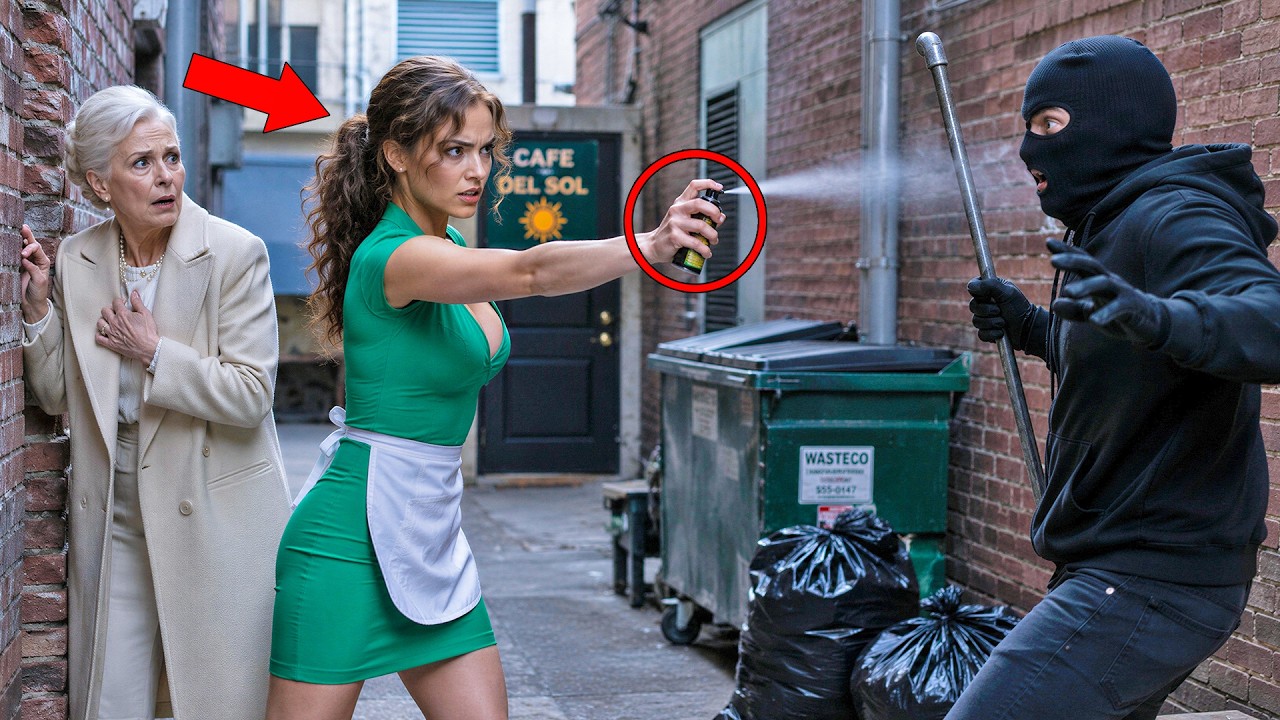
Maya raised the spray bottle, pointing the nozzle directly at his eyes.
“This is industrial cleaning chemical containing a corrosive agent. Want to see what it will do to your cornea before the police arrive?”
He looked at Maya, then at the chemical bottle, then glanced at the woman leaning heavily against the brick wall, gasping for breath.
He spat on the ground, folded the knife, and ran down the alley, disappearing into the mist.
Maya breathed a sigh of relief. Her knees suddenly trembled violently.
She set the chemical bottle down and walked over to the woman.
Up close, she looked noticeably weaker. Her skin was pale, cold, and damp.
“Are you alright?”
Maya reached out to support her.
“Do you need an ambulance?”
The woman flinched slightly when Maya touched her, but then gradually relaxed.
“No, no, not to the hospital. My medicine is in my coat pocket.”
Maya reached into her silk-lined pocket, took out a small inhaler, and offered it to her.
The woman took two deep breaths, closed her eyes, and leaned her head against the dirty wall.
Slowly, a rosy hue began to return to her face.
“Come inside,” Maya said, looking anxiously toward the end of the alley.
“It’s very cold. I’ll get you a glass of water.”
The woman opened her eyes.
Her eyes were dark, sharp, and full of scrutiny.
She looked at Maya’s worn boots, her stained apron, and the burn scar on her right wrist, the result of an accident with a deep fryer two years ago.
“You did something incredibly stupid to take that risk,” she said. Her voice had regained some of its strength.
“Yes, I only have ten minutes left on my shift. My quota for caring about others today is exhausted.”
Maya sighed.
“Now go inside before he comes back with his accomplices.”
She helped the woman through the back door and seated her in a vinyl-covered chair near the kitchen.
Lou glanced at them suspiciously, but said nothing as Maya poured a cup of hot water and handed her a stack of cheap tissues to wipe the blood from her cheek.
The woman sat in the chair opposite, looking completely out of place in the squalid surroundings.
She wiped the blood from her face with a strangely dignified composure.
“Do you have anyone to call?” Maya asked, leaning against the counter.
“A taxi? A family member?”
“My driver was supposed to be waiting at the corner of Fifth and Maine. We had an unexpected incident on the way. I walked to avoid trouble,” she replied cryptically.
“I’ll make my own way home.”
She took a sleek, matte black phone from her bag and dialed a single number.
She spoke quickly in Italian, her voice low but firm.
Maya didn’t understand the words.
But she understood the tone.
It was a command.
Four Men in Suits
The morning shift at the LSE diner was a different kind of hell.
It was a mix of construction workers, drunken college students, and customers who’d been waiting for their omelets since yesterday.
It was 9:30 a.m.
Maya had only slept four hours.
Her feet ached, her left arm clutched three greasy plates of fries, while her right hand poured coffee.
Then suddenly, the diner fell silent.
Not all at once.
The workers’ chatter died down first, followed by the clinking of knives and forks.
Maya turned around, her coffee pot still in her hand.
Four men had just walked in.
They didn’t belong here.
Neither did they belong in this neighborhood.
Their suits cost more than the building the diner was in. Charcoal gray and dark blue suits, tailored to fit their incredibly broad shoulders.
They moved with terrifying synchronicity, almost without a sound.
One of them, a giant with a broken nose and eyes as black as dead coal, stepped past the sign that read “Please wait to be seated.”
He went straight to the front door, flipped the sign from “Open” to “Closed,” and turned the lock.
An instant panic surged through Maya’s chest.
Beside her, Lou dropped the food spatula.
Another man, thinner but with a scar running across his left eyebrow, stepped into the middle of the diner.
He didn’t need to raise his voice, yet it echoed through every corner of the room.
“Everyone finish your breakfast. Everyone remain seated.”
The construction workers, the men who usually enjoyed getting into brawls in bars, were now huddled in their seats.
These weren’t ordinary thugs.
These were professionals.
The violence emanating from them was chillingly clean.
The scarred man approached the counter.
He looked at Lou, who was sweating from grease and terror.
“Who worked the night shift last night?”
He asked in a polite tone.
That question only made things worse.
Lou swallowed hard, looking at Maya.
He hadn’t intended to betray her, but his eyes unconsciously glanced at her for half a second.
That was enough.
The man shifted his gaze to Maya. His eyes swept from her face down to her hands, stopping at the jagged burn scar on her right wrist.
“Maya.”
It wasn’t a question.
It was a statement.
She tightened her grip on the coffee pot handle.
If she threw the boiling liquid in his face, she might be able to escape through the back door. But the giant standing near the front door had begun to move, blocking her way.
“What do you want?”
Her voice trembled.
She hated it.
“You’ll come with us,” the man said.
“No way.”
Maya recoiled, bumping into the glass display case of pies.
“I don’t know who you are. I owe no one money.”
“You won’t get into trouble, Maya.”
He stepped closer.
He didn’t touch her. He simply invaded her personal space, letting his size and presence exert pressure.
“But you’ll come with us. You can walk out the front door quietly, or we can cause a commotion that will cost your boss his entire business.”
He reached into his inner pocket.
Lou groaned, raising her hands in surrender.
But the man didn’t draw his gun.
He pulled out a thick wad of money tied with string and placed it on the counter, right next to a half-eaten plate of pancakes.
“Compensation for the disruption to your business,”
He said to Lou.
Then he turned to look at Maya.
“Your coat.”
Maya looked at the four men.
She looked at the locked door.
There was no escape that wouldn’t end with her in an ambulance or worse.
Her heart pounded like a trapped bird.
She took off her apron with trembling fingers, tossed it onto the counter, and grabbed her denim jacket from the hanger behind her.
She stepped out from behind the counter.
The giant opened the door for her.
Outside, three black SUVs were illegally parked, blocking the street.
No one honked.
“Get in,” the scarred man said, opening the back door of the middle vehicle.
Maya climbed inside.
The seats were soft, faintly smelling of expensive leather and high-end perfume.
The door slammed shut, trapping her in the soundproof space with its tinted windows.
The scarred man sat in the front passenger seat.
“Where are you taking me?” Maya questioned as the car sped away.
He didn’t turn around.
“To see someone you owe a conversation to.”
“I owe no one anything.”
“You helped a woman last night.”
Maya’s stomach tightened.
The alley.
The cashmere coat.
A calm, authoritative voice.
“That old woman…” she whispered.
“Yes. That old woman is Beatrice Rossy.”
The man’s voice suddenly turned cold.
“And you’re going to see her son.”
Maya leaned her head back against the seat, closing her eyes.
Rossy.
Even a slum-dwelling dishwashing maid knew that name.
Their family owned the shipping docks.
They controlled the unions.
They manipulated politicians.
She hadn’t saved a homeless old woman.
She had saved the female head of the largest criminal organization on the East Coast.
And now, she was sitting in their car.
Dominic Rossy
The car sped for forty minutes, leaving behind the dilapidated buildings of the city, ascending the hills where mansions were hidden behind iron gates and exuded an air of ageless wealth.
The car passed through a large, automatically opening security gate.
They drove along a long, winding road, flanked by ancient oak trees.
The house wasn’t a ostentatious, flashy villa.
It was a massive Brutalist-style structure, built of stone, glass, and dark wood.
It resembled a fortress trying to disguise itself as a home.
The car stopped.
The doors opened.
The giant gestured for her to get out.
Maya stepped onto the gravel, pulling her cheap denim jacket tightly around her.
She felt painfully small.
Maya was escorted through the massive double doors into the spacious foyer, where their footsteps echoed.
There was no loud music, no ostentatious golden statues. Only a few expensive works of art were sparsely displayed, and an atmosphere of stifling silence prevailed.
The scarred man led her down the long corridor, stopping before a heavy oak door.
He knocked once, opened it, and gestured for her to enter.
Maya stepped through the doorway.
The door closed behind her with a dry click.
The office was vast, bookshelves lining the walls, the air faintly scented with cedar wood and old paper.
Sitting behind a huge mahogany desk was a man.
Initially, he didn’t look up.
He was examining a leather-bound notebook, the heavy gold pen moving quickly and decisively across the page.
He wore a pristine white shirt, sleeves rolled up to reveal strong forearms with defined muscles and a few faint tattoos.
“Sit down.”
His voice was low, devoid of any warmth.
Maya remained standing.
“I prefer standing.”
He stopped writing.
Slowly, he looked up.
His eyes were exactly like Beatrice’s: black, sharp, and scrutinizing.
But while her eyes carried the weary dignity of someone who had experienced too much, his were predatory.
His jaw was clenched, his chin covered in a sparse stubble.
He looked like someone who hadn’t slept for days, surviving only on black coffee and the adrenaline of stress.
This was Dominic Rossy.
He put down his pen.
He leaned back in his chair, clasped his hands in front of his stomach, and observed her.
His gaze swept over her tapered boots, faded jeans, and the exhaustion etched in her eyes.
“Maya.”
The name sounded completely different when it came from his mouth.
He seemed to be testing its sound, weighing each syllable.
“Listen,” she said, her voice strained. “If this relates to last night, I don’t know who she was. I only saw a woman being attacked by robbers.”
She looked straight at him.
“I didn’t do this to get dragged into your mess. I don’t want the reward. I don’t want anything. Let me get back to my work.”
Dominic didn’t blink.
“My mother was a very cautious woman. She always had bodyguards with her. Last night, her driver was attacked. Someone ordered her assassination.”
He paused.
“She walked three blocks to avoid the fighting and found an alley to catch her breath. That’s when a local drug addict with a knife came looking for her.”
He leaned forward, resting his elbows on the table.
“You interfered. You threatened him with chemicals that could cause burns. You brought my mother into the bar. And then, you refused a ten thousand dollar tip.”
He slowly emphasized the last number.
Ten thousand dollars.
That was more than she earned in a whole year.
Maya’s stomach churned.
“I thought it was dirty money,” she protested. “I didn’t want LSE to be raided by the police.”
“Nobody refuses money.”
Dominic said in a flat tone.
The skepticism in his voice was so heavy it seemed to drag on the floor.
“Everyone has their price. Everyone is calculating their own interests.”
He stared at her.
“So tell me, Maya. What’s your price?”
“I have no ulterior motives!”
Anger finally flared up, piercing through her fear.
“I was tired. I was taking out the rotting garbage. I saw a dying old woman in the alley and reacted instinctively. That’s all!”
She took a step forward.
“Not everything in the world is a conspiracy, Mr. Rossy.”
His eyes narrowed.
The atmosphere in the room became heavy, suffocatingly tense.
You Might Also Enjoy



Manchester United finalising deal to appoint Mauricio Pochettino as Carrick replacement

Single Dad Took Two Bullets Saving the Army General’s Daughter — “Move, I’ll Handle This!”

They Tried to Take the Stray Puppy—Then the Quiet Nurse Realized Why the K9 Needed Him



