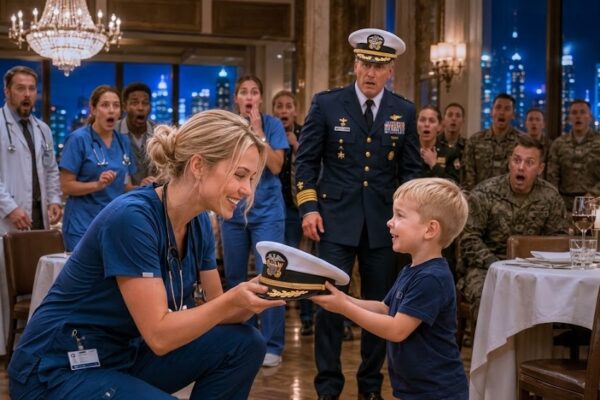
Doctors Failed — Then a Rookie Nurse Saved the SEAL Admiral’s 5-Year-Old Granddaughter

Doctors Failed — Then a Rookie Nurse Saved the SEAL Admiral’s 5-Year-Old Granddaughter
The emergency room at St. Mary’s Medical Center had never been so quiet.
Five-year-old Sophie Bennett lay motionless on the hospital bed, her tiny fingers wrapped around a stuffed rabbit. Machines beeped around her, and a team of the hospital’s most experienced doctors stood nearby, staring helplessly at her test results.
For nearly three hours, they had tried everything.
Nothing worked.
Her heart rate kept dropping, her oxygen levels were dangerously low, and nobody could explain why a seemingly healthy little girl had suddenly collapsed.
Standing outside the room was Admiral Richard Bennett, a highly decorated former Navy SEAL commander. A man who had survived combat missions, enemy fire, and countless life-threatening situations.
But tonight, none of his military experience could help him save his granddaughter.
“Please,” he whispered to the attending physician. “She’s all I have left. Tell me you can do something.”
Dr. Harrison lowered his eyes.
“We’re doing everything medically possible, Admiral. But we don’t know what’s causing this.”
Richard clenched his fists.
“Then find someone who does!”
At that moment, a young nurse entered the room.
Her name was Emma Collins. She was twenty-four years old and had been working in the emergency department for barely six weeks.
She wasn’t famous. She wasn’t a specialist. And most of the senior doctors barely knew her name.
But something about Sophie’s condition caught her attention.
Emma approached the bed and carefully examined the little girl’s face.
“Doctor, may I ask something?”
Dr. Harrison barely looked at her.
“Not now, Nurse Collins.”
“But I noticed something unusual.”
He sighed.
“What?”
Emma pointed toward Sophie’s lips.
“Has anyone checked whether she might have swallowed something?”
The doctor frowned.
“We’ve already examined her. There’s no evidence of poisoning.”
Emma shook her head.
“I’m not talking about poisoning. Look at her breathing. Something seems to be interfering with her airway.”
One of the senior nurses rolled her eyes.
“She’s been unconscious for hours. We have specialists handling this.”
But Emma didn’t move.
She remembered something from her pediatric emergency training: small children could accidentally inhale or swallow foreign objects without anyone noticing. Sometimes, the symptoms were confusing, and the initial examination could miss the cause.
She turned toward Richard.
“Admiral, can I ask you something about Sophie?”
Richard immediately stepped closer.
“Anything.”
“Did she eat or play with anything unusual before she became sick?”
Richard thought for a moment.
“She was at my house this afternoon. She was playing with her grandmother’s sewing box. But her parents said she seemed perfectly fine afterward.”
Emma’s expression changed.
“A sewing box?”
“Yes. Why?”
Emma immediately asked the medical team to reassess the possibility of an inhaled foreign object. She did not attempt any procedure herself. Instead, she insisted that the appropriate specialist urgently examine Sophie.
Dr. Harrison initially hesitated.
But when he noticed the subtle signs Emma had identified, he ordered an emergency airway evaluation.
Within minutes, the pediatric specialist arrived.
After examining Sophie, the specialist discovered something that changed everything: a tiny foreign object was obstructing part of her airway.
The team prepared for an emergency procedure.
Richard stood outside the operating room, his hands shaking.
For the first time in decades, the former SEAL commander found himself completely powerless.
“Please, God,” he whispered. “Don’t take her from me.”
Nearly forty minutes later, the operating room doors opened.
The specialist removed his surgical mask.
“Admiral Bennett?”
Richard rushed toward him.
“How is my granddaughter?”
The doctor smiled.
“She’s stable. We successfully removed the object. She should recover, but we’ll continue monitoring her closely.”
Richard’s knees nearly gave way.
He covered his face with both hands as tears streamed down his cheeks.
“Thank you. Thank you so much.”
Then he asked the question that had been on his mind.
“Who noticed it?”
The doctor glanced toward the nurses’ station.
“A young nurse named Emma Collins. She was the one who raised the concern that led us to investigate her airway.”
Richard slowly turned.
Emma was standing quietly near the wall, still wearing her blue scrubs.
He walked toward her.
“You’re the nurse?”
Emma nodded nervously.
“Yes, sir.”
Richard looked at her for a long moment.
“How long have you been working here?”
“Six weeks, sir.”
“Six weeks?”
“Yes.”
He shook his head in disbelief.
“Tonight, some of the most experienced doctors in this hospital couldn’t figure out what was happening to my granddaughter. But you noticed something everyone else overlooked.”
Emma lowered her eyes.
“I just didn’t want to give up on her.”
Richard’s eyes filled with tears again.
He gently took her hand.
“Listen to me. I’ve spent my entire life leading men into dangerous situations. I’ve seen bravery in places most people will never understand.”
He paused.
“But tonight, I saw a different kind of courage. The courage to speak up when everyone around you thinks you’re wrong.”
The following morning, Sophie opened her eyes.
Her first words were:
“Grandpa?”
Richard immediately leaned over her bed.
“I’m right here, sweetheart.”
She smiled weakly.
“Where’s my rabbit?”
Richard laughed through his tears and placed the stuffed rabbit beside her.
Then Sophie noticed Emma standing near the doorway.
“That’s the nice nurse!”
Emma walked closer.
“How are you feeling, princess?”
Sophie reached out her tiny hand.
“Thank you for helping me.”
Emma couldn’t hold back her tears.
A few days later, Admiral Bennett returned to the hospital. This time, he wasn’t wearing his military uniform or carrying the weight of a family emergency.
He brought a bouquet of flowers and a handwritten letter addressed to Emma.
Inside was a simple message:
“In the military, we are taught that rank does not determine courage. Tonight, you proved that the same is true in medicine. Never allow anyone to make you believe that your voice doesn’t matter.”
Emma kept that letter for the rest of her career.
And Admiral Bennett never forgot the young nurse who had helped save the little girl he loved more than anything.
Because sometimes, the person who makes the greatest difference isn’t the most experienced person in the room. It’s the one who cares enough to notice what everyone else has missed.
You Might Also Enjoy



Manchester United finalising deal to appoint Mauricio Pochettino as Carrick replacement

Single Dad Took Two Bullets Saving the Army General’s Daughter — “Move, I’ll Handle This!”
They Tried to Take the Stray Puppy—Then the Quiet Nurse Realized Why the K9 Needed Him