“I Don’t Need a Mother,” the Girl Said — “Good. I Don’t Need a Daughter. Pass Me the Flour”
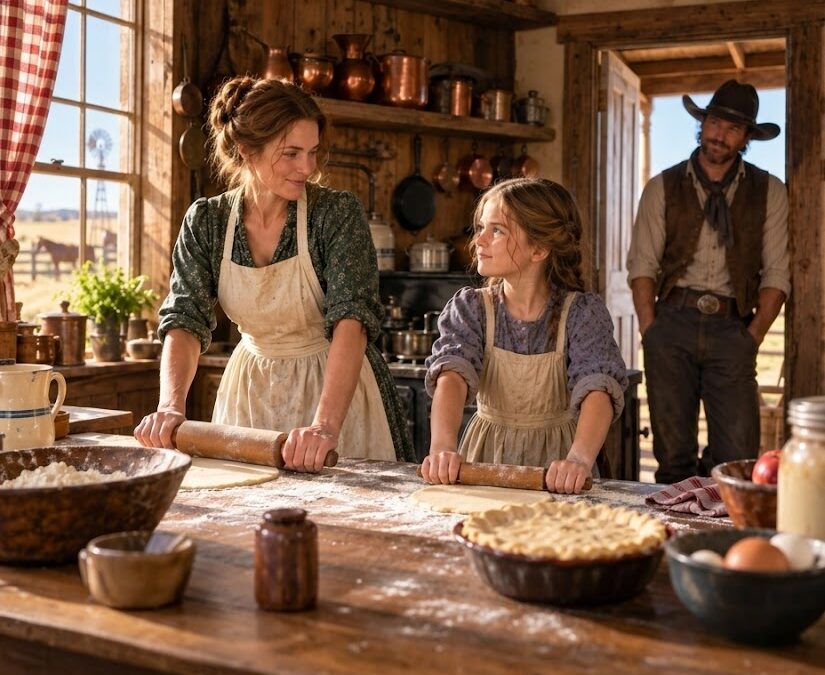
The first time twelve-year-old Lily Bennett met the woman who was supposed to become her stepmother, she made one thing perfectly clear.
“I don’t need a mother.”
The woman stood in the doorway of the kitchen, holding a grocery bag in one hand and a wooden spoon in the other.
She didn’t look offended.
She didn’t look surprised.
She simply glanced at Lily, then at the bowl of flour on the counter.
“Good,” she replied. “I don’t need a daughter. Pass me the flour.”
Lily blinked.
She had prepared herself for tears, lectures, or the usual speech about how they were going to become one big happy family.
She hadn’t prepared herself for that.
“Excuse me?”
“The flour,” the woman repeated. “Unless you’d prefer to stand there arguing until the biscuits burn.”
Lily stared at her.
Then, despite herself, she looked toward the oven.
Something smelled suspiciously like smoke.
“Those are burning.”
“Excellent observation. Now pass me the flour.”
Lily handed it over.
And that was how her war against her father’s new wife began.
Or, as it turned out, how it slowly ended.
Chapter One: The Woman Who Didn’t Try to Be Her Mother
Lily had been ten years old when her mother died.
For two years, she had lived with her father, Daniel, in the same small white house where she had learned to ride a bicycle, lost her first tooth, and celebrated every birthday with a chocolate cake her mother made from scratch.
After her mother’s death, Daniel tried his best.
He packed Lily’s lunches, attended school meetings, and learned how to braid her hair by watching online tutorials. Some mornings, he got it right.
Other mornings, Lily looked as though she had wrestled a lawn mower.
They survived.
But surviving wasn’t the same as being happy.
Then Daniel met Margaret Ellis.
Margaret was thirty-nine, worked as a baker, and owned a small shop called Morning Light Bakery on the corner of a quiet street.
She had flour on her sleeves more often than not, drove an old blue pickup truck, and laughed loudly enough to make people turn around.
Lily disliked her almost immediately.
Not because Margaret was cruel.
That would have been easier.
She disliked her because Margaret was kind.
She brought Daniel coffee when he worked late. She remembered that Lily hated raisins. She never complained when Lily answered questions with one-word responses.
And worst of all, she never tried to replace Lily’s mother.
That made Lily suspicious.
Every adult who had spoken to her about Daniel dating again had used the same phrases.
Your father deserves to be happy.
Your mother would have wanted him to move forward.
Margaret seems lovely.
Nobody had asked Lily what she wanted.
Nobody had asked whether she was ready to share her home, her father, or the memories of her mother with someone new.
So Lily made a decision.
She would never call Margaret family.
She would never let her get close.
And if Margaret thought she could walk into their house and become her mother, she had another thing coming.
The problem was that Margaret didn’t seem interested in becoming anyone’s mother.
When Daniel announced that Margaret would move in after their wedding, Lily crossed her arms.
“I don’t need a mother.”
Daniel opened his mouth, but Margaret spoke first.
“Good. I don’t need a daughter.”
Lily’s face turned red.
Margaret continued calmly, “But I do need someone to help me make biscuits tomorrow. Your father says you’re good at measuring ingredients.”
Then she walked into the kitchen.
Lily stood in the hallway, completely speechless.
For the first time in two years, someone had refused to argue with her grief.
And Lily had absolutely no idea what to do about it.

Chapter Two: The Rules of the Kitchen
Margaret moved into the house three weeks later.
She brought six boxes, two suitcases, a collection of battered baking pans, and a cat named Pickles who immediately claimed Lily’s favorite armchair.
She also brought rules.
Not many.
Just enough to make Lily furious.
Rule number one: Nobody ate cookies before dinner.
Rule number two: If you used the last of the milk, you wrote it on the shopping list.
Rule number three: The kitchen was a shared space, which meant Lily couldn’t slam cupboards just because she was angry.
“I wasn’t slamming them,” Lily protested one evening.
Margaret looked at the cupboard hanging slightly open.
“Of course not. The hinges are simply terrified of you.”
Lily hated that she almost laughed.
Almost.
Margaret didn’t force conversations. She didn’t ask Lily to hug her. She didn’t buy expensive presents and expect gratitude.
Instead, she went about her life.
She woke early to bake bread, returned home smelling of cinnamon, and spent Sunday afternoons repairing things around the house that Daniel had been meaning to fix for months.
One Saturday, Lily came downstairs and found Margaret sitting on the kitchen floor with a screwdriver.
“What are you doing?”
“Trying to stop this cabinet door from falling off.”
“Dad said he’d fix that.”
“Yes. Your father has been saying that since last Christmas.”
Lily sat on the stairs.
“It’s been broken since Christmas?”
“Unless we’re celebrating a very unusual Christmas this year.”
Lily watched Margaret struggle with the screwdriver.
After a moment, she stood up, found the correct tool in the drawer, and handed it over.
Margaret accepted it without comment.
They worked in silence for fifteen minutes.
When the cabinet finally closed properly, Margaret nodded toward Lily.
“Good teamwork.”
Lily shrugged.
“I just gave you a screwdriver.”
“And I just fixed a cabinet. Between us, we’re practically unstoppable.”
That time, Lily did laugh.
It escaped before she could stop it.
Margaret looked up.
For one brief second, their eyes met.
Then Margaret returned to the cabinet as though nothing unusual had happened.
Lily went upstairs, annoyed with herself.
She had laughed.
And somehow, that felt like betrayal.
Chapter Three: The Photograph in the Drawer
One rainy afternoon, Daniel left for a work meeting and Margaret went to the bakery.
Lily was alone in the house when she decided to look for a missing notebook in the hall closet.
She found the notebook beneath a stack of old magazines.
But beside it was a small wooden box she had never seen before.
Inside were photographs, folded letters, and a white ribbon Lily recognized immediately.
It had belonged to her mother.
Lily sat down on the floor.
Her mother had worn that ribbon in her hair on Lily’s seventh birthday. She remembered the way it caught the sunlight when they stood together in the garden.
She picked up a photograph.
Her mother was smiling, holding a mixing bowl while Lily stood on a chair beside her, covered in flour.
On the back, her mother had written:
For my little baker. Never forget that the sweetest things are made with love.
Lily’s throat tightened.
She hadn’t looked at that photograph in months.
For a moment, she was seven again, standing in a warm kitchen with her mother laughing beside her.
Then she heard the front door open.
Margaret walked in carrying a paper bag.
She stopped when she saw Lily sitting on the floor with the box.
Neither of them spoke.
Finally, Margaret set the bag down.
“I wondered where that box had gone.”
Lily quickly wiped her face.
“Why do you have my mother’s things?”
“Your father asked me to keep them safe while he reorganized the closet.”
Lily looked at the ribbon.
“Did you touch them?”
“Only to put them away.”
“Did you read her letters?”
“No.”
Lily’s eyes filled with anger.
“You don’t have to pretend to care about her!”
Margaret went very still.
“I don’t pretend to care about your mother, Lily. I never knew her.”
“Then why are you here?”
The question came out louder than Lily intended.
“Why are you trying to live in her house? Why are you using her kitchen? Why are you acting like you belong here?”
Margaret didn’t answer immediately.
She pulled a chair closer and sat down, leaving enough space between them that Lily didn’t feel trapped.
“Because I love your father,” she said quietly. “And because I care about you.”
“I don’t need you to care about me!”
“I know.”
“Then stop!”
Margaret looked at the photograph in Lily’s hands.
“You’re right about one thing. I’ll never be your mother. I can’t be the person who carried you, raised you from a baby, or made those memories with you.”
Lily stared at her.
“But I can be someone who makes breakfast when you’re hungry,” Margaret continued. “I can listen when you want to talk. I can help you with homework, teach you how to make biscuits, and sit outside your bedroom door when you’re having a terrible day.”
She paused.
“And I can love your father without asking you to love me the same way.”
Lily’s lips trembled.
“What if I never love you?”
Margaret’s answer came without hesitation.
“Then I’ll still hope you have a good life.”
For some reason, that hurt more than any argument could have.
Lily lowered her head.
Margaret didn’t reach for her.
She didn’t tell her to stop crying.
She simply sat beside her until the rain softened against the windows.
And when Lily finally put the photograph back into the box, Margaret closed the lid carefully.
As though the memories inside deserved respect.
Chapter Four: The Day Everything Went Wrong
Two months later, Lily’s school held its annual family baking competition.
Students could enter with a parent or guardian. The winning team would receive a small trophy and have its recipe featured in the school newsletter.
Lily had planned to enter with Daniel.
They had already decided to make her mother’s chocolate biscuits.
But the night before the competition, Daniel called from work.
A colleague had suffered an emergency, and Daniel needed to cover an overnight shift.
He sounded devastated.
“I’m so sorry, sweetheart. I’ll try to get there before the judging.”
Lily said it was fine.
It wasn’t.
She had spent three weeks preparing for the competition. She had practiced the recipe every evening and carefully copied her mother’s handwritten instructions.
Now she would have to enter alone.
When she arrived at school the next morning, she saw children setting up their stations with their mothers, fathers, grandparents, and older siblings.
One girl had matching aprons for herself and her mother.
Another boy was laughing with his father while they decorated cupcakes.
Lily set down her ingredients.
She told herself she didn’t care.
She didn’t need a mother.
She didn’t need anyone.
Then she realized she’d forgotten the vanilla extract.
Her stomach dropped.
She checked every bag twice.
Nothing.
She could almost hear her mother’s voice reminding her that the recipe wasn’t complete without it.
Lily stared at the mixing bowl.
She wanted to leave.
She wanted to go home, crawl under her blankets, and pretend the entire day had never happened.
Then a familiar voice came from behind her.
“Move over, little baker.”
Lily turned.
Margaret stood there wearing a flour-covered apron and carrying a grocery bag.
“What are you doing here?”
“Your father called me.”
Lily looked away.
“I didn’t ask you to come.”
“I know.”
“I don’t need a mother.”
Margaret placed the grocery bag on the table.
“Good. I brought vanilla, and I refuse to let a perfectly good batch of chocolate biscuits die because someone forgot an ingredient.”
Lily stared at her.
“You came all the way here just to bring vanilla?”
“No. I also came because I happen to be very competitive.”
Despite herself, Lily smiled.
Margaret tied on an apron.
“Now, pass me the flour.”
And just like that, they began.
They measured the ingredients, mixed the dough, and carefully shaped the biscuits.
Margaret let Lily make the important decisions.
“How much chocolate?” she asked.
“More.”
“How much more?”
“Enough.”
“Excellent. A precise scientific measurement.”
Lily laughed.
For the first time that morning, the knot in her chest loosened.
They worked side by side, and when Lily became nervous about the judging, Margaret leaned toward her.
“Listen. Your biscuits don’t have to be perfect. They just have to be yours.”
Lily looked down at the dough.
“My mom taught me this recipe.”
“Then let’s make her proud.”
Margaret said it so naturally that Lily forgot to be angry.
They placed the tray in the oven.
And waited.
Chapter Five: The Recipe That Won
When the judges arrived, Lily stood beside Margaret with her hands clasped tightly together.
Their biscuits were slightly uneven.
One was too dark around the edges.
Another had a small crack down the middle.
They weren’t the prettiest entry in the competition.
But the smell of chocolate filled the room.
The head judge, a retired baker named Mrs. Thompson, took one bite.
Then another.
She looked at Lily.
“Who taught you this recipe?”
“My mother,” Lily answered.
Mrs. Thompson smiled.
“It’s wonderful. There’s something very special about a recipe that carries a memory.”
Lily glanced at Margaret.
Margaret gave her a small nod.
The judges moved to the next table.
Lily held her breath.
When the results were announced, their team received second place.
A boy named Oliver won first with a spectacular three-tiered cake decorated with sugar flowers.
For a moment, Lily felt disappointed.
Then Margaret nudged her gently.
“Second place is excellent.”
Lily looked at the little silver certificate.
“Yeah.”
“Besides,” Margaret whispered, “we both know those sugar flowers were probably held together with industrial-strength glue.”
Lily burst out laughing.
Mrs. Thompson, standing nearby, raised an eyebrow.
“I’m sure they were perfectly edible.”
Margaret straightened immediately.
“Of course. A beautiful cake. An excellent cake. The finest cake I’ve ever seen.”
Lily laughed even harder.
And then, without thinking, she slipped her hand into Margaret’s.
Margaret looked down.
Lily realized what she had done and began to pull away.
But Margaret didn’t hold on tightly.
She simply let Lily decide.
After a moment, Lily kept her hand there.
It wasn’t a declaration.
It wasn’t forgiveness for every difficult day.
It was just a small gesture from a girl who was beginning to understand that loving someone new didn’t mean loving someone she had lost any less.
Chapter Six: The Question Lily Was Afraid to Ask
That evening, Daniel came home to find Lily and Margaret in the kitchen.
A tray of biscuits sat on the counter.
Margaret was washing dishes, and Lily was writing something in a notebook.
“How did it go?” Daniel asked.
“Second place,” Lily announced.
Daniel’s face lit up.
“That’s fantastic!”
“We could have won,” Lily said, “but Oliver’s cake was suspiciously perfect.”
Margaret nodded solemnly.
“A matter that deserves further investigation.”
Daniel laughed.
Then he noticed something.
Lily was wearing one of Margaret’s old aprons.
And Margaret had flour in her hair.
The two of them looked as though they had spent the entire day baking together.
He turned away for a moment, pretending to examine the refrigerator.
He didn’t want them to see his eyes fill with tears.
Later that night, Lily found Margaret putting away the last of the baking supplies.
“Can I ask you something?”
Margaret closed the cupboard.
“Of course.”
Lily hesitated.
“Do you get sad that I don’t call you Mom?”
Margaret considered the question.
“Sometimes I wonder what it would feel like. But I don’t want you to call me something you’re not ready to call me.”
“What if I never am?”
“Then I’ll still be Margaret.”
Lily looked down at her hands.
“My real mom used to make biscuits with me.”
“I know.”
“I don’t want to forget her.”
Margaret’s expression softened.
“Lily, you don’t have to forget someone to make room for someone else. Your mother will always be part of your story.”
Lily swallowed.
“Do you think she’d be mad at me for liking you?”
Margaret’s eyes grew moist.
“No, sweetheart. I think she’d want you to be loved.”
Lily stared at her for a long moment.
Then she stepped forward and wrapped her arms around Margaret’s waist.
Margaret froze.
She had imagined this moment before, but she had never expected it to happen this way.
Slowly, carefully, she returned the hug.
Lily pressed her face against Margaret’s apron.
It smelled like vanilla, warm sugar, and home.
“I still don’t need a mother,” Lily whispered.
Margaret smiled through her tears.
“I know.”
Lily pulled back.
“But maybe I could use a Margaret.”
Margaret laughed softly.
“Well, you’re in luck. There’s only one of me.”
Lily smiled.
Then she asked the question that had been sitting in her heart for months.
“Can you teach me your cinnamon roll recipe?”
Margaret looked at her.
“Tomorrow morning. Six o’clock.”
Lily’s eyes widened.
“Six?”
“Great bakers don’t sleep in.”
“That is the worst thing you’ve ever said to me.”
“Wait until you see how much flour gets everywhere.”
Lily laughed.
And for the first time in a long time, she looked forward to the morning.
Epilogue: The Place Beside the Flour
Five years later, Morning Light Bakery had become the busiest little bakery in town.
Margaret still arrived before sunrise.
Lily, now seventeen, worked beside her on weekends and had become particularly skilled at making chocolate biscuits.
Daniel often stopped by after work, bringing coffee and pretending he wasn’t stealing pastries from the display case.
On a shelf behind the counter stood a framed photograph.
It showed Lily at twelve, holding a second-place certificate, with Margaret beside her in two flour-covered aprons.
Beneath the photograph was a small handwritten note.
Family isn’t always the people who fill the same roles. Sometimes it’s the people who stay, make room for your memories, and pass you the flour.
One quiet morning, a young girl entered the bakery with her father.
She looked around nervously, clutching the sleeve of his coat.
Margaret greeted them warmly.
“Good morning! What can I get you?”
The girl stared at the display case.
“I don’t know.”
Lily came out from the kitchen carrying a tray.
“Chocolate biscuits are my favorite,” she said.
The girl looked up.
“Are they really good?”
Lily smiled.
“They’re the best. But you have to promise not to tell the cinnamon rolls.”
The girl giggled.
Her father smiled with relief.
Lily watched them find a table by the window.
For a moment, she thought about her mother.
She thought about the woman who had taught her the original recipe, and the woman who had taught her that love could take a different shape without replacing what came before.
Then Margaret called from the kitchen.
“Lily! I need the flour!”
Lily rolled her eyes.
“Coming!”
She hurried into the kitchen, laughing.
And as she passed Margaret the flour, she leaned close and whispered something she had never quite found the courage to say before.
“I’m glad you didn’t try to be my mother.”
Margaret looked at her.
“I’m glad you let me be part of your life.”
Lily smiled.
Then, almost casually, she added:
“Love you, Mom.”
Margaret stopped moving.
The kitchen fell silent.
For a moment, she could only stare at the girl standing in front of her, now taller, older, and no longer the frightened child who had once declared she needed nobody.
Then Margaret reached across the counter and took Lily’s hand.
“You don’t know how long I’ve waited to hear that.”
Lily’s eyes filled with tears.
“I know.”
Outside, the sun rose over the quiet street.
Inside, the oven warmed, the dough rose, and the smell of cinnamon drifted through the bakery.
Nothing about the past had changed.
Lily’s first mother was still gone. The memories were still precious. The grief had never needed to disappear for happiness to return.
But Lily had learned something she would carry for the rest of her life.
Love isn’t always about replacing the people you’ve lost. Sometimes, it’s about discovering that your heart can remember one person forever and still find room for someone new.
And sometimes, the beginning of a family isn’t a promise to become mother and daughter.
Sometimes, it’s simply a woman standing in a kitchen, refusing to argue with a hurting little girl.
“Good. I don’t need a daughter. Pass me the flour.”
And a girl who finally feels safe enough to stay. ❤️
You Might Also Enjoy



Manchester United finalising deal to appoint Mauricio Pochettino as Carrick replacement

Single Dad Took Two Bullets Saving the Army General’s Daughter — “Move, I’ll Handle This!”

They Tried to Take the Stray Puppy—Then the Quiet Nurse Realized Why the K9 Needed Him



