Eminem Shocked America With “The Storm” — The Freestyle That Put His Career on the Line
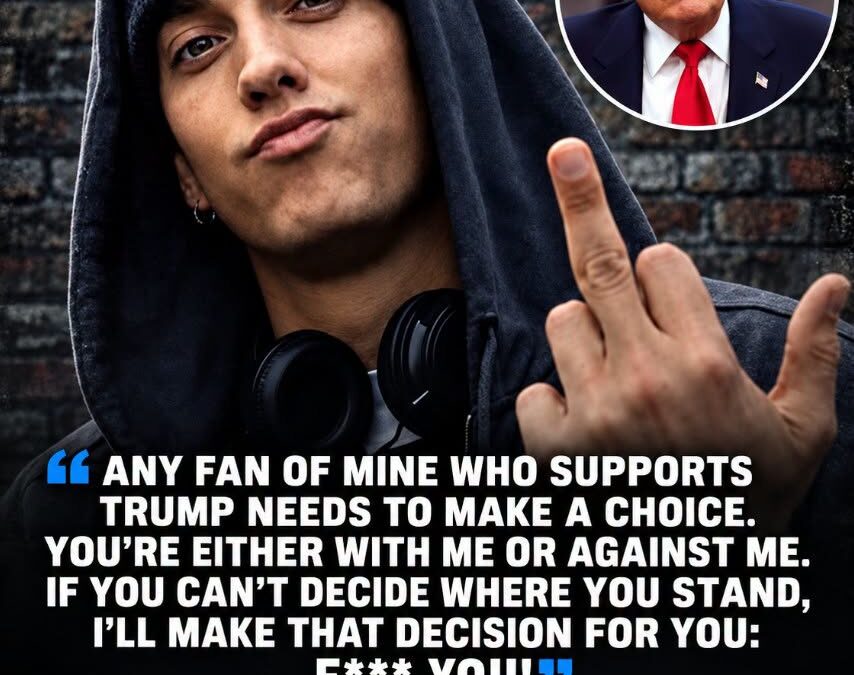
In 2017, Eminem reminded the world that he was more than a rapper known for sharp lyrics, controversial music, and record-breaking albums. He was an artist willing to use his voice to challenge political power, even if doing so meant turning some of his own fans against him.
At the BET Hip Hop Awards, Eminem delivered one of the most talked-about political performances of his career: “The Storm.”
There was no elaborate stage production. No flashy costumes. No catchy chorus designed to dominate the radio.
Instead, Eminem stood alone in a Detroit parking garage, wearing a black hoodie, delivering a nearly five-minute freestyle directly into the camera. His words were intense, his expression serious, and his message unmistakable.
His target was then-President Donald Trump.
What followed was a political statement that sparked national debate, divided listeners, and demonstrated just how far Eminem was willing to go to express his beliefs.
A Freestyle Unlike Anything Fans Expected
Eminem had built his reputation on fearless lyrics and a willingness to confront uncomfortable subjects. Throughout his career, he had challenged celebrities, criticized public figures, and used controversy as fuel for his music.
But “The Storm” was different.
This time, his anger was directed toward the president of the United States.
The performance was filmed in a Detroit parking garage and released during the 2017 BET Hip Hop Awards. Standing in front of the camera, Eminem delivered his message without the usual musical backing that might distract from his words.
The stripped-down presentation made the freestyle feel less like a traditional rap performance and more like a direct address to the American public.
Every line carried a purpose.
Every pause added weight.
And every accusation pushed the performance further into political territory.
Eminem wasn’t trying to make everyone comfortable. He wanted people to listen, think, and confront the issues he believed were being ignored.
The result was a moment that extended far beyond hip-hop.
Why Eminem Took Aim at Donald Trump
Donald Trump’s presidency had already become a source of intense division in the United States.
From immigration and race relations to international diplomacy and the role of athletes in political protests, the president’s words and actions frequently generated controversy.
Eminem addressed several of these issues in his freestyle.
He criticized Trump’s response to the devastation caused by Hurricane Maria in Puerto Rico, an island whose residents faced an enormous humanitarian crisis after the storm struck in September 2017.
He also condemned Trump’s criticism of NFL players who protested racial injustice by kneeling during the national anthem.
For Eminem, the protests were about more than football. They represented a broader argument about racial inequality, freedom of expression, and whether athletes should be allowed to use their public platforms to draw attention to social problems.
The rapper also criticized Trump’s confrontational rhetoric toward North Korea, expressing concern about the consequences of escalating international tensions.
These were not casual political references inserted into a song for publicity.
They formed the foundation of his argument: that a president’s conduct should be open to scrutiny, particularly when his decisions affect millions of people.
Eminem wanted his audience to understand that celebrity status did not eliminate the responsibility to speak about issues that mattered.
And he was prepared to accept the consequences of doing so.

“This Is for Colin, Ball Up a Fist”
One of the most memorable moments in “The Storm” came when Eminem expressed support for former NFL quarterback Colin Kaepernick.
Kaepernick had become a central figure in the national debate over racial inequality after kneeling during the national anthem before NFL games in 2016.
His protest was intended to draw attention to police brutality and systemic racial injustice. It also triggered fierce criticism, particularly from people who believed the gesture disrespected the American flag and military personnel.
Trump became one of the protest’s most prominent critics.
Eminem, however, used his freestyle to stand with Kaepernick.
His line, “This is for Colin, ball up a fist,” offered a direct expression of solidarity.
The reference carried historical significance. A raised or clenched fist has long been used as a symbol of resistance, solidarity, and the struggle for equality.
By including Kaepernick in his performance, Eminem connected hip-hop with a wider movement that had become one of the most contentious social and political issues in American sports.
The message was clear: he believed that speaking out against injustice was not something athletes or entertainers should be forced to abandon simply because it made powerful people uncomfortable.
Kaepernick subsequently expressed appreciation for Eminem’s public support.
For many listeners, that moment represented one of the freestyle’s strongest statements about solidarity and the importance of using a public platform to amplify a cause.
The Moment Eminem Challenged His Own Fans
Perhaps the most controversial aspect of “The Storm” was not what Eminem said about Trump himself.
It was what he said to his own audience.
Eminem understood that his fan base was politically diverse. His music reached millions of people across different backgrounds, generations, and ideological beliefs.
Some of those listeners supported Trump.
Others strongly opposed him.
Rather than avoid the disagreement, Eminem confronted it directly.
He challenged fans who supported the president to reconsider their political allegiance and made it clear that he would not compromise his convictions simply to maintain their loyalty.
It was a risky decision.
Music careers depend heavily on audiences. Alienating a substantial portion of a fan base can damage an artist’s reputation, reduce commercial opportunities, and create divisions that last for years.
Eminem knew that his words could cost him listeners.
But he was willing to accept that possibility.
His message was essentially this: if a fan’s political support for Trump was incompatible with the values Eminem believed in, he would rather lose that fan than remain silent.
That attitude reflected a defining characteristic of his public persona.
Throughout his career, Eminem had often rejected the idea that he needed to make himself universally likable. He had built his reputation by saying things that other entertainers might avoid, even when his words triggered criticism.
With “The Storm,” he applied that same confrontational approach to presidential politics.
He wasn’t simply criticizing a politician.
He was telling his audience that their support did not give them the right to dictate his beliefs.
“Loving America” Doesn’t Mean Agreeing With Its President
Another important theme in the freestyle was patriotism.
Political disagreements in the United States frequently become arguments about who truly loves the country. Critics of a president may be accused of disrespecting America, while supporters may describe their political allegiance as a defense of national values.
Eminem challenged that way of thinking.
His criticism of Trump did not mean he opposed the United States or its military. Instead, he distinguished his love for his country from his opinion of the person occupying the White House.
That distinction was central to his message.
For Eminem, patriotism did not require unquestioning loyalty to a political leader.
A person could respect the country while criticizing its government. Someone could appreciate military service while disagreeing with a president’s policies. And an American citizen could believe that challenging authority was itself an expression of democratic responsibility.
This argument was particularly relevant during the controversy surrounding NFL protests.
For many critics of the protests, kneeling during the national anthem represented disrespect toward the flag and the military.
Supporters of Kaepernick argued that the protest was intended to draw attention to racial injustice, not to attack the country itself.
Eminem placed himself firmly on the side of those who believed that social criticism and patriotism could coexist.
His freestyle became another contribution to a national conversation about freedom of expression, racial inequality, and the meaning of loyalty.
America Reacted — And Hip-Hop Took Notice
After its release, “The Storm” quickly became one of the most widely discussed political moments in Eminem’s career.
The performance circulated across social media, attracted extensive media coverage, and generated strong reactions from both supporters and critics.
For some fans, Eminem’s willingness to speak openly about politics was admirable. They saw an internationally successful artist risking his popularity to address issues he considered important.
Others disagreed with his political position and criticized the decision to use his music to attack a sitting president.
Some Trump supporters said they would stop listening to Eminem.
That reaction illustrated the very risk the rapper had accepted: political expression could strengthen his connection with some listeners while permanently alienating others.
Yet the controversy also demonstrated the influence of popular music in political discussions.
Eminem was not a politician, and “The Storm” was not a policy paper. It was a freestyle built around emotion, accusation, and personal conviction.
But that was precisely why it attracted so much attention.
Millions of people who might never read a political essay encountered the performance through their interest in music.
The freestyle transformed a rap release into a public argument about leadership, protest, race, and the responsibility of celebrities in a divided society.
And once the conversation began, it was impossible to contain it within the boundaries of the music industry.
The Secret Service Attention Added Another Layer
The controversy surrounding Eminem’s political lyrics did not end with the public reaction.
The rapper had previously attracted attention from the U.S. Secret Service over lyrics referring to Trump, including material connected to his song “Framed.”
Reports about the agency’s interest became another part of the discussion surrounding Eminem’s political expression.
The situation raised questions about the boundaries between artistic provocation, threatening language, and the responsibilities of agencies tasked with protecting public officials.
For artists, the issue was particularly sensitive.
Rap has a long history of using exaggerated language, fictional scenarios, aggressive imagery, and provocative storytelling. Determining how such material should be interpreted when it refers to real political figures can be complicated.
Eminem’s lyrics brought that tension into public view.
His work had always challenged boundaries, but political references involving a sitting president introduced an entirely different level of scrutiny.
The attention surrounding those lyrics reinforced the sense that Eminem was not simply participating in a celebrity dispute.
He was engaging with a political climate in which words from a globally recognized entertainer could become the subject of national debate.
Why “The Storm” Still Matters
Years after its release, “The Storm” continues to resurface in discussions about Eminem, Trump, and the relationship between music and politics.
Its lasting significance comes from more than the specific criticisms it contained.
It represents a moment when one of the world’s most commercially successful rappers chose to make his political position unmistakable, despite knowing that the decision could divide his audience.
Eminem could have avoided the controversy.
He could have concentrated on album sales, tours, and maintaining a broad commercial appeal.
Instead, he chose to speak.
Whether listeners agreed with him or not, the performance forced them to confront an uncomfortable question: should entertainers remain silent about political issues to protect their careers, or should they use their influence to express their convictions?
There is no universal answer.
Artists have different responsibilities, different audiences, and different reasons for entering public debates. Some choose to keep their political beliefs private. Others consider speaking out an essential part of their identity.
Eminem’s decision in 2017 was unmistakable.
He was willing to risk losing fans rather than pretend to hold beliefs he did not share.
That choice became part of the freestyle’s legacy.
More Than a Rap Performance
“The Storm” was not simply an attack on Donald Trump.
It was also a declaration of independence from the expectation that entertainers must remain agreeable to everyone.
Eminem used his platform to defend a protest movement, criticize presidential leadership, and challenge listeners who expected his personal beliefs to align with their own.
He drew a distinction between loving a country and agreeing with its president.
And he demonstrated that a musician’s influence does not end when the song stops playing.
For his supporters, the freestyle was an example of courage and conviction.
For his critics, it was an unwelcome intrusion of politics into entertainment.
But regardless of where people stood, the performance made one thing clear: Eminem was prepared to accept the consequences of speaking his mind.
In the end, “The Storm” was about more than Donald Trump. It was about the price of conviction, the power of protest, and the willingness to stand by your beliefs even when doing so means losing people who once stood beside you.
And that is why the freestyle remains one of the most memorable political statements of Eminem’s career. 🎤
You Might Also Enjoy
Manchester United finalising deal to appoint Mauricio Pochettino as Carrick replacement
Single Dad Took Two Bullets Saving the Army General’s Daughter — “Move, I’ll Handle This!”

They Tried to Take the Stray Puppy—Then the Quiet Nurse Realized Why the K9 Needed Him