Nosebleeds Hit the Mafia Boss Every Winter for 7 Years — His Chubby Upholsterer Slashed His Chair
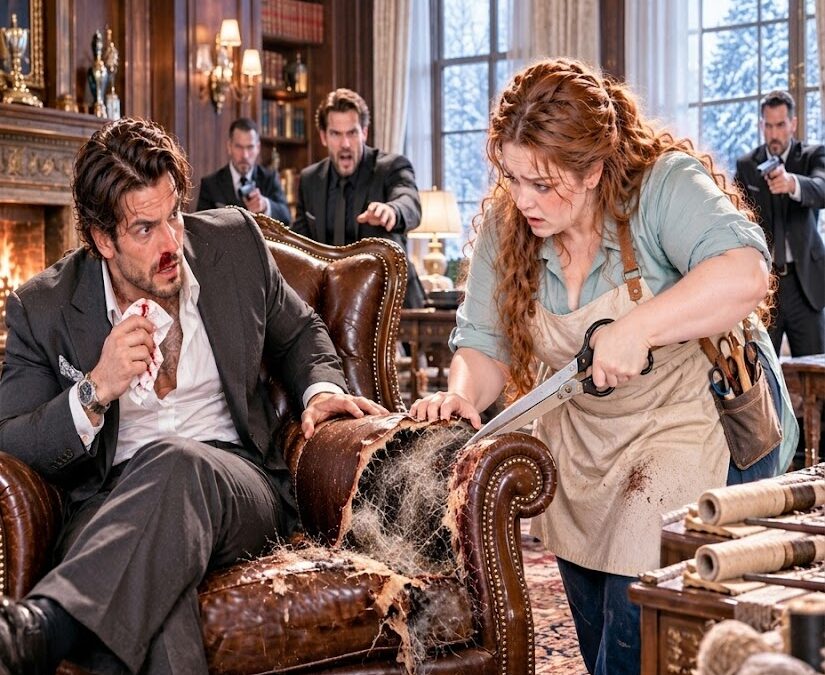
Nosebleeds Hit the Mafia Boss Every Winter for 7 Years — His Chubby Upholsterer Slashed His Chair
Chapter 1: The Curse That Returned Every Winter
For seven consecutive winters, Don Alessandro Romano had suffered from mysterious nosebleeds.
They always began the same way.
First came a strange warmth behind his nose. Then a faint metallic taste filled his mouth. Within seconds, blood would drip onto his expensive shirts, his polished desk, or the white handkerchief he kept in the breast pocket of his tailored suit.
And every single time, the bleeding began shortly after he sat in the same leather armchair.
The chair stood in the center of his private study, facing a fireplace carved from black marble. Its dark brown leather was cracked at the edges, and its wooden arms had been polished so many times that they gleamed beneath the chandelier.
It had belonged to Alessandro’s father, Don Vittorio Romano, the man who had built the Romano criminal empire from a small neighborhood operation into one of the most feared organizations on the East Coast.
Alessandro inherited the chair when his father died.
He also inherited the empire.
At forty-nine, Alessandro was a man whose name could silence an entire restaurant. His enemies feared him, his associates obeyed him, and even powerful politicians chose their words carefully when speaking in his presence.
Yet every December, the most powerful man in the city found himself sitting in a doctor’s office, holding a bloodstained handkerchief and demanding answers.
Seven years.
Seven winters.
And not one satisfactory explanation.
On a freezing Monday morning, Alessandro entered his study at precisely eight thirty.
His personal assistant, Marco, followed behind him carrying a leather folder.
“Your meeting with the Bellucci family is scheduled for ten, Don Alessandro. The lawyers will arrive at nine fifteen, and Dr. Moretti called to confirm your appointment this afternoon.”
Alessandro barely listened.
He removed his overcoat, handed it to Marco, and lowered himself into his father’s chair.
For several seconds, everything was normal.
Then the familiar warmth crept into his nose.
He froze.
A red drop landed on the folder in his assistant’s hands.
Marco stared at it.
“Don?”
Alessandro touched his upper lip.
When he pulled his fingers away, they were covered in blood.
“Get the doctor,” he snapped.
Marco hurried toward the door.
Alessandro grabbed a handkerchief and leaned forward, breathing through his mouth. Blood continued to flow, staining the white fabric a deep crimson.
His anger quickly replaced his embarrassment.
“Seven years,” he muttered. “Seven damn years.”
He looked at the chair beneath him.
For the first time, he wondered whether his father’s most treasured possession had become something far more sinister.
Something that had been waiting for him.
Something that knew exactly when winter would arrive.
And somewhere inside the enormous Romano estate, someone might already know the answer.
Chapter 2: The Man Everyone Underestimated
Luca Bellini was not the kind of man people noticed when he entered a room.
At thirty-eight, he was short, broad-shouldered, and noticeably overweight. His cheeks were round, his dark hair was perpetually untidy, and his fingers were covered in tiny scars from years of working with needles, blades, and upholstery tools.
He wore inexpensive clothes, drove an aging delivery van, and spoke so quietly that people often asked him to repeat himself.
For six years, Luca had worked as the Romano family’s upholsterer.
He repaired dining chairs, restored antique sofas, replaced torn leather, and rebuilt furniture that other craftsmen considered beyond saving.
He knew the difference between genuine Italian leather and cheap imitation material by touch alone.
He could identify a damaged spring by the sound it made when someone sat down.
And he could tell when a chair had been opened and resealed, even if the person responsible had spent hours trying to hide the evidence.
Unfortunately, none of those skills impressed the men who worked for Alessandro Romano.
To them, Luca was simply the fat furniture man.
They joked about his appearance, mocked his quiet voice, and treated him as if he were part of the building rather than a person.
Luca never complained.
His mother lived in a modest care facility outside the city, where she received treatment for a heart condition. His father’s old workshop had closed years earlier, and the Romano estate provided the steady income he needed to pay her medical bills.
So he endured the insults.
He did his work.
And he kept his eyes open.
That morning, the head housekeeper, Mrs. Conti, found him repairing a dining chair near the kitchen.
“Mr. Bellini, the Don wants you in his study.”
Luca put down his needle.
“Did something happen?”
Mrs. Conti glanced toward the hallway.
“His nose started bleeding again.”
Luca’s hands stopped moving.
“Again?”
She looked at him sharply.
“You know about it?”
“I’ve heard people talking.”
“Well, stop listening to gossip and get upstairs. He wants his chair inspected.”
Luca wiped his hands on his apron and followed her.
As they approached the study, he noticed two armed guards standing outside the door.
One of them looked him up and down.
“Careful in there, Fatso. Scratch that chair, and the Don might have you decorating the bottom of a river.”
The other guard laughed.
Luca said nothing.
He entered the room and found Alessandro standing beside his desk, a bloodstained handkerchief clenched in his fist.
The Don looked exhausted.
“You’re the upholsterer?”
“Yes, sir.”
“Then tell me what’s wrong with this thing.”
Alessandro pointed at the chair.
“I’ve had doctors examine me. I’ve had the room inspected. I’ve replaced the heating system, the carpets, and the curtains. Nothing changes.”
He leaned closer.
“Every winter, I sit here, and I bleed.”
Luca approached the chair.
He did not answer immediately.
Instead, he examined the leather, the seams, the wooden frame, and the brass studs along the edges.
Then he crouched beside it.
His fingers moved carefully over the underside.
Something felt wrong.
The bottom fabric was newer than the rest of the chair.
Not dramatically newer. Not enough for an ordinary observer to notice.
But the stitching was different.
Luca ran his thumb along the seam.
He had repaired this chair twice before. He remembered its original construction because Alessandro had explicitly ordered him never to alter the antique frame.
This was not how the chair had looked six months earlier.
Someone had opened it.
Someone had closed it again.
And whoever had done so had not wanted anyone to notice.
Luca slowly stood.
“Don, I need to inspect the inside.”
Alessandro’s eyes narrowed.
“Then inspect it.”
“I may have to cut the bottom lining.”
For a moment, the room became completely silent.
The Don looked at the chair, then back at Luca.
“Do you understand what you’re asking me to allow?”
“Yes, sir.”
“That chair belonged to my father.”
“I understand.”
Alessandro stepped closer.
“If you damage it without finding something worth finding, you’ll answer to me.”
Luca swallowed.
Then he nodded.
“I understand that, too.”
For the first time that morning, Alessandro noticed something unusual about the quiet upholsterer.
The man was frightened.
But he was not backing down.
Chapter 3: The First Cut
At noon, Luca returned to the study carrying a small leather tool case.
Alessandro had ordered everyone out except two guards and his trusted adviser, Salvatore Greco.
Salvatore had served the Romano family for nearly twenty years. He was tall, silver-haired, and impeccably dressed. He spoke gently, rarely raised his voice, and had a reputation for solving problems before they became disasters.
He watched Luca place the chair on a protective work blanket.
“Do you really think you’ll find something?” Salvatore asked.
“I don’t know.”
“Then perhaps we should leave the chair alone.”
Luca looked up.
“Someone has already altered it.”
Salvatore’s smile disappeared for half a second.
Then it returned.
“Old furniture is repaired all the time.”
“Not like this.”
Alessandro raised one hand.
“Enough. Let him work.”
Luca turned the chair upside down.
He examined the newer stitching once more, then selected a narrow upholstery blade.
His hands were steady.
He inserted the blade beneath the seam and made a short, precise cut.
The thread separated.
A thin opening appeared in the dark fabric.
Luca continued slowly, exposing the padding beneath the seat.
Dust drifted into the air.
He removed a layer of old cotton batting, then another layer of protective fabric.
Nothing.
He reached deeper.
His fingers brushed something hard.
He stopped.
“What’s that?” Alessandro demanded.
“I don’t know yet.”
Luca carefully moved the surrounding padding aside.
A small, flat metal case was concealed beneath the seat, wrapped in a piece of gray oilcloth.
It was no larger than a man’s wallet.
The two guards immediately stepped forward.
Salvatore took a sharp breath.
Alessandro raised his hand again, ordering everyone to remain where they were.
Luca withdrew the case and placed it on the worktable.
There was no visible label.
No lock.
No obvious explanation for why anyone would hide it inside a chair.
Alessandro stared at the object.
“Open it.”
Luca hesitated.
“It may contain something dangerous. We should let a specialist examine it.”
The Don’s expression hardened.
“After seven years of bleeding in my own house, you want me to wait?”
“I want to make sure we don’t destroy the evidence.”
For several seconds, Alessandro said nothing.
Then, unexpectedly, he nodded.
“You’re right.”
He turned to his guards.
“Call the forensic team. Nobody touches that case.”
Salvatore stepped forward.
“Alessandro, perhaps this is a misunderstanding. Your father had many private arrangements. The case might contain nothing more than old documents.”
Alessandro slowly turned toward him.
“Perhaps.”
His voice was quiet.
“But if that’s true, why was it hidden inside my chair?”
Salvatore had no answer.
And Luca, watching the older man’s face, noticed something that made his stomach tighten.
Salvatore was not looking at the metal case.
He was looking at the cut in the chair.
As if he already knew what was inside.
Chapter 4: Seven Years of Silence
The metal case was taken to a secure laboratory that afternoon.
Alessandro wanted answers immediately, but the specialists refused to make assumptions before completing their examination.
Meanwhile, Dr. Moretti arrived at the estate and examined the Don.
His nosebleeds had stopped, but the doctor was concerned by their recurring nature.
“Repeated nosebleeds can have many causes,” he explained. “Dry air, irritation, medication, blood pressure problems, or other medical conditions. We need to investigate them properly.”
Alessandro sat behind his desk.
“And the chair?”
“I cannot say the chair caused your symptoms. We should test the room, examine any suspicious materials, and compare the results with your medical history.”
The Don looked toward the doorway.
Luca was standing there, waiting to be dismissed.
“Tell me something, Bellini.”
“Yes, sir?”
“How long have you known that someone tampered with the chair?”
“I noticed the uneven padding several months ago.”
“And you didn’t tell me?”
“I thought it was an ordinary repair. I mentioned that the bottom lining needed replacement, but I was told to preserve the original construction.”
“Who told you that?”
Luca hesitated.
“The household manager.”
Alessandro’s face darkened.
“Who authorized the repair that changed the stitching?”
“I don’t know.”
“Then find out.”
Luca shook his head.
“Sir, I’m a furniture restorer. I can examine the chair, but I can’t investigate your employees.”
Alessandro leaned back.
“Why not?”
“Because everyone here knows who I am. If I start asking questions, they’ll laugh at me. And if someone really did something to that chair, they’ll know I’m looking.”
For the first time, Alessandro seemed to consider Luca’s position.
The man had spent six years in the estate, surrounded by people who barely respected him. He had watched, listened, and learned without attracting attention.
That made him more useful than Alessandro had initially realized.
“You won’t investigate anyone alone,” the Don said. “You’ll give me everything you know, and I’ll handle the rest.”
Luca nodded.
Then he hesitated.
“There’s something else.”
Alessandro waited.
“Whoever opened the chair knew what they were doing. The stitching was done by someone with experience. It wasn’t a careless job.”
“Meaning?”
“Meaning it could have been a professional repair. Or someone who knew how to make it look like one.”
The room fell silent.
Alessandro looked at the photograph of his father hanging above the fireplace.
For seven years, he had believed his mysterious illness was an unfortunate medical problem.
Now, for the first time, he had reason to suspect that someone had used the one object he trusted most to conceal a secret.
He just didn’t know whether that secret was a threat, a warning, or something far more complicated.
Chapter 5: The Man Who Knew Too Much
That evening, Salvatore Greco visited Alessandro in the private dining room.
The two men had known each other since they were young. Salvatore had been present at Alessandro’s father’s funeral. He had helped manage the family business during the difficult years that followed.
If Alessandro trusted anyone, it was him.
“I think you’re letting suspicion get the better of you,” Salvatore said as he poured two glasses of wine.
Alessandro did not touch his glass.
“Someone opened the chair.”
“Perhaps your father ordered a repair.”
“Why would he hide a metal case inside it?”
“Maybe he didn’t. Perhaps a previous owner placed it there.”
“My father owned that chair for thirty years.”
Salvatore paused.
Then he smiled faintly.
“Thirty years is a long time. Many things can happen in thirty years.”
Alessandro watched him carefully.
“You seemed nervous when Luca found the case.”
Salvatore’s hand stopped above the table.
“Nervous?”
“You looked at the chair as if you recognized something.”
For the first time that evening, Salvatore’s expression hardened.
“Alessandro, I’ve spent twenty years protecting your family. I have buried friends, negotiated with enemies, and stood beside you when everyone else abandoned you.”
“I know.”
“Then don’t treat me like a suspect because a furniture repairman found an old box.”
Alessandro remained silent.
Salvatore finished his wine and stood.
“I hope you find the answers you’re looking for.”
He walked toward the door.
Before leaving, he turned back.
“Just remember something. Sometimes, the person who appears to have discovered a secret is simply the person who wants you to believe it exists.”
The door closed behind him.
Alessandro sat motionless.
He could not tell whether Salvatore was offering wise advice or issuing a warning.
Across the estate, Luca was finishing an inventory of the chair’s original materials.
He had asked the household manager for copies of previous repair records. Most were ordinary invoices, documenting work done by local craftsmen.
But one entry stood out.
Seven years earlier, during the first winter of Alessandro’s unexplained nosebleeds, the chair had been removed from the study for three days.
The record listed a private furniture restoration company.
The company no longer existed.
Its owner had died five years earlier.
And the person who authorized the work was listed as Salvatore Greco.
Luca read the entry twice.
Then he photographed it and sent it to Alessandro.
His phone rang less than a minute later.
“Where did you get this?” the Don demanded.
“From the maintenance archive.”
“Does anyone else know?”
“No.”
“Stay where you are. I’m coming to you.”
Luca looked toward the workshop door.
For the first time in his life, he wished he had never touched that chair.
Chapter 6: The Photograph in the Old Ledger
Alessandro arrived at the workshop with two guards.
He read the maintenance record in silence.
“Seven years ago,” he murmured.
“Yes, sir.”
“The first winter.”
Luca nodded.
Alessandro took out his phone and called his head of security.
“I want every document related to the chair’s restoration. Invoices, visitor logs, photographs, everything. Start with the company listed here.”
He ended the call.
Then he looked at Luca.
“Did you find anything else?”
Luca hesitated.
“There was an old photograph attached to the archive.”
He opened a folder on his worktable.
The photograph showed Alessandro’s father sitting in the study, smiling beside the leather armchair. Salvatore stood behind him, one hand resting on the chair’s wooden frame.
On the back, someone had written a date.
December 14.
Seven years before Alessandro inherited the chair.
Below the date were four words:
Keep this one untouched.
Alessandro stared at the handwriting.
He recognized it immediately.
It belonged to his father.
“What does it mean?” Luca asked.
Alessandro did not answer.
He remembered something from his childhood: his father had always insisted that certain possessions remain exactly as they were. An old watch. A desk drawer. A leather chair that nobody was permitted to move.
His father had been a cautious man, suspicious even of his closest associates.
But why would he have written those words?
And why had Salvatore arranged a restoration months before his death?
Alessandro picked up the photograph.
“Someone knows what happened here,” he said.
Luca lowered his eyes.
“Do you think your father was involved?”
“I think I need to know what was inside that case.”
A knock interrupted them.
One of the guards entered.
“Don, the laboratory has called. They have preliminary findings.”
Alessandro stood immediately.
“What did they find?”
The guard swallowed.
“They say the case contains a small collection of old documents, a key, and a sealed envelope. They haven’t completed the chemical analysis of the material found beside it.”
Alessandro looked at Luca.
“Come with me.”
“Sir?”
“You found the case. You’re coming with me.”
For once, Luca did not argue.
Chapter 7: The Letter
The laboratory was located in a secure building outside the city.
Alessandro entered with his security chief, Dr. Moretti, and Luca.
The metal case sat inside a transparent evidence container.
Beside it lay a small brass key, several faded documents, and an envelope bearing the initials V.R.
Vittorio Romano.
Alessandro’s father.
A forensic specialist explained that the documents appeared to be several decades old. The material found in the chair remained under examination, and its composition had not yet been conclusively identified.
“We can’t say whether it was dangerous,” the specialist emphasized. “And we certainly cannot connect it to your medical symptoms without further evidence.”
Alessandro nodded impatiently.
“What about the letter?”
The specialist carefully opened the envelope and removed a folded sheet of paper.
The handwriting was unmistakable.
Alessandro read the first line.
Then he stopped.
His face changed.
Luca watched him.
“Don?”
Alessandro continued reading.
The letter was dated three days before his father’s death.
It contained a confession of sorts, though not the kind Alessandro had expected.
Vittorio wrote that he had discovered financial irregularities within the family organization. Large sums had disappeared from accounts controlled by a trusted adviser. When he began asking questions, several documents vanished, and the people responsible denied knowing anything.
He had hidden copies of the original records inside the chair, believing that nobody would think to search an object he had ordered everyone to preserve.
The letter did not name the person responsible.
But it contained a warning.
Alessandro, if you ever find this, do not assume that loyalty is proven by the number of years someone has stood beside you. Some men remain close because they love you. Others remain close because they are waiting for you to stop looking.
Alessandro read the sentence again.
For years, he had believed his father left him an empire.
Now he wondered whether his father had also left him a trap.
At the bottom of the letter was a final paragraph.
The key opens the second drawer of my old desk. If the documents are missing, then the person I feared has already found them.
Alessandro lowered the paper.
“My father’s desk,” he whispered.
It had been stored in the estate’s private archive since his death.
Nobody had used it for years.
Nobody, except the person who had the key.
Chapter 8: The Second Drawer
The old desk stood in a locked room on the estate’s ground floor.
Its mahogany surface was covered in dust, and the brass handles had darkened with age. Alessandro had not entered the room in months.
He inserted the key into the second drawer.
It turned smoothly.
Inside were several empty folders, an old fountain pen, and a small leather notebook.
Alessandro lifted the notebook.
Its pages contained dates, names, and handwritten financial figures. Several entries referred to payments made through companies that had no obvious connection to the Romano organization.
Luca stood near the doorway, careful not to touch anything.
Alessandro read through the entries.
Then he found a name that appeared repeatedly.
Salvatore Greco.
The room seemed to shrink around him.
For twenty years, Salvatore had been his closest adviser. He had managed meetings, settled disputes, and helped Alessandro navigate the complicated transition after his father’s death.
If the notebook was authentic, Salvatore had been involved in the financial irregularities his father had tried to expose.
But the notebook was not proof of every suspicion.
Some entries were incomplete. Several dates did not match the surviving records. The financial transactions needed independent verification.
Alessandro understood that anger could not replace evidence.
He ordered his security chief to preserve the notebook and send copies to the family’s lawyers.
Then he did something nobody expected.
He invited Salvatore to dinner.

Chapter 9: The Dinner of Two Old Friends
Salvatore arrived at eight o’clock wearing a charcoal suit and a silver tie.
He seemed relaxed.
He greeted Alessandro warmly, asked about his health, and complained about the cold weather.
For the first twenty minutes, they discussed ordinary matters.
Then Alessandro placed a photograph on the table.
It showed Salvatore standing beside Vittorio Romano’s chair seven years earlier.
Salvatore glanced at it.
“What is this?”
“A reminder.”
“Of what?”
“That some things are never as simple as they appear.”
Salvatore put down his fork.
Alessandro placed the maintenance record beside the photograph.
Then the copy of the old ledger.
Salvatore looked at each document.
His face remained composed, but his fingers tightened around the edge of the table.
“You’ve been busy,” he said.
“I’ve had time to think.”
“And what have you decided?”
“That my father suspected someone close to him was stealing from the family.”
Salvatore said nothing.
“That someone arranged for his chair to be restored shortly before he died.”
Still nothing.
“And that you authorized the restoration.”
Salvatore leaned back.
“You have a photograph and an old maintenance record. Neither proves what you’re suggesting.”
“I know.”
For the first time, Salvatore looked surprised.
Alessandro continued.
“That’s why my lawyers are examining the documents. That’s why the financial records are being independently verified. And that’s why I’m asking you one question before the evidence speaks for itself.”
He leaned forward.
“Why did you open my father’s chair?”
Salvatore stared at him.
Then he gave a short, humorless laugh.
“You think I put something in your chair to make your nose bleed?”
“I think you know more than you’ve told me.”
Salvatore’s expression changed.
For several seconds, the only sound in the room was the ticking of the clock.
Finally, he spoke.
“Your father was a paranoid man.”
Alessandro’s eyes narrowed.
“He was also a careful one.”
“He believed everyone was stealing from him. He trusted nobody.”
“And you?”
Salvatore looked toward the window.
“I trusted him more than you can imagine.”
“Then answer the question.”
Salvatore’s shoulders dropped.
“I arranged for the chair to be opened because your father asked me to.”
Alessandro did not move.
“What?”
“Your father believed someone had hidden documents inside it. He wanted me to retrieve them, but he was afraid that the servants would notice. He gave me instructions to have the chair examined privately.”
“Then why didn’t you tell me?”
“Because I never found the documents.”
Alessandro stared at him.
Salvatore continued.
“I opened the chair. I searched the padding. I found nothing. I had it restored, and I returned it to the study.”
“What about the metal case?”
“I never saw it.”
“Why did you look so frightened when Luca found it?”
Salvatore rubbed his face.
“Because I realized someone had opened that chair again. And if your father had hidden something there after I searched it, then whoever found it might know about the records.”
Alessandro remained silent.
For the first time, Salvatore seemed genuinely afraid.
But fear was not proof of innocence.
And the financial records still had to be examined.
Chapter 10: The Truth About the Blood
Three weeks later, the independent investigation produced its first clear findings.
The documents from the metal case helped establish the existence of financial transactions that had been concealed from the family. Some records pointed toward companies associated with people who had worked with Salvatore, although the investigation was still determining who had authorized each transaction.
Salvatore was temporarily removed from his responsibilities while the lawyers reviewed the evidence.
He denied deliberately stealing from the family and insisted that several payments had been made under instructions from Vittorio Romano.
Alessandro refused to accept either accusation or denial without proof.
The investigation continued.
But the mystery of the chair remained.
The specialists had not found conclusive evidence that the material hidden inside it had caused Alessandro’s nosebleeds.
Dr. Moretti arranged additional medical tests and reviewed the Don’s health records from the previous seven winters.
The results revealed something that surprised Alessandro.
His symptoms had repeatedly appeared during periods when the heating system was running at its highest setting. The air in the study had been unusually dry, and medical examinations suggested that irritation inside his nose might have contributed to the bleeding.
That did not explain every episode.
It did, however, offer a plausible medical explanation that did not require a conspiracy.
The strange material inside the chair remained suspicious, but no evidence established that it had caused the symptoms.
Alessandro sat in the doctor’s office, looking at the report.
“So after seven years, I may have been blaming the wrong thing.”
Dr. Moretti folded his hands.
“You may have had more than one problem. The chair was altered, and the documents suggest someone concealed information. But we cannot conclude that the chair caused your nosebleeds.”
Alessandro nodded slowly.
He had spent seven winters believing his body was betraying him.
Then he had spent several weeks believing someone was poisoning him.
Now he faced a more complicated truth: a genuine mystery had been hidden inside an ordinary medical problem, and the two might never have been connected.
For a man accustomed to certainty, that was difficult to accept.
But it was better than inventing an answer simply because he wanted one.
Chapter 11: The Upholsterer’s Reward
Luca was preparing to leave the estate when Alessandro summoned him to the study.
The original leather chair had been moved to a secure storage room. In its place stood a new armchair upholstered in deep blue fabric.
It was comfortable, simple, and entirely unremarkable.
Alessandro sat in it without hesitation.
“Come in, Luca.”
Luca entered carrying his tool case.
“You wanted to see me, sir?”
Alessandro pointed to the chair opposite him.
“Sit.”
Luca did.
For a few seconds, neither man spoke.
Then Alessandro said, “You saved me from making a very expensive mistake.”
Luca looked confused.
“I don’t understand.”
“I was ready to accuse half the people in this house. You kept telling me what you knew and what you didn’t know.”
“That was the truth.”
“Exactly.”
Alessandro opened a desk drawer and removed an envelope.
“I want you to accept this.”
Luca looked at it suspiciously.
“What is it?”
“Enough money to open your own upholstery workshop. A proper one. You can buy the equipment you need, hire assistants, and stop working for people who think they can treat you however they please.”
Luca stared at the envelope.
“I can’t accept that.”
“Why not?”
“Because I didn’t solve everything. I don’t even know what was inside that chair or why it was there.”
Alessandro smiled faintly.
“You found the question everyone else missed. You didn’t pretend to know the answer.”
He pushed the envelope across the desk.
“Take it.”
Luca hesitated.
Then he thought of his mother, the medical bills, and the little workshop his father had once dreamed of opening.
He accepted the envelope.
“Thank you, Don Alessandro.”
Alessandro nodded.
“One more thing.”
“Yes?”
“Your new workshop will need a sign.”
Luca smiled for the first time that day.
“I’ve already chosen one.”
“What will it say?”
“Bellini Upholstery. Fine Furniture Restoration.”
Alessandro laughed.
“Simple.”
“I prefer simple.”
“So do I,” the Don replied. “I’ve had enough complicated things in my life.”
Chapter 12: The Winter That Changed Everything
One year later, the first snow fell over Chicago.
Luca stood inside his own workshop, inspecting a restored antique sofa while his assistant carefully measured a length of fabric.
The shop smelled of leather, wood polish, and fresh coffee.
His mother sat beside the front window, wrapped in a warm blanket, watching the snow drift past the glass.
Luca had finally built the life he had wanted.
He still received occasional calls from the Romano estate, but he no longer worked there full-time. He had become known for his craftsmanship, his honesty, and his ability to restore furniture other people considered beyond repair.
One afternoon, Alessandro visited the shop.
He arrived without a large entourage, wearing a dark overcoat and carrying a small wooden box.
Luca looked up from his workbench.
“Don Alessandro. What brings you here?”
Alessandro placed the box on the counter.
“I thought you might appreciate this.”
Inside lay a brass nameplate that had once been attached to the underside of his father’s chair.
The metal was worn, and the engraved letters had faded.
Luca lifted it carefully.
“Do you want me to restore it?”
“No.”
Alessandro looked around the workshop.
“I want you to keep it.”
Luca frowned.
“Why?”
“Because you were the one who noticed that something was wrong. You didn’t know what you would find. You didn’t know whether I would believe you. You didn’t even know whether I would blame you for cutting into the chair.”
He paused.
“But you did what you thought was right.”
Luca looked down at the nameplate.
“I was frightened.”
“Of course you were.”
Alessandro walked toward the front window.
“For seven years, I thought the chair was the enemy. Then I thought it was a weapon. In the end, it was simply an object that had been altered by someone who had their own reasons.”
He turned back.
“The nosebleeds may have been caused by something as ordinary as the air in my study. The financial secrets were real, but we still had to prove who was responsible for them. And the person who found the hidden case was a man almost everyone in my house had ignored.”
Luca smiled faintly.
“People don’t usually pay attention to the furniture.”
“Perhaps they should.”
Alessandro extended his hand.
Luca shook it.
Before leaving, the Don glanced at the wooden sign above the door.
BELLINI UPHOLSTERY — WE REPAIR WHAT OTHERS THROW AWAY.
He read it twice.
Then he smiled.
“That’s a good motto.”
Luca watched him walk toward his car.
Outside, the snow continued to fall.
Seven winters had passed since the first mysterious nosebleed.
The chair had been opened, the hidden documents discovered, and the family’s secrets dragged into the light. Yet some questions remained unanswered, and not every suspicious detail had found a neat explanation.
Alessandro had learned that power could open doors, but it could not force the truth to appear.
Luca had learned that being underestimated did not mean being powerless.
And both men had discovered that sometimes the smallest detail could change everything.
A loose thread.
A strange seam.
A few millimeters of uneven padding.
One careful cut.
And a secret that had remained hidden for years finally came into view.
Because the most dangerous thing in a room is not always the person sitting in the chair.
Sometimes, it is the truth hidden beneath them.
THE END.
You Might Also Enjoy



Manchester United finalising deal to appoint Mauricio Pochettino as Carrick replacement

Single Dad Took Two Bullets Saving the Army General’s Daughter — “Move, I’ll Handle This!”

They Tried to Take the Stray Puppy—Then the Quiet Nurse Realized Why the K9 Needed Him



