Virgil van Dijk Is Heartbroken as Liverpool Legends Leave Anfield — The Emotional Moment That Says Everything About His Love for the Club 💔😭
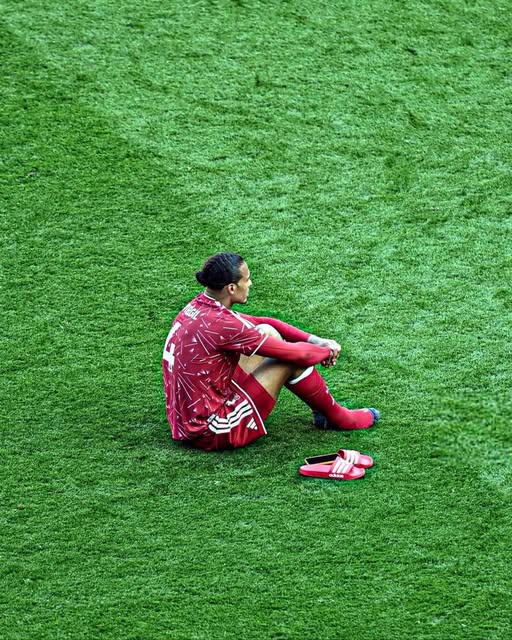
Sometimes, football gives us moments that are more powerful than any goal, trophy, or victory. There are moments when the noise of the crowd fades away, the stadium begins to empty, and a footballer’s emotions reveal just how much a club truly means to him.
For Virgil van Dijk, one of those moments came at Anfield, when the Liverpool captain sat alone on the pitch, looking towards the Kop as the celebrations and farewells unfolded around him.
There was no trophy in his hands. No microphone in front of him. No teammate beside him to share the moment.
Just Van Dijk, sitting on the grass, reflecting on a season filled with difficult memories and the departure of two players who had shared some of the greatest moments of his Liverpool career.
The image immediately struck a chord with supporters. Many wondered what was going through the captain’s mind as he watched Mohamed Salah and Andy Robertson prepare to say goodbye to the club.
Was he thinking about everything they had achieved together? Was he remembering the unforgettable nights at Anfield? Or was he simply trying to process the reality that another chapter of Liverpool’s history was coming to an end?
Van Dijk later explained that the 2025–26 campaign had been the toughest season of his career mentally. He revealed that he had been sitting on the grass watching Salah and Robertson, two teammates with whom he had played for eight years, as they said their farewells.
For a player who has given so much to Liverpool, the moment carried a meaning that went far beyond football.
A Captain Watching His Brothers Leave
Virgil van Dijk is not simply another player in Liverpool’s dressing room. He is the captain, a leader who has carried enormous responsibility throughout his time at Anfield.
Since arriving from Southampton in January 2018, the Dutch defender has become one of the defining figures of Liverpool’s modern era. His presence transformed the team’s defense, his leadership helped establish a winning mentality, and his performances played a crucial role in some of the club’s most memorable achievements.
Alongside Mohamed Salah and Andy Robertson, Van Dijk became part of the core that helped Liverpool return to the summit of English and European football.
Together, they experienced the pressure of title races, the heartbreak of painful defeats, and the unforgettable joy of winning major trophies.
They lifted the Champions League trophy in 2019. They celebrated Liverpool’s long-awaited Premier League title in 2020. They helped create an era that supporters will remember for generations.
But football careers never remain the same forever.
Players grow older. Contracts expire. New opportunities emerge. Clubs make difficult decisions, and eventually, even the strongest groups begin to change.
For supporters, seeing a familiar player leave can be painful. For the teammates who shared the dressing room with that player for years, the feeling can be even more personal.
Van Dijk was not simply watching two footballers leave Liverpool. He was watching two men with whom he had shared an extraordinary journey walk away from a place that had become a major part of their lives.
That is why the image of the Liverpool captain sitting alone resonated so strongly.
Sometimes, the people who carry the greatest responsibility are the ones who find it hardest to express what they are feeling.

Mohamed Salah and Andy Robertson: More Than Teammates
Mohamed Salah and Andy Robertson have played enormous roles in Liverpool’s modern success.
Salah became one of the most prolific forwards in the club’s history, producing goals, assists, and performances that repeatedly changed the outcome of important matches.
Robertson brought energy, determination, defensive commitment, and relentless attacking support from the left flank. His partnership with Liverpool’s forwards became a defining feature of the team’s most successful years.
Alongside Van Dijk, they formed part of a group that helped transform Liverpool from title challengers into champions of England and Europe.
Their connection was built through thousands of hours on the training ground, countless matches, and the pressure of competing at the highest level.
They experienced the excitement of major victories together. They endured difficult defeats together. They knew what it meant to represent Liverpool when millions of supporters expected nothing less than total commitment.
That shared history cannot simply disappear when a player leaves.
In his farewell message, Van Dijk described Salah and Robertson as once-in-a-lifetime players who had shown extraordinary consistency at the highest level. His words reflected the respect he had for both teammates and the importance of their contributions to Liverpool.
For Van Dijk, their departures marked the end of a significant chapter.
And when you have spent so many years fighting alongside the same people, saying goodbye can feel like losing a part of your everyday life.
Why That Moment on the Anfield Pitch Was So Powerful
Footballers are often seen celebrating in front of thousands of fans, lifting trophies, and enjoying the rewards of their success.
But the image of Van Dijk sitting alone offered something completely different.
There was no performance for the cameras. No dramatic speech. No attempt to turn the moment into a spectacle.
Instead, there was a captain taking a quiet moment to reflect while the people around him gradually left the pitch.
The scene became particularly emotional because supporters knew how much had changed at Liverpool over the preceding years.
The club had experienced historic triumphs, managerial transitions, painful losses, and the gradual departure of players who helped define an extraordinary period.
For Van Dijk, those changes were deeply personal.
He had been part of the journey for years, and he had watched Liverpool develop into one of the most respected teams in world football.
Now, some of the familiar faces who had helped build that success were moving on.
It is easy to underestimate how difficult such changes can be for a team captain. He must continue leading, motivating younger players, preparing for matches, and representing the club publicly, even when he is dealing with his own emotions.
A captain cannot always afford to show how difficult things feel.
But once the final whistle blows and the immediate responsibilities disappear, those feelings can become harder to ignore.
Van Dijk’s solitary moment appeared to capture precisely that transition: from the public role of Liverpool captain to the private experience of a man reflecting on the people and memories that shaped his career.
Although the image alone cannot tell us exactly what he was thinking, his later comments made clear that the season had taken a significant emotional toll.
A Season That Tested Van Dijk Mentally
In an interview reflecting on the campaign, Van Dijk described the season as the toughest of his career mentally.
He spoke about the inconsistency Liverpool experienced and the enormous emotional weight of everything that had happened.
One of the most painful events was the death of his teammate Diogo Jota, whose loss affected the Liverpool community profoundly.
Van Dijk explained that the difficult period stretched from receiving the devastating news about Jota to the final match, when Liverpool said goodbye to Salah and Robertson.
That context gives the image of him sitting alone at Anfield a much deeper meaning.
It was not simply a case of a captain feeling disappointed because teammates were leaving. He was reflecting on a season that had brought grief, pressure, uncertainty, and major changes to the club.
The loss of a teammate is different from the departure of a player to another club. One involves a permanent absence that no transfer or future reunion can change. The other represents the end of a professional chapter, even when friendships remain.
Yet both experiences can force a team to confront the passage of time and the fragility of the relationships built inside a dressing room.
For Van Dijk, carrying on as captain while processing those experiences was clearly challenging.
He also acknowledged that he felt an enormous sense of responsibility and that he may sometimes have taken on too much.
That admission reveals another side of leadership.
The captain is expected to be strong for everyone else, but he is also human. He can feel exhausted, overwhelmed, and uncertain about how to process everything that happens around him.
And sometimes, even the strongest leaders need a moment alone.
Is Van Dijk Upset That Liverpool’s Familiar Faces Keep Leaving?
It is understandable why supporters might interpret the scene that way.
Over the years, Liverpool have seen important members of their successful era move on, and the departure of long-serving teammates can leave a captain facing a very different dressing room from the one he once knew.
When familiar faces leave one after another, a football club can begin to feel like a different place.
The jokes in the dressing room change. The relationships evolve. The players who once understood each other’s movements instinctively are replaced by new teammates who need time to build the same understanding.
For someone like Van Dijk, who values leadership and has spent years building relationships within the squad, those changes could naturally bring mixed emotions.
There is pride in seeing teammates begin new chapters, but there can also be sadness about the end of a shared journey.
However, it would be unfair to claim that Van Dijk sat on the pitch specifically because he was angry about Liverpool players leaving. His own explanation pointed to a broader combination of difficult experiences, including the loss of Jota and the emotional farewell to Salah and Robertson.
What we can say is that the departures were part of a much larger moment of reflection.
And the captain’s comments made clear just how deeply he cares about the people around him and the club he represents.
The Pressure of Being Liverpool’s Captain
Being captain of Liverpool is a privilege, but it also comes with enormous expectations.
Van Dijk must help organize the defense, communicate with teammates, set standards during training, and represent the club when results are disappointing.
He must also help new players settle into the team while preserving the culture established by previous generations.
When experienced teammates leave, that responsibility can become even greater.
Players such as Salah and Robertson brought years of experience and a deep understanding of Liverpool’s expectations. Their presence helped establish the standards required to compete for major trophies.
When those players move on, someone must help ensure that the team’s identity survives.
Van Dijk is one of the people best placed to do that.
But leadership is not simply about telling others what to do. It also involves preserving memories, respecting the past, and helping a new generation understand what makes a club special.
The captain must find a balance between honoring what Liverpool have achieved and refusing to become trapped by nostalgia.
That is not an easy task, particularly when the changes are happening alongside difficult sporting results and personal grief.
Van Dijk’s challenge is to turn those experiences into motivation for the next chapter.
He must continue leading Liverpool forward while acknowledging that the era he helped build will never look exactly the same again.
Anfield Will Always Mean Something Special to Van Dijk
For Liverpool supporters, Anfield is more than a stadium.
It is a place where generations of fans have gathered to celebrate victories, mourn defeats, remember legends, and share experiences that become part of their lives.
For the players, it can become a second home.
Van Dijk has experienced the atmosphere at Anfield during some of the most important moments of his career. He has heard the crowd roar after decisive goals, felt the pressure of crucial matches, and stood in front of supporters after both victories and disappointments.
The stadium is connected to memories that cannot be recreated elsewhere.
That is why the sight of him sitting on the pitch, looking towards the Kop, was so moving.
He was sitting in the place where so many of his greatest professional memories had been created, watching teammates who had shared those memories prepare to leave.
There is a particular sadness in realizing that something which once felt permanent is changing.
The matches will continue. New players will arrive. Another season will begin.
But the exact combination of people who created those unforgettable moments will never be together in quite the same way again.
For Van Dijk, that realization may have been part of what made the farewell so difficult.
And for Liverpool fans, the scene was a reminder that the players who wear the shirt are not immune to the emotions that supporters feel.
They also form friendships. They also remember difficult moments. And they also understand that football moves forward, even when part of them wants to hold on to the past.
What Happens Next for Liverpool and Their Captain?
Liverpool now face the challenge of building the next chapter of their story.
The club must continue competing at the highest level while integrating new players, maintaining its standards, and ensuring that the departures of experienced figures do not undermine the team’s identity.
Van Dijk will remain an important figure in that process for as long as he continues to lead the side.
His experience, defensive ability, and understanding of the club make him a valuable presence during a period of transition.
But the coming years will inevitably bring questions about the future.
How long can Liverpool keep their remaining leaders together? Which younger players will emerge as the next generation of senior figures? And how will the club preserve the mentality that helped it achieve so much success?
These questions are part of football’s natural cycle.
Every great team eventually changes. The challenge is making sure that the next generation learns from the previous one without being expected to recreate the past exactly.
For Van Dijk, the task is not simply to remember what Liverpool once were. It is to help shape what they can become.
That means continuing to compete, supporting his teammates, and accepting that even the most successful eras eventually come to an end.
It also means recognizing that the relationships built along the way remain valuable, regardless of where individual careers lead.
A Moment Liverpool Fans Will Not Forget
The image of Virgil van Dijk sitting alone on the Anfield pitch will likely remain one of the most memorable scenes from Liverpool’s emotional farewell to the 2025–26 season.
It captured a side of football that statistics cannot measure.
There was no goal to analyze, no tactical formation to debate, and no trophy to celebrate.
There was simply a captain reflecting on a difficult year and watching two teammates bring their Liverpool journeys to a close.
His later comments gave supporters a clearer understanding of the emotions behind the moment. He described the season as mentally exhausting and spoke openly about the impact of losing Diogo Jota and saying goodbye to Salah and Robertson.
Those words made the scene more than a photograph of a player sitting alone.
They revealed the weight of a season that had demanded so much from him as a footballer, teammate, and captain.
And perhaps that is why the moment resonated with so many people.
Because beneath the shirts, the trophies, and the millions of supporters, football remains a game built around human relationships.
Players spend years working together, sharing difficult moments, and chasing the same dreams. When those journeys come to an end, the emotions are real.
Final Thoughts: Even the Strongest Captain Has a Heart 💔
Virgil van Dijk has built his reputation on strength, composure, and leadership. He is the defender Liverpool have relied on in difficult moments and the captain expected to guide the team through uncertainty.
But that image of him alone on the Anfield grass reminds us that strength does not mean being unaffected by loss.
Sometimes, strength means acknowledging how much something matters.
Van Dijk has spoken about his love for Liverpool and the responsibility he feels as captain. He has also been honest about the emotional challenges of a season that brought both personal grief and the departure of long-serving teammates.
His solitary moment was a powerful reminder that even the biggest names in football carry memories, friendships, and feelings that cannot be measured by their performances.
Mohamed Salah and Andy Robertson were more than familiar faces in the dressing room. They were teammates who had shared eight years of Van Dijk’s Liverpool journey, helping create an era that supporters will remember for decades.
Watching them leave meant watching another piece of that era become history.
And while Liverpool will move forward, the memories of what they achieved together will remain.
Virgil van Dijk was not just watching two teammates say goodbye. He was reflecting on a chapter of his life that helped define him as a player and a leader.
Football will continue. New stars will emerge. New trophies will be won.
But some moments remind us that the greatest part of the game is not always what happens on the pitch.
Sometimes, it is the people who stand beside you while you are there.
And sometimes, when they leave, even the strongest captain needs a moment to sit quietly and remember. ❤️🔴
You Might Also Enjoy



Manchester United finalising deal to appoint Mauricio Pochettino as Carrick replacement

Single Dad Took Two Bullets Saving the Army General’s Daughter — “Move, I’ll Handle This!”

They Tried to Take the Stray Puppy—Then the Quiet Nurse Realized Why the K9 Needed Him



