A Deaf Boy Sits Alone in the Emergency Room — Until a Nurse Understands His Sign Language
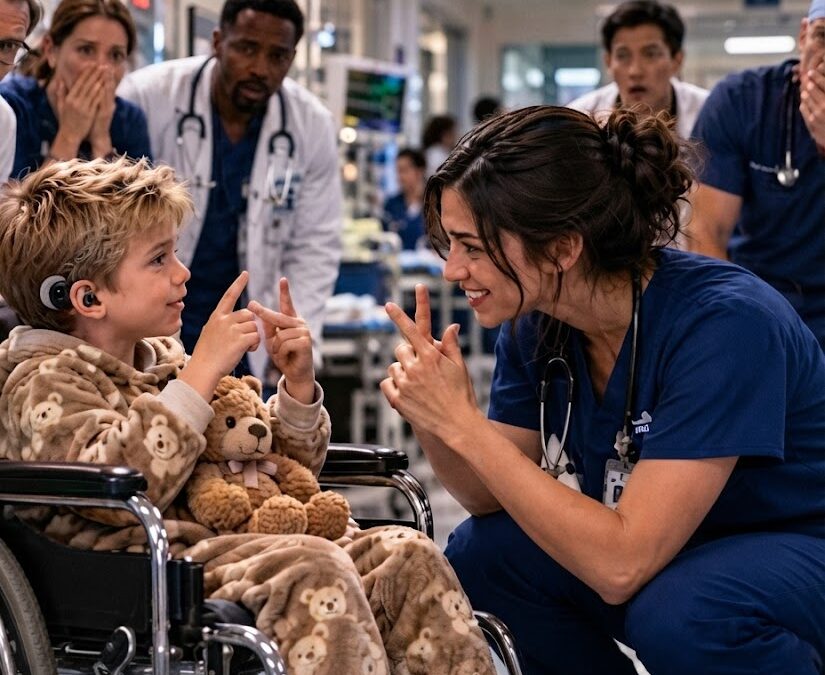
A deaf boy sat alone in his wheelchair in the crowded hallway of the emergency room. Doctors walked past him as if he were just a piece of furniture.
He was trying to warn them of something terrible, but no one would listen.
Only a quiet nurse, in her oversized uniform, understood the silent movements of his hands.
When she responded with sign language, the entire emergency room fell silent.
Soon after, a team of U.S. Navy SEALs burst through the door, carrying a wounded comrade.
A life hung in the balance, with only a few terrifying minutes left to save it.
And a simple first aid technique, something anyone could learn, became the only thing separating a family from tragedy.
Who was this nurse who never raised her voice?
And why were the SEALs so silent when they saw her face?
If this story touches your heart, please like, subscribe to the Life of Silent Badges channel, and let us know where you’re watching from, and who in your life has taught you how to listen.
Because what happens in this emergency room will stay with you long after the story ends.
The Ignored Boy
The boy sat in the hallway of Lakeshore Heritage Medical Center for 40 minutes.
Not a single doctor looked him in the eye.
He was about 8 years old, with messy blond hair, a small hearing aid behind his ear, and an old brown teddy bear in his lap.
He wore soft pajamas with little bear patterns.
His hands gripped the sides of his wheelchair as if the entire large emergency room could swallow him at any moment.
His name was Eli Mercer.
He couldn’t hear the alarm bells, the screams, or the stretchers rolling down the hallway.
He could only see faces.
And one face after another turned away.
Behind a trolley of instruments, Lena barely noticed him.
She was 31, about 1.63 meters tall, with dark blonde hair loosely tied back and gray-blue eyes always looking down at the floor.
Her bright blue uniform was too big for her.
Her hands often trembled whenever someone looked at her.
And everyone in the hospital thought that was simply who she was.
Dr. Evan Whitlock strode quickly down the hallway with three residents behind him.
He was tall, with streaks of gray at his temples, and famous in the hospital for his voice.
Eli reached out and gently tugged at the hem of his white lab coat.
His small hands moved incessantly, pleadingly.
Whitlock pulled his coat away as if a stray dog had touched him.
“Someone get this child out of the way,” he said. “I don’t have time for a patient who can’t even tell me what’s wrong with him.”

Lena stepped out from behind the trolley before she could stop herself.
“Doctor, the boy is telling us what’s going on. He’s gesturing about his father. His father is in room number 4.”
Whitlock turned around.
His smile was more unpleasant than his shout.
“Another nurse wasting time waving in front of an object? Gestures aren’t medicine.”
“His father is a tired soldier, just has a headache and needs rest. Go replenish the linens and don’t embarrass the whole department.”
The resident doctors laughed.
Two nurses looked down at their shoes.
Raymond Pike, the hospital manager, stood at the reception desk with his arms crossed.
“One more complaint about you, Hartley, and I will personally sign your dismissal papers.”
Lena Intervenes
Lena swallowed it all down, just as she had swallowed everything over the past two years.
Two years hiding in dark corners.
Two years taking the worst shifts.
Two years letting others take credit.
She had a reason to hide herself.
She had promised herself that her life carrying a medical kit on the battlefield was over forever.
Her hands began to tremble.
Then she looked down at Eli.
And the trembling stopped.
Lena knelt down in front of the wheelchair.
Her hands began to move.
Eli’s face instantly lit up with relief.
He gestured so quickly that the teddy bear almost fell from his knees.
Lena responded slowly, gently, each movement precise.
Eli said that his father was a Navy SEAL.
Three days earlier, an explosion during training had thrown his father against a wall.
This morning, his father said that everything before his eyes was shaking and he felt like he was tasting burning metal.
He tried to tell the doctor in the room, but no one looked at his hands.
Eli had seen that expression once at home.
Just before his father collapsed to the kitchen floor and convulsed.
Lena slowly stood up.
Her voice was low but echoed down the hallway.
“You never looked at him. You only glanced at him.”
Whitlock’s face hardened.
“Don’t lecture me, nurse.”
“Room 4,” Lena said. “Your father is about to have a seizure.”
No one moved.
Then a monitor started beeping from Room 4.
A man shouted:
“Help needed!”
Lena ran off.
In Room 4, Petty Officer Colt Mercer lay on the floor.
He was a tall, heavily shaved man.
His back was arched, his arms stiff.
Then his body began to convulse.
A medical crisis
A young resident pressed down on Colt’s chest to restrain him.
Another fumbled with a wooden instrument, trying to shove it between his teeth.
Whitlock stood in the doorway, his face pale.
“Take your hands off him,” Lena said.
Her voice had changed.
Deep.
Calm.
Unquestionable.
“Take your hands off his chest. Get that thing out of his mouth. Both of you step back.”
The doctors obeyed before they could understand why.
What was happening in Colt’s brain was a seizure—a sudden, abnormal surge of electrical activity in the brain.
The muscles stiffened and twitched violently.
The patient was unable to hear or respond to anyone.
The danger isn’t just the convulsions themselves.
The danger also comes from the possibility of the patient falling, hitting a hard object, or having fluids obstruct their airway.
Lena performed the steps she had practiced thousands of times.
First, stay calm and check the clock, because time is of the essence.
Next, remove any hard objects and place something soft under the patient’s head.
Loosen anything that is too tight around the neck.
Do not restrain someone who is having a seizure and absolutely do not put anything in their mouth.
Then wait.
When the seizure stops, gently lay the patient on their side, with the upper leg slightly bent to keep the airway clear and allow secretions to drain.
Stay by their side and monitor their breathing.
If the seizure lasts longer than 5 minutes, call emergency services immediately.
Lena took a blanket from the shelf and placed it under Colt’s head.
She kicked the trolley out of reach.
She loosened his collar.
Her eyes glanced at the wall clock.
Then the sound of heavy shoes echoed in the hallway.
The SEALs Appear
Five men in dusty field uniforms burst into the room.
The largest one stood blocking the doorway.
His name was Titan, the team leader and Colt’s comrade.
His beard was streaked with silver.
His eyes took only a second to survey the entire room.
“Sir, this area is restricted,” Whitlock began.
Titan didn’t even hear.
He was looking at a small woman in an oversized uniform kneeling beside his brother.
“1 minute 50 seconds,” Lena said.
“No one touch him. No one speaks to him. Let the convulsion pass.”
Titan leaned toward a young soldier beside him and almost whispered:
“Those hands aren’t those of an ordinary nurse.”
“That’s battlefield skill.”
At 2 minutes and 40 seconds, Colt’s body began to stop convulsing.
He let out a long sigh.
The whole room seemed to breathe with him.
Lena didn’t celebrate.
She placed one hand on Colt’s shoulder, the other on his hip.
“Titan, help me turn him toward me. Slowly and gently. Keep his head straight with his body.”
The giant SEAL immediately complied.
Colt lay on his side.
His upper knee was bent.
A thin stream of fluid trickled from the corner of his mouth instead of into his lungs.
Lena counted each breath.
“You’re safe, Colt. You’re in the hospital. Stay with me.”
Whitlock finally spoke.
His voice was sharp and trembling.
“Enough, Hartley. You ignored my orders and handled the patient on your own.”
He turned to Pike.
“Tell her to leave this area.”
Pike hurried in with two security guards.
“Nurse Hartley, you are suspended. Effective immediately. Hand over your badge.”
Lena slowly removed her badge.
Her hands were completely calm.
That was the strangest thing in the room.
Titan stepped between her and the two security guards.
“No one is taking anyone away until my brother is stable.”
“Sir, this is a hospital, not a military base,” Pike replied.
“Then act like a hospital.”
Whitlock gestured to his staff.
“Take him for a CT scan immediately. I don’t want this charade continuing in my emergency room.”
Four staff members pushed the stretcher down the hallway.
Lena followed, accompanied by a SEAL pushing Eli’s wheelchair.
A Race Against Time
Halfway down the hallway, Colt arched his back.
He started convulsing again.
The hallway was now crowded with people.
The patient’s family.
A wheelchair.
A mother holding a crying child.
Two stretchers waiting for the room.
People started gathering, panicking and raising their phones to film.
A panicked staff member let go.
The stretcher lurched towards the wall.
“Titan, block the hallway!”
Lena said.
“No one within 3 meters!”
“Lock the wheels!”
“That mother, move your child back!”
“Emergency Room 7, 30 steps to the left. The door is open. The room is empty.”
“Get him in there. Lay him flat. Protect his head.”
She knew it because many nights before, she had walked through every corridor of the hospital, counting the steps to each exit.
A habit she had never been able to break.
Five SEALs quickly formed a barrier.
The noisy corridor instantly transformed into a silent tunnel.
They carried Colt into room number 7.
Lena looked at her watch.
3 minutes.
Then 4 minutes.
She turned to Whitlock, who had also followed and was standing motionless at the foot of the bed.
“Doctor, the seizure has lasted 4 minutes.”
“At 5 minutes, this will become a life-threatening condition.”
“I need to call a neurologist and prepare the anticonvulsant medication right now.”
Whitlock blinked.
“We should wait.”
“It might stop on its own. We don’t want to overtreat a patient with a head injury.”
“Every minute that passes increases the risk of brain damage and respiratory failure.”
Lena said.
“Call them.”
“You’re a suspended nurse. You have no right to be here.”
Something changed in the room.
Lena straightened her back.
Her shoulders, usually hunched, were now as rigid as steel.
The timid nurse vanished.
In her place was a woman whose voice once echoed through the cold mountains.
Lena’s secret was revealed.
“My name is Lena Hartley.”
“I served in the United States Navy as Hospital Corpsman First Class.”
“My nickname is Sparrow.”
“I treated the victims of the explosion in conditions with no radio communication and no hospitals within a radius of hundreds of miles.”
“Doctor, you can argue with me.”
“Or you could pick up the phone.”
“Choose.”
Titan whispered the name as if he’d just heard a prayer.
“Sparrow.”
Whitlock took the phone with trembling hands.
The neurologist team quickly arrived.
Medication was administered under Lena’s guidance.
At 5 minutes and 40 seconds, Colt’s body went limp on the blanket.
His breathing became slow and steady.
Lena gently laid him on his side again and checked his pulse.
Titan had heard that nickname around campfires for years.
The female medic had carried 11 wounded men down a frozen mountainside in complete silence because the radio was broken and the enemy was eavesdropping.
She had guided them using hand signals she had learned as a child to communicate with her deaf younger brother, Danny.
Titan had thought the story too unbelievable to be true.
A wheelchair creaked.
Eli rolled over to his father’s side.
He looked at Titan.
He began to gesture.
Titan didn’t understand sign language.
Lena translated softly:
“The boy said, ‘I am Sparrow.’”
“He said his father told that story every night.”
“He said, ‘I am the reason my father came home.’”
Colt opened his eyes.
His vision was blurry, but he found Lena’s face.
His lips moved.
Then, his thick, scarred fingers slowly rose.
He gestured two words to his son.
“Thank you.”
Lena turned away.
Her shoulders trembled.
But this time not from fear.
Justice was served.
Pike stood in the door.
In his hand was still the suspension paper.
His face had lost all color.
Titan stepped in front of him.
Calm and silent.
Every word he spoke weighed like a stone.
“Mr. Pike.”
“This medic was awarded the Silver Star.”
“The Navy will not be pleased if a hospital punishes someone who just saved a SEAL’s life.”
“I think you should think carefully before signing anything.”
Pike looked at the paper.
Then he folded it in half.
Then he folded it again.
He put it in his pocket.
Whitlock remained at the foot of the bed.
The resident doctors watched him.
For the first time, he realized everyone was looking at him in a completely different way.
He slowly walked over to Eli.
He knelt down.
He turned to Lena.
“How do you apologize?”
Lena showed him.
A fist closed, then forming a small circle over a heart.
Whitlock tried twice.
Both awkwardly.
Eli looked at him for a long time.
Then he gestured a short sentence.
“The boy said: ‘It’s forgivable.’”
Lena translated.
“‘When you learn to say hello first.’”
Someone in the hallway started clapping.
Then another.
Then the entire emergency room clapped.
The nurses.
The staff.
The patients’ families.
And all five SEALs, who almost never clapped for anything.
A Life Changed
After things calmed down, Titan found Lena next to the vending machine.
She was holding a half-finished cup of coffee in both hands.
“Why did you leave, Sparrow?”
Lena looked down at the floor.
Then looked up.
For the first time, she looked him straight in the eye.
“I wanted to save people before they fell.”
“Not after they’ve fallen.”
Titan nodded slowly.
As if that answer were worth more than any medal on his chest.
A New Legacy
The next morning, Lena sat in the hospital director’s office.
Her old badge lay on the desk.
Titan offered her a training team in Virginia.
The Navy still wanted her back.
Pike offered her a new position with a higher salary.
Lena refused them all.
She said she would stay in the emergency room.
Every doctor, nurse, and security guard in the hospital will receive basic training in sign language.
They will also be trained on how to handle a patient having a seizure.
So that no child has to sit in the hallway for 40 minutes just because no one stops to listen.
The director signed off on the program before she finished speaking.
The Teddy Bear
Before leaving the hospital that day, Lena stopped in the lobby.
Eli wheeled his wheelchair over to her.
He placed the brown teddy bear in her lap.
He gestured slowly.
“The bear’s name is Captain.”
“Captain protects those who listen.”
Lena hugged the bear to her chest.
And smiled.
It was the first genuine smile anyone in the hospital had ever seen on her face.
The doctors had called her weak.
But she had never hidden her weakness.
Silence was never an empty space.
It was filled with people who wouldn’t listen.
Lessons from Lena
When someone has a seizure:
Stay calm and remember when the seizure started.
Remove any hard or dangerous objects.
Place a soft object under the patient’s head to prevent injury.
Do not restrain someone who is having a seizure.
Absolutely do not put anything in their mouth.
When the seizure stops, gently lay the person on their side to keep their airway clear.
Stay by their side and monitor their breathing.
Call emergency services if the seizure lasts longer than 5 minutes, recurs, the person is injured, has difficulty breathing, or it is their first seizure.
The message of the story is simple:
Listening is a form of respect—and it doesn’t necessarily require ears.
Anyone can learn to help others.
And sometimes, the person who bends down to listen to the quietest voice in the room…
is the one who saves a life.
If this story makes you want to listen more carefully, share it with the people you love.
Because the next life saved may begin with something very simple:
Someone stopping and paying attention.
You Might Also Enjoy



Manchester United finalising deal to appoint Mauricio Pochettino as Carrick replacement

Single Dad Took Two Bullets Saving the Army General’s Daughter — “Move, I’ll Handle This!”

They Tried to Take the Stray Puppy—Then the Quiet Nurse Realized Why the K9 Needed Him



