Doctors Ignored Paralyzed Girl in the Waiting Room — Until a K9 Lay Beside Her and Nurse Understood
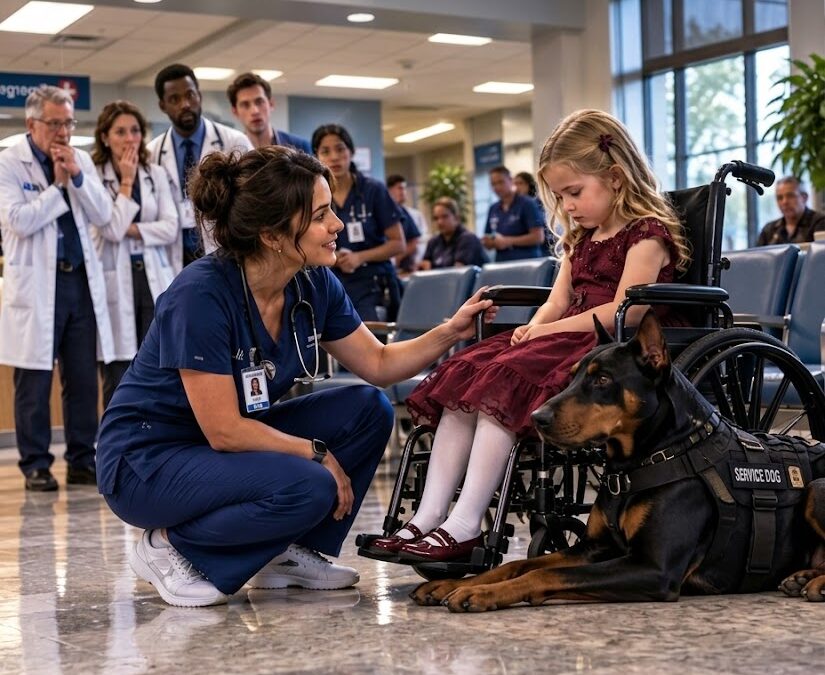
Doctors Ignored the Paralyzed Girl in the Waiting Room — Until a K9 Lay Beside Her and the Nurse Understood
An emotional story of a forgotten little girl, a loyal police dog, and a secret that would change everything.
Chapter 1: The Girl Nobody Wanted to See
The little girl had been sitting in the emergency room waiting area for nearly two hours.
Her name was Lily Bennett. She was eight years old, wore a faded pink sweater, and sat motionless in a wheelchair that was too large for her tiny body.
Her legs were covered by a thin blanket. Her hands rested in her lap, and her pale face was turned toward the hospital doors.
Every few minutes, she whispered the same question.
“Excuse me… could someone please help me?”
The first nurse glanced at her chart and hurried away.
The second told her that the doctors were busy.
The third barely looked up from her computer.
“Sweetheart, you’ll have to wait your turn.”
Lily nodded obediently.
She had learned that asking for help too many times only made people angry.
Three months earlier, Lily had been an energetic little girl who loved running through her grandmother’s garden. She climbed trees, raced her friends, and dreamed of becoming a veterinarian.
Then came the accident.
A terrible car crash had killed her mother and injured Lily’s spine. After several operations, doctors told her family that she might never walk again.
Her father, Daniel Bennett, had been a police officer.
He had died six weeks before the accident while responding to an armed robbery.
With both parents gone, Lily had been placed under the temporary care of her aunt, Vanessa.
At first, Vanessa had cried while holding her.
She promised that Lily would never be alone.
But grief had quickly turned into resentment.
Vanessa complained about hospital appointments, physical therapy, and the money required to care for a disabled child.
Eventually, she began treating Lily as if the girl were a burden she had never wanted.
That morning, Vanessa had brought Lily to St. Mary’s Hospital, handed the receptionist a folder, and told her she would be back shortly.
Then she left.
Two hours passed.
Lily was still waiting.
Her stomach hurt, her head was spinning, and a sharp pain had begun spreading across her lower back.
She tried to call her aunt, but her phone had no battery.
Finally, she looked toward the reception desk.
“Please,” she whispered. “I think something is wrong.”
The receptionist sighed.
“Your paperwork is still being processed.”
Lily lowered her eyes.
“Okay.”
She didn’t know that the next person to enter the hospital would notice what dozens of adults had ignored.
And she certainly didn’t know that a police dog would be the first to understand that she was in danger.
Chapter 2: The K9 Who Refused to Walk Away
At 10:17 a.m., the emergency room doors opened.
A tall police officer entered with a German Shepherd walking calmly beside him.
The dog’s name was Rex.
He was six years old, highly trained, and known throughout the police department for his exceptional ability to detect changes in human behavior.
His handler, Officer Michael Harris, had worked with him for four years.
Together, they had searched buildings for missing children, tracked suspects through dense forests, and helped locate survivors after a devastating apartment fire.
Rex was not an ordinary family dog.
He had been trained to remain focused in chaotic environments, to ignore distractions, and to alert his handler when he detected something unusual.
That morning, Michael had brought Rex to the hospital for a routine examination after the dog injured one of his paws during training.
Michael was checking in when Rex suddenly stopped walking.
His ears rose.
His nose moved rapidly through the air.
Then he turned toward the waiting room.
“Rex?” Michael murmured.
The dog pulled gently against his leash.
At first, Michael assumed Rex had noticed another animal or smelled food.
But then Rex saw Lily.
The little girl was sitting perfectly still, her eyes closed, and her head tilted against the wheelchair’s headrest.
Rex stared at her.
A low sound escaped his throat.
Not a growl.
Something closer to a whine.
“Easy, boy,” Michael said.
But Rex wasn’t looking at him.
He walked toward Lily, guided by the loose leash, and stopped directly in front of her wheelchair.
Lily opened her eyes.
For the first time that morning, her face brightened.
“A dog,” she whispered.
Rex lowered his head.
Lily lifted one trembling hand and touched his forehead.
“Hello, puppy.”
The German Shepherd gently nudged her palm.
Then something extraordinary happened.
Rex turned in a small circle, lowered his powerful body to the floor, and lay beside Lily’s wheelchair.
He pressed his warm side against her legs, resting his head carefully across her shoes.
Lily began to cry.
“Oh,” she whispered. “You came to see me.”
Michael approached, smiling faintly.
“Looks like he likes you.”
But Rex suddenly lifted his head.
His ears stood straight.
He stared at Lily’s face, then nudged her hand again.
Lily’s fingers barely moved.
“I’m tired,” she whispered.
Rex let out another sharp whine.
Then he stood and placed his front paws close to the wheelchair, refusing to move away.
Michael’s smile disappeared.
He had seen Rex behave this way only a handful of times.
Once, before a child with an undetected seizure collapsed.
Another time, before Rex alerted officers to a man who had lost consciousness inside a parked vehicle.
Rex wasn’t a doctor, and Michael knew that a dog’s behavior could never establish a medical diagnosis.
But he had learned to take these warnings seriously.
He looked at Lily.
“Sweetheart, are you feeling okay?”
Lily tried to answer.
“I… my back hurts.”
“Where?”
She pointed weakly toward her lower abdomen.
“And I feel cold.”
Michael immediately turned toward the nurses’ station.
“Excuse me! This little girl needs medical attention now!”
A nurse looked up impatiently.
“Sir, everyone here is waiting.”
Michael pointed toward Lily.
“She’s pale, she’s barely responding, and my K9 is alerting to her condition. I need someone to assess her.”
The nurse glanced at Rex, then at Lily.
“Sir, please control your dog.”
Michael’s jaw tightened.
“Rex is under control. What I’m asking you to do is look at the child.”
Before the nurse could answer, a woman in blue scrubs stepped out of a nearby treatment room.
Her name was Nurse Emily Carter.
She had worked in emergency medicine for eleven years and had learned never to dismiss a patient simply because their symptoms were difficult to explain.
She took one look at Lily.
Then she saw Rex.
The dog was lying rigidly beside the wheelchair, his eyes fixed on the girl’s face.
Emily’s expression changed.
“What’s her name?”
“Lily Bennett,” Michael replied. “I’ve never met her before. Rex came straight to her.”
Emily knelt beside the wheelchair.
“Lily, sweetheart, can you tell me when you last ate?”
Lily’s lips trembled.
“Yesterday.”
Emily looked up sharply.
“And where is the adult who brought you here?”
Lily pointed toward the hospital doors.
“She said she’d come back.”
“How long ago?”
Lily looked at the clock.
“I don’t know.”
Emily checked the girl’s wrist, then examined her face more closely.
Her skin was cool and unusually pale. Her breathing was shallow. A sheen of sweat covered her forehead.
Emily turned toward the nurses’ station.
“Get me a stretcher. Now.”
The room suddenly became very quiet.
And Rex, as if he understood that someone had finally listened, lowered his head beside Lily’s hand.
Chapter 3: The Nurse Recognized the Warning Signs
Within minutes, Lily was taken into an examination room.
Emily called for the emergency physician while another nurse checked the girl’s vital signs.
Her blood pressure was dangerously low.
Her heart was beating much faster than expected, and she was showing signs of dehydration.
When the doctor arrived, Emily gave a concise report.
“Eight-year-old female with a history of spinal cord injury. She’s been waiting unattended, reports lower abdominal and back pain, and appears acutely unwell. We need an immediate assessment.”
The physician, Dr. Samuel Reed, examined Lily and ordered urgent blood tests, imaging, and monitoring.
As the team worked, Emily remained beside the bed.
“Lily, can you tell me what happened before you came here?”
The little girl stared at the ceiling.
“My aunt said I was being difficult.”
Emily felt a knot tighten in her chest.
“Why did she say that?”
“Because I kept telling her my back hurt.”
“Does your back usually hurt?”
“Sometimes. But today it’s different.”
Lily swallowed.
“My tummy hurts, too.”
Emily gently adjusted the blanket.
“I’m glad you told me.”
Lily’s eyes filled with tears.
“Am I in trouble?”
Emily froze.
“What?”
“Because I asked for help so many times.”
For a moment, Emily could not speak.
Then she took Lily’s hand.
“No, sweetheart. You are not in trouble. You did exactly the right thing by telling someone you were hurting.”
Lily looked uncertain.
“Then why did nobody listen?”
Emily felt the question settle heavily inside her.
She had no answer that an eight-year-old should ever have needed to hear.
So she gave the only honest response she could.
“I’m sorry they didn’t. But I’m listening now.”
Outside the examination room, Rex sat beside Michael.
The dog refused to settle completely. Every few minutes, he lifted his head toward the door.
Michael crouched beside him.
“You did good, partner.”
Rex leaned against his handler.
Michael stroked the fur behind his ears, but his thoughts remained with the little girl inside.
He had seen children frightened by hospitals before.
He had seen injured children.
But something about Lily’s quiet acceptance of her own suffering disturbed him more than anything else.
She hadn’t screamed.
She hadn’t demanded attention.
She had simply sat there, believing that pain was something she had to endure until somebody decided she mattered.
Michael looked through the small glass window in the treatment-room door.
Lily was holding Emily’s hand.
And for the first time since entering the hospital, she no longer looked completely alone.

Chapter 4: The Secret in the Medical Records
The first test results arrived forty minutes later.
Dr. Reed studied them, then reviewed Lily’s previous medical records.
His expression grew serious.
“Emily, I need you to look at this.”
She stepped beside him.
“What is it?”
“Her previous scans show significant changes in her urinary tract since her last admission. Her symptoms could indicate a serious infection, and we’re concerned about possible complications.”
He pointed toward the laboratory results.
“Given her history, we need to rule out sepsis and other urgent causes. We’re starting treatment immediately.”
Emily nodded.
“Has anyone been monitoring her follow-up appointments?”
Dr. Reed checked the chart.
“Apparently not consistently.”
They looked at one another.
Lily had suffered a spinal injury months earlier. Depending on the nature of her injury, she could have difficulty recognizing certain symptoms or emptying her bladder normally. These complications required careful medical follow-up.
Yet her recent records showed missed appointments and incomplete assessments.
Emily returned to Lily’s bedside.
“Sweetheart, do you have someone who helps you with your medical care at home?”
“My aunt.”
“Does she help you take your medicine?”
Lily nodded slowly.
“Sometimes.”
“Sometimes?”
“She says it’s too expensive to keep buying everything.”
Emily kept her expression calm.
“Do you have any other family?”
Lily thought for a moment.
“My daddy had a friend. A police officer.”
“Do you remember his name?”
She shook her head.
“He came to Daddy’s funeral. He had a dog.”
Emily glanced through the window toward Michael.
“Was the dog brown?”
Lily’s eyes widened.
“No. He was black and tan. Just like Rex.”
Emily felt a sudden chill.
“Did your father know Officer Harris?”
“I think so. Daddy said he was a good man.”
Emily excused herself and approached Michael.
“Officer, can I ask you something about Lily’s father?”
Michael stood.
“What about him?”
“His name was Daniel Bennett. He was a police officer who died several months ago.”
Michael’s face changed immediately.
“Daniel was my friend.”
He looked through the glass toward Lily.
“I didn’t know she was his daughter.”
Emily lowered her voice.
“She may be dealing with medical complications, and her follow-up care appears to have been neglected. We need to find out who is responsible for her care and whether she has a safe place to go.”
Michael stared at the floor.
He remembered Daniel Bennett.
A brave officer. A devoted father. A man who used to carry photographs of his daughter in his wallet.
Daniel had once told Michael that his greatest fear was leaving Lily alone in the world.
Michael had promised him that if anything ever happened, he would help.
But after Daniel’s death, Michael had been transferred to another unit. He had attended the funeral, offered condolences, and assumed that the family would take care of the little girl.
He had never checked.
Now Daniel’s daughter was lying in a hospital bed, dangerously ill, while a dog had noticed what so many adults had missed.
Michael looked at Emily.
“Find out where her aunt is.”
Then he added quietly:
“And make sure Lily knows she isn’t alone anymore.”
Chapter 5: Rex Wouldn’t Leave Her Side
By late afternoon, Lily’s condition had stabilized enough for the doctors to continue treatment without moving her to intensive care.
She still needed close monitoring, antibiotics, fluids, and further tests.
When Emily entered the room, she found Lily looking toward the door.
“Is the dog gone?”
Emily smiled gently.
“No, sweetheart. Rex is right outside.”
“Can he come in?”
“I’ll check with the doctor.”
A few minutes later, Dr. Reed approved a brief supervised visit.
Michael brought Rex into the room on a short leash, making sure the dog stayed clear of the medical equipment.
The moment Lily saw him, her entire face changed.
“Rex!”
The dog approached the bed and sat beside her.
Lily reached down, and he rested his chin against the mattress.
“You found me,” she whispered.
Michael pulled a chair beside the bed.
“He has a pretty good nose.”
Lily gave a tiny laugh.
“Does he know when people are sad?”
“Sometimes he notices things we miss.”
She looked at Rex.
“Then he must know I’m sad.”
Michael’s smile faded.
“Maybe. But I think he also knows you’re brave.”
Lily shook her head.
“I’m not brave.”
“Why do you say that?”
“Because I cry when nobody is looking.”
Michael leaned forward.
“Lily, being brave doesn’t mean you never cry. It means you keep going even when things are hard.”
She stared at him.
“That’s what my daddy used to say.”
Michael’s throat tightened.
“He was right.”
Lily hesitated.
“Did you know my daddy?”
“Yes. He was a good officer.”
“Was he scared when he died?”
Michael took a slow breath.
He would not lie to her.
“I wasn’t there when it happened, so I can’t tell you what he felt. But I know he cared about you more than anything.”
Tears slipped down her cheeks.
“I miss him.”
Michael moved his chair closer.
“I know.”
“Sometimes I pretend he’s coming to pick me up from school.”
She looked toward the window.
“Then I remember he can’t.”
Rex rose gently and placed his head beside her arm.
Lily wrapped her fingers around the fur on his neck.
For several minutes, nobody spoke.
Then Lily whispered something that made Michael’s heart ache.
“Can Rex stay until I fall asleep?”
Michael looked at the dog.
Rex was already settling beside her bed.
“If the medical team agrees, we’ll stay as long as we can.”
Lily closed her eyes.
“Thank you.”
Michael watched her drift toward sleep, one small hand resting on the dog’s head.
He had spent years protecting strangers.
But in that quiet hospital room, he made a promise to a little girl whose father had once been his friend.
He would not allow her to disappear into the system.
Not while he had a voice to speak for her.
Chapter 6: The Aunt Who Came Back
Vanessa Bennett returned to the hospital shortly after six in the evening.
She entered the emergency department carrying a shopping bag and wearing an irritated expression.
“I’m here for Lily,” she announced.
The receptionist looked at her.
“Are you her legal guardian?”
“I’m her aunt. I’ve been taking care of her.”
A social worker approached.
“Ms. Bennett, we need to speak with you about Lily’s medical care.”
Vanessa frowned.
“What’s this about?”
“Lily arrived with significant medical concerns. We also need to understand why she was left unattended in the waiting room.”
“I had errands to run.”
“For nearly two hours?”
Vanessa crossed her arms.
“She was safe inside a hospital. I didn’t think she needed me sitting beside her every second.”
The social worker remained calm.
“Lily is eight years old, has a significant disability, and was acutely unwell. She needed an adult to remain with her.”
Vanessa rolled her eyes.
“This is ridiculous. Do you know how difficult it is to take care of a child like that? I have a life, too.”
A voice came from behind her.
“She is not a problem to be managed.”
Vanessa turned.
Michael Harris stood several feet away, Rex beside him.
His expression was controlled, but his eyes were hard.
“Who are you?” Vanessa demanded.
“Officer Michael Harris. I served with Daniel Bennett.”
For the first time, Vanessa seemed uncertain.
Michael continued.
“Your niece was asking for help while you were gone. She was in pain, frightened, and too ill to understand what was happening to her.”
“I brought her to the hospital, didn’t I?”
“And then you left.”
Vanessa’s cheeks flushed.
“You have no idea what I’ve sacrificed for that child.”
Michael took a breath.
“Then let’s discuss it with the medical team and the child welfare professionals. They can determine what support she needs and whether she’s safe in your care.”
Vanessa’s expression turned hostile.
“You can’t take her away from me.”
“I’m not making that decision,” Michael replied. “The people responsible for her welfare will investigate. But you will not intimidate anyone into ignoring what happened.”
A hospital social worker stepped forward.
“Ms. Bennett, we need you to come with us to discuss the situation. Lily will remain under medical supervision while we assess her care arrangements.”
Vanessa looked around, realizing that nobody was rushing to defend her.
She lowered her voice.
“This is all because of that dog, isn’t it?”
Michael glanced at Rex.
“No. The dog got our attention. Lily’s condition is what matters.”
Vanessa had no answer.
As the social worker escorted her toward an office, Michael returned to Lily’s room.
He didn’t tell the little girl that her aunt had been confronted.
He didn’t burden her with adult arguments.
He simply sat beside her bed and waited for her to wake.
When she opened her eyes, she looked frightened.
“Is my aunt here?”
Michael chose his words carefully.
“She came to the hospital. The social workers are making sure everyone understands what you need to be safe and cared for.”
“Am I going to be sent away?”
Michael reached for the chair.
“I don’t know exactly what will happen next. But you deserve to be safe, and the adults responsible for helping you are working on that.”
Lily stared at him.
“Will you leave, too?”
Michael looked at Rex.
Then he looked back at her.
“I won’t make promises about things I can’t control. But I will do everything I properly can to make sure the right people know what’s happening and that you have someone speaking up for you.”
It wasn’t a magical solution.
But it was the truth.
And for Lily, the truth was beginning to feel safer than the promises she had heard before.
Chapter 7: The Letter Her Father Left Behind
Three days later, Lily was improving.
The doctors had identified the source of her infection, started appropriate treatment, and arranged further assessment of her spinal injury and ongoing care needs.
Her pain was easing.
She was eating again.
And Rex had become the highlight of her hospital stay.
Michael visited whenever his duties allowed, always following the hospital’s rules and bringing Rex only when the medical team approved.
On the fourth morning, Michael arrived carrying a small envelope.
“Lily, I found something that belongs to you.”
She sat up carefully.
“What is it?”
“A letter.”
He placed the envelope on her blanket.
Her name was written across the front in handwriting she recognized immediately.
To my little star, Lily.
She stopped breathing for a moment.
“That’s Daddy’s writing.”
Michael nodded.
“I found it among some personal things from his locker. It had been sealed with his other belongings, and I thought you should have it.”
Lily touched the envelope as if it were made of glass.
“Will you read it to me?”
“Of course.”
Michael opened the letter carefully.
The paper was slightly yellowed, but Daniel’s handwriting remained clear.
My little star,
If you are reading this, then something has happened that I hoped would never happen.
I want you to know three things.
First, none of the difficult things in this world will ever be your fault. Not the days when you cry, not the days when you feel different, and not the days when you need someone to help you.
Second, you never have to earn love by being easy to care for. You deserve kindness simply because you are you.
And third, if I cannot be there to hold your hand, I hope you will find people who remind you that you still belong in this world.
There will be days when people don’t understand you. There will be days when you feel invisible.
On those days, remember that your life matters.
You are my greatest joy, Lily. Always have been. Always will be.
Love,
Daddy.
Michael’s voice faltered on the final line.
He folded the letter and looked at Lily.
She was crying silently.
“I thought he forgot me,” she whispered.
Michael shook his head.
“No, sweetheart. Never.”
Lily pressed the letter against her chest.
For a long time, she didn’t speak.
Then she looked at Rex.
“Do you think my daddy would like him?”
Michael smiled through the ache in his throat.
“I think Daniel would have loved him.”
Lily reached down and stroked Rex’s head.
“Then I guess Daddy sent him to find me.”
Michael didn’t try to explain away the child’s belief.
He simply sat beside her while she held the letter.
Sometimes, he thought, the most important thing a person could do was allow a grieving child to feel connected to someone she had lost.
And sometimes, a loyal dog could help a lonely little girl feel that connection again.
Chapter 8: The Choice That Changed Her Life
Lily remained in the hospital for another week.
During that time, the medical team developed a plan for her ongoing care, including physical rehabilitation, follow-up appointments, and support for the complications associated with her spinal injury.
A social worker also helped arrange a formal assessment of her living situation.
Vanessa’s conduct was investigated, and the authorities began reviewing whether she could safely continue as Lily’s caregiver.
Michael did not attempt to bypass the process.
Instead, he helped connect Lily’s caseworker with people who had known Daniel and could provide information about his wishes for his daughter.
One of them was Daniel’s older sister, Margaret.
She lived several hours away and had not been in close contact with the family since Daniel’s marriage. When she received the call, she drove to the hospital immediately.
The moment she entered Lily’s room, she covered her mouth.
“Oh, my goodness.”
Lily stared at her.
“Who are you?”
Margaret approached slowly.
“I’m your Aunt Maggie. Your daddy used to call me that.”
Lily’s eyes widened.
“Daddy talked about you?”
“Every chance he got.”
Margaret knelt beside the bed.
“He used to tell everyone that you were the cleverest little girl in the world.”
Lily began to cry.
Margaret wrapped her arms around her carefully.
“I should have visited more often,” she whispered. “I’m sorry.”
For the first time in months, Lily felt the warmth of someone who loved her because she was family, not because caring for her was an obligation.
Margaret agreed to undergo the necessary assessments to become Lily’s caregiver.
The process took time.
There were interviews, background checks, medical discussions, and practical questions about accessibility and rehabilitation.
But Margaret never disappeared.
She visited every day.
She learned Lily’s care routine. She spoke with the doctors. She asked questions about wheelchair access and the equipment Lily might need at home.
And when Lily was frightened, Margaret sat beside her and listened.
A week later, Dr. Reed entered the room with good news.
“Lily, you’re making progress. We believe you can continue your recovery at home once your discharge plan is finalized.”
Lily looked at Margaret.
“Can I go with Aunt Maggie?”
Margaret took her hand.
“If the team and the social workers approve, yes. And if you come home with me, we’ll make sure you have the care and support you need.”
Lily turned toward Michael.
“Will I see Rex again?”
Michael smiled.
“Absolutely. We can arrange visits when it’s appropriate.”
Rex, lying beside his handler, thumped his tail against the floor.
Lily laughed.
For the first time since the accident, she began to imagine a future that contained more than hospital rooms and painful memories.
She imagined a garden.
A bedroom with a window facing the sunrise.
A school where other children would know her name.
And a dog who might visit often enough to remind her that the world still contained kindness.
Chapter 9: The Day the Hospital Fell Silent
Six months later, St. Mary’s Hospital held a small recognition ceremony for its emergency staff and community partners.
Michael attended in his uniform.
Rex sat beside him, wearing his working harness.
Lily arrived with Aunt Maggie.
She was still using her wheelchair, and her recovery remained a work in progress. Some days were harder than others, and her medical team had made no promises about whether she would regain the ability to walk.
But she was stronger.
She had completed weeks of rehabilitation, learned new ways to manage her daily activities, and returned to school with a support plan.
Most importantly, she no longer believed she had to endure pain in silence.
When the hospital director invited her to speak, Lily rolled her wheelchair toward the microphone.
She looked out at the crowd.
Doctors.
Nurses.
Police officers.
Hospital staff.
And Rex, sitting patiently beside Michael.
Lily took a deep breath.
“The day I came here, I was scared,” she began.
The room grew quiet.
“I thought that because I couldn’t walk, people wouldn’t want to help me.”
Emily Carter stood near the front, her eyes already shining.
Lily continued.
“I asked for help, but people were busy. I thought maybe my pain wasn’t important.”
She paused.
“Then Rex came and sat beside me.”
The dog lifted his head at the sound of his name.
A few people smiled through their tears.
“He didn’t know me. He didn’t know my daddy. He didn’t know why I was sad.”
Lily stroked the edge of her wheelchair.
“But he stayed.”
Michael lowered his head.
“And then Nurse Emily listened. Officer Harris stayed. Dr. Reed helped me get better. My Aunt Maggie came to take care of me.”
She looked toward the hospital staff.
“I learned that asking for help isn’t wrong. And being disabled doesn’t mean I matter less.”
No one moved.
Then Lily smiled.
“I also learned that sometimes the person who helps you first doesn’t say anything at all.”
She turned toward Rex.
“Sometimes, he just lies beside you.”
The applause began softly, then spread throughout the room.
Emily wiped her eyes.
Michael placed a hand on Rex’s harness.
And Rex, apparently deciding that the ceremony had lasted long enough, leaned against his handler and closed his eyes.
The entire room laughed.
For a few beautiful seconds, there was no tragedy, no fear, and no little girl wondering whether anyone cared.
There was simply a community celebrating a child who had survived a difficult chapter of her life.
Epilogue: The Girl Who Was Finally Seen
One year later, Lily returned to St. Mary’s Hospital.
This time, she wasn’t arriving in pain.
She came with Aunt Maggie to attend a community event celebrating the work of hospital staff, rehabilitation teams, and local police officers.
Rex was waiting near the entrance.
The moment he saw Lily, his ears perked up.
Lily wheeled toward him, laughing.
“Rex!”
He approached calmly and lowered his head into her waiting hands.
“You remember me!”
Michael smiled.
“I don’t think he’s forgotten you for a single day.”
Lily stroked Rex’s ears.
“I haven’t forgotten him, either.”
She had made progress in rehabilitation, though she still needed her wheelchair and ongoing medical support. Her doctors continued to focus on her independence, comfort, and long-term well-being.
She was learning to paint.
She had made friends at school.
And every week, she attended a support group for children living with disabilities, where she encouraged others to speak up when something hurt or frightened them.
Before leaving the hospital, Lily stopped outside the emergency room waiting area.
She looked at the chairs where she had once sat alone.
Then she turned to Emily, who had come to greet her.
“Do you remember the day I came here?”
Emily nodded.
“I remember.”
Lily’s voice became quiet.
“I used to think that if people ignored me, it meant I wasn’t important.”
Emily knelt beside her.
“And what do you think now?”
Lily smiled.
“I think sometimes people fail to notice when someone needs help. But that doesn’t mean the person doesn’t deserve it.”
Emily hugged her gently.
“You’re absolutely right.”
Across the hallway, Michael waited with Rex.
Lily rolled toward them, her laughter echoing through the hospital.
And as Rex walked beside her, the people in the waiting room looked up.
They saw a little girl in a wheelchair.
They saw a police officer.
They saw a loyal German Shepherd.
But most importantly, they saw Lily.
A child who had once been ignored.
A child who had nearly been forgotten.
A child who had taught an entire hospital that compassion begins with paying attention.
And the most important lesson was never that a dog had understood something the doctors didn’t.
It was that a little girl should never have needed a dog to make the adults around her listen.
Because every patient deserves to be seen.
Every child deserves to be heard.
And no one should ever have to prove that their suffering matters before someone offers to help.
The End.
You Might Also Enjoy



Manchester United finalising deal to appoint Mauricio Pochettino as Carrick replacement

Single Dad Took Two Bullets Saving the Army General’s Daughter — “Move, I’ll Handle This!”

They Tried to Take the Stray Puppy—Then the Quiet Nurse Realized Why the K9 Needed Him



