José Mourinho Reveals the Tactical Secret Behind Camavinga’s Movement Against Barcelona: “Attack Space!”
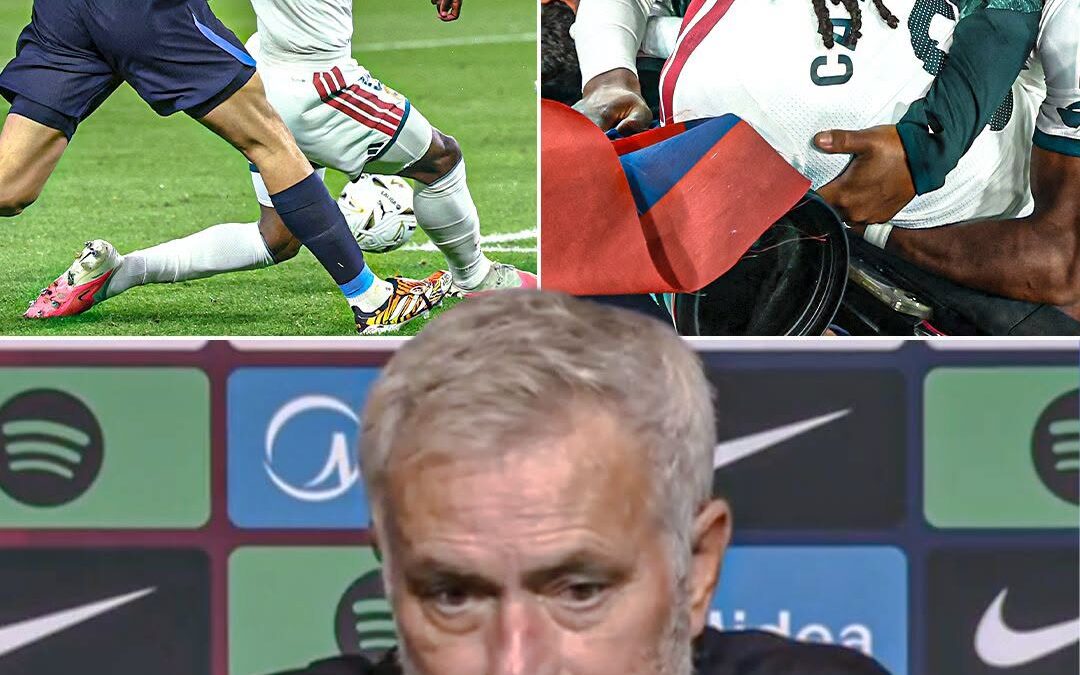
José Mourinho has once again highlighted a tactical detail that can make the difference in the biggest football matches: attacking space with midfielders rather than relying entirely on forwards.
The Portuguese coach’s alleged explanation involving Eduardo Camavinga, Aurélien Tchouaméni, and Jude Bellingham offers an intriguing look at how a team can attempt to break through Barcelona’s defensive structure.
According to the statement provided, Mourinho’s instructions to Camavinga were straightforward: Tchouaméni would remain deeper to protect the defence, while Camavinga would be given the freedom to attack space.
It sounds simple, but the tactical reasoning behind it is significant.
Why attacking space against Barcelona is so difficult
Barcelona’s defensive organization is designed to deal with forward runs, particularly when attackers attempt to exploit gaps behind the defensive line.
When forwards repeatedly run into those spaces, defenders can anticipate their movements, maintain their positioning, and use the offside trap to disrupt the attack. Goalkeeper Joan García can also play an important role by reading through balls and moving quickly off his line.
That makes predictable attacking patterns easier to defend.
Instead of asking forwards to make every decisive run, the tactical approach described in Mourinho’s statement focuses on an unexpected source of danger: the midfield.
Midfielders often begin their movements from deeper positions, making it harder for defenders to track them while simultaneously monitoring the opposition’s forwards. When a midfielder accelerates into an open channel at the right moment, the defensive line can suddenly face a problem it was not prepared to handle.
The key is timing.
A midfielder must recognize the space, anticipate the passing opportunity, and make the run before the opposition can adjust.
Camavinga: The weapon that changes the equation

Eduardo Camavinga possesses several qualities that make him suited to this kind of tactical responsibility.
His acceleration allows him to cover ground quickly, while his ball-carrying ability helps him progress through midfield and force opponents to make decisions. Rather than simply circulating possession, he can turn a defensive or transitional situation into an attacking opportunity with one forward movement.
If Tchouaméni stays behind to provide defensive protection, Camavinga can take greater risks without leaving the team completely exposed.
That division of responsibilities is crucial.
One midfielder protects the space in front of the centre-backs, while the other looks to exploit the gaps appearing between the opposition’s midfield and defence.
The result can be a more balanced attack: one player provides security, while another supplies penetration.
Why Jude Bellingham can make the difference

Jude Bellingham offers a different but equally dangerous dimension.
His ability to arrive in advanced areas, combine with teammates, and time his runs into the penalty area makes him difficult to track when he moves from midfield rather than starting alongside the forwards.
Defenders must decide whether to follow him or maintain their positions against the attacking line. Either decision can create opportunities elsewhere.
If a centre-back steps forward to track Bellingham, space may open behind him. If the defensive midfielder drops back to cover the run, another player may find room to receive the ball.
This is the tactical advantage of using midfielders to attack space: they force defenders to make decisions that disrupt the structure of the entire defensive unit.
The importance of Tchouaméni’s defensive role
The plan would be far less effective without a midfielder prepared to remain disciplined.
Tchouaméni’s responsibility, as described in the supplied quotation, is to stay deeper and protect the defence while his teammates advance.
That position provides cover against counterattacks and helps prevent the team from becoming stretched when Camavinga or Bellingham moves forward.
It also allows the attacking midfielders to concentrate on finding openings instead of constantly worrying about the space they leave behind.
In tactical terms, the balance between defensive stability and forward movement is what makes the idea work.
Mourinho’s central lesson: Make the defence defend something unexpected
The broader lesson is that beating a well-organized defence is not always about asking the forwards to run faster or make more runs.
Sometimes, the answer is to change where the danger comes from.
When midfielders attack at the right moment, they can create numerical advantages, disrupt defensive assignments, and open passing lanes that would not otherwise exist. Against a team that relies on a coordinated defensive line, those movements can be especially valuable.
However, the approach requires excellent coordination between the passer, the runner, and the deeper midfielder providing cover. Poor timing or an inaccurate pass can quickly turn an ambitious forward movement into a lost possession and a counterattacking opportunity.
That is why execution matters just as much as the tactical idea itself.
The bottom line: the approach described in Mourinho’s statement is built around three complementary roles: Tchouaméni protects, Camavinga penetrates, and Bellingham exploits the spaces that emerge.
It is a reminder that football’s biggest tactical battles are often decided not by the players everyone expects to make the decisive run, but by those arriving from positions the opposition has overlooked.
You Might Also Enjoy



Manchester United finalising deal to appoint Mauricio Pochettino as Carrick replacement

Single Dad Took Two Bullets Saving the Army General’s Daughter — “Move, I’ll Handle This!”

They Tried to Take the Stray Puppy—Then the Quiet Nurse Realized Why the K9 Needed Him



