The CEO Left His Pregnant Wife in a Blizzard With Just Three Words: “Wait for the Tow Truck”
PART 1
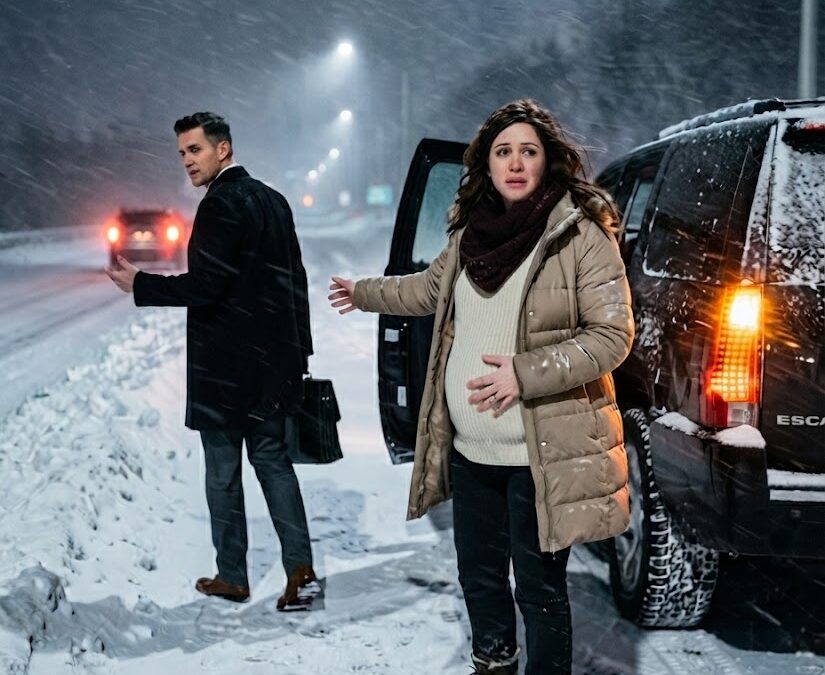
“Wait for the tow truck,” my husband said, stepping out of our SUV and leaving me alone in a blizzard at thirty-four weeks pregnant. “I’m not wasting the entire night sitting here because you’re uncomfortable.” Then he drove away, leaving me beside a snow-covered highway with a dead phone, a failing car battery, and temperatures dropping below zero. My name is Olivia Bennett. I was thirty-four years old, eight months pregnant, and married to Michael Bennett, a forty-one-year-old CEO who believed every problem could be solved with money—unless solving it required him to care about someone besides himself. We were driving home from a corporate dinner outside Albany, New York, when the snow became so heavy that traffic slowed to a crawl. Our SUV began losing power, and Michael pulled onto the shoulder. “Call roadside assistance,” I said, rubbing my belly as our unborn daughter kicked beneath my coat. Michael checked his phone. “No signal.” “Then we should stay inside and wait for help.” He glanced at me with open irritation. “You’ve been complaining about the cold for the last hour.” “I’m pregnant, Michael. The heater stopped working, and I’m having cramps.” He dismissed my words with a wave. “They’re probably Braxton Hicks. You worry about everything.” The engine clicked but refused to restart. Snow gathered across the windshield, and the temperature inside the vehicle began falling. I reached for my emergency blanket, but Michael grabbed his briefcase and opened the driver’s door. “Where are you going?” I asked. “To find somewhere with a signal.” “You can’t leave me here!” He looked back at me, his face illuminated by the dashboard. “Wait for the tow truck. I’ll call someone when I get service.” “Michael, please. I don’t feel right.” For one moment, I thought he might reconsider. Instead, he shut the door, climbed into the second vehicle behind us that had stopped to help, and persuaded its driver to take him toward the nearest town. He never asked whether I could walk. He never checked whether I had enough warmth. He simply left. Minutes later, I tried calling emergency services, but my phone displayed one percent battery and no reliable connection. My cramps grew stronger. I wrapped the emergency blanket around my shoulders and pressed both hands against my stomach. Then I saw headlights approaching through the snow. A pickup truck stopped behind my SUV. A middle-aged man stepped out wearing a reflective winter jacket and carrying a flashlight. “Ma’am, are you alone?” I nodded, struggling to speak through chattering teeth. He opened the passenger door, called 911 through his vehicle’s radio connection, and helped me into the heated cab without making me walk through the snow. As we waited for the ambulance, he asked the question that shattered the last excuse I had made for my husband. “Your husband left you here?” I stared at the empty highway. “Yes,” I whispered. “He said to wait for the tow truck.” The man’s expression hardened. “Then I hope you have people who know what he’s done.” I looked down at my stomach, terrified for my daughter. And for the first time in my marriage, I realized that the person I had trusted to protect us might be the greatest danger we faced. I continued the story in the first comment.

PART 2
The ambulance arrived twenty-two minutes later. By then, my fingers were numb, my clothes were damp from the snow, and the cramps had become regular enough to frighten me. The paramedics wrapped me in heated blankets, checked my vital signs, and placed a monitor against my abdomen. I listened to the rapid beeping as they assessed our daughter’s heartbeat. “Her heart rate is stable right now,” one paramedic told me. “But we need to get you to the hospital and have the obstetric team evaluate you.” I began crying—not because I was cold anymore, but because I had no idea where Michael was or whether he even remembered that I was pregnant with his child. At Albany Medical Center, nurses warmed me gradually while the obstetric team monitored the contractions. The doctor explained that exposure to severe cold and the stress of the incident warranted careful observation, although the monitoring did not show that our daughter was in immediate distress. I was not in active labor, but I needed to remain under observation overnight. A nurse named Hannah brought me a phone charger and helped me contact my younger sister, Rachel. When Rachel answered, I could barely get the words out. “Michael left me on the highway.” There was a long silence. “What do you mean, left you?” I told her everything. The stalled SUV. The freezing cabin. The cramps. His promise to call someone. The second vehicle taking him away. Rachel arrived less than an hour later, still wearing her office clothes beneath a thick winter coat. She hugged me carefully, then pulled a chair beside my bed. “I knew he could be selfish,” she said, her voice trembling with anger. “But I never thought he would do something like this.” Neither had I. At 2:17 a.m., Michael finally called. “Where are you?” he demanded. I stared at the screen. Not a single message asking whether I was safe had appeared before his call. “At the hospital.” “What? Why?” “Because I was left alone in a blizzard while pregnant, Michael.” He exhaled sharply. “I told you I was going to get help. My phone died. I thought the tow company would reach you.” “You told me to wait for the tow truck. You never called one.” “I was trying to handle the situation.” “You left in another vehicle.” “Olivia, don’t turn this into some dramatic accusation. I’m dealing with a crisis at work, and I can’t have you making me look like a monster.” I felt something inside me become unexpectedly still. “You’re worried about how you look?” “I’m saying we need to discuss this calmly.” “No. You need to understand that our daughter and I could have died out there.” He lowered his voice. “I’m coming tomorrow. We’ll talk when you’re not emotional.” Then he hung up. Rachel had heard enough to understand that this was not an ordinary marital argument. “Save every message,” she said. “Write down exactly what happened while you remember it. Don’t let him convince you that it was your fault.” I followed her advice. I saved the call log, photographed the messages, and wrote a detailed account of the evening. I also asked the hospital staff how to obtain my medical records. The following morning, Michael arrived carrying flowers and wearing the charcoal suit he reserved for investor meetings. He looked more annoyed than frightened. “I’ve had a terrible night,” he began. “The company has a financing deadline, and the board is already questioning my judgment.” I stared at him. “I spent the night in a hospital bed because you left me in a blizzard.” He set the flowers down. “I made a bad decision. I admit that. But we both know I’ve supported you throughout this pregnancy.” “Support is not something you can use to excuse abandoning me.” He looked toward Rachel, who was standing beside the window. “This is between my wife and me.” Rachel folded her arms. “It stopped being private when you left her on the side of a highway.” Michael ignored her and turned back to me. “Come home. We can put this behind us. The last thing we need is a public scandal.” That sentence told me everything. He wanted his reputation restored before he had even asked what the doctor had said about our baby. “I’m not coming home with you today,” I replied. His jaw tightened. “You’re making a mistake.” “Maybe. But for once, it will be my decision.” After he left, Rachel helped me arrange temporary accommodation at her house for when the hospital discharged me. I also contacted an attorney who specialized in family law. Her name was Susan Miller, and she listened without interrupting as I described the incident. “First,” she said, “we need to make sure you and your baby are medically safe. Then we’ll review your finances, your housing rights, and your options. Don’t sign anything Michael gives you under pressure.” I had spent years helping Michael manage household budgets while he built his company. I knew our savings, our mortgage payments, and the investments we had accumulated together. I had also reduced my working hours during pregnancy, believing we were building a stable family. Now I began reviewing our financial records with new eyes. Three days later, while I was still staying with Rachel, an email arrived from Michael’s executive assistant. Attached was a document titled Temporary Separation Agreement. It required me to leave our marital home, accept a fixed monthly payment, and waive several potential financial claims in exchange for what the document described as a clean, private separation. The proposed agreement offered no independent valuation of our shared assets. It also included language restricting what I could say about Michael’s personal conduct. I forwarded it to Susan without signing. Her response came that afternoon. “Do not agree to this as written. We need complete financial disclosure and independent legal review.” That evening, Michael sent me one final message. If you involve lawyers, you will destroy this family. I looked at the words for a long time. He had left me in a blizzard because he believed my safety was less important than his convenience. Now he was trying to make me responsible for the consequences. I typed one sentence and sent it. I am protecting myself and our daughter. You should have thought about that before you left us. What do you think will happen next? I’d love to hear your honest guess or reaction.
You Might Also Enjoy



Manchester United finalising deal to appoint Mauricio Pochettino as Carrick replacement

Single Dad Took Two Bullets Saving the Army General’s Daughter — “Move, I’ll Handle This!”

They Tried to Take the Stray Puppy—Then the Quiet Nurse Realized Why the K9 Needed Him



