Doctors Gave Up on a SEAL’s Son. The Quiet Night Nurse Did What No One Else Could
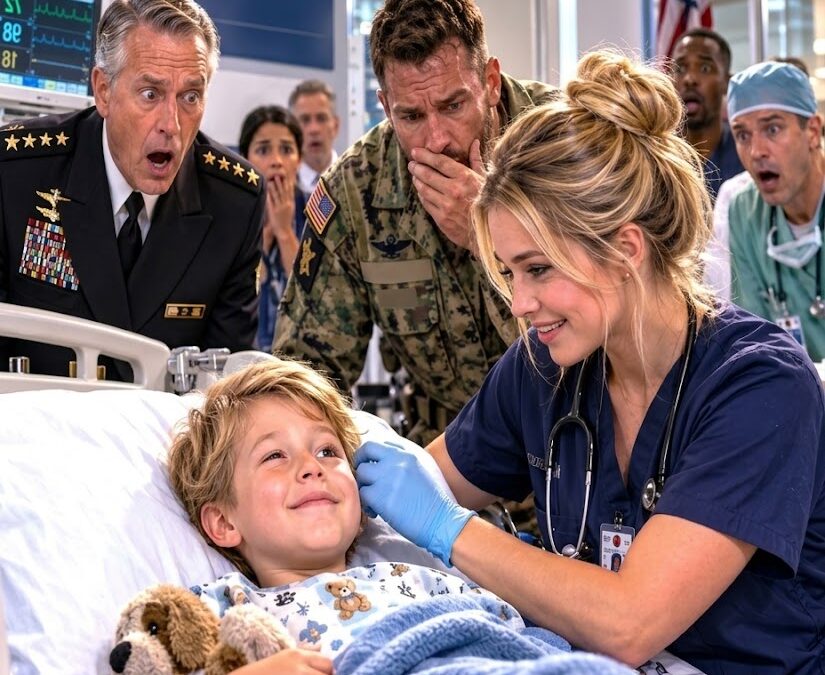
Doctors Gave Up on a SEAL’s Son. The Quiet Night Nurse Did What No One Else Could
At 2:17 a.m., the most feared Navy SEAL in the hospital was on his knees, begging a stranger to save his son.
Commander Jack Morrison had faced enemy fire in Afghanistan, survived an ambush in the mountains of Syria, and led his men through missions that never appeared in the newspapers. He had stared death in the face more times than he could count.
But nothing had prepared him for the sight of his seven-year-old son lying motionless beneath the pale hospital lights.
“Please,” Jack whispered, his voice breaking. “He’s all I have left.”
Dr. Richard Hayes stood beside the bed, his expression heavy. Behind him, two specialists exchanged the kind of glance that parents learned to dread.
“We’ve tried everything we can safely do right now, Commander,” the doctor said. “Your son’s condition is extremely serious. We need to prepare you for the possibility that he may not recover.”
Jack stared at him.
“Prepare me?”
“Yes, sir.”
“I’m a Navy SEAL. I’ve survived things you wouldn’t believe. My son is seven years old. You don’t get to tell me to prepare for his death.”
Nobody answered.
Machines hummed softly around the bed. A monitor displayed the fragile rhythm of a little boy’s heartbeat.
His name was Noah Morrison.
Three weeks earlier, Noah had been a cheerful child who loved dinosaurs, chocolate pancakes, and listening to his father’s stories about faraway places. Then a sudden illness had turned his world upside down.
At first, the doctors believed it was a severe infection. But as Noah’s condition worsened, the tests became more complicated, the treatments more aggressive, and the answers more uncertain.
Now, after days in intensive care, his body was exhausted.
His mother had died two years earlier in a highway accident. Since then, Jack had reorganized his entire life around raising his son. He had turned down deployments, changed assignments, and learned how to braid hair badly enough that Noah sometimes insisted on wearing a baseball cap to school.
Noah was the reason Jack came home.
He was also the reason Jack was terrified of losing the next battle.
“Can I have a few minutes with him?” Jack asked.
Dr. Hayes nodded.
The specialists left the room.
Jack pulled a chair beside the bed and wrapped his son’s tiny hand between both of his.
“Hey, buddy,” he whispered. “Dad’s here.”
Noah didn’t respond.
“You remember what I told you about being brave? Being brave doesn’t mean you’re never scared. It means you keep going even when you’re scared.”
His voice trembled.
“Well, I’m scared, buddy. I’m really scared.”
He lowered his forehead onto Noah’s hand.
“And I don’t know how to do this without you.”
For several minutes, the hardened soldier cried in silence.
Outside the room, a nurse pushing a medication cart slowed her steps.
Her name was Anna Williams.
She was thirty-four years old, worked the night shift, and rarely spoke unless she had something important to say. Her coworkers described her as quiet, almost invisible. She never joined the loud conversations in the staff lounge, never complained about difficult patients, and never tried to impress the doctors.
But Anna had a habit that few people noticed.
She remembered the small things.
Which elderly patient liked the window open. Which child needed a night-light. Which frightened teenager pretended not to be in pain because his parents were already overwhelmed.
And for the past four nights, she had noticed something about Noah Morrison.
Even when he was barely conscious, his fingers sometimes moved whenever someone spoke to him.
It was subtle.
So subtle that anyone in a hurry might have missed it.
Anna had also noticed that whenever the machines alarmed or the hallway grew noisy, Noah’s breathing seemed to become more strained.
She didn’t know why.
She wasn’t a specialist, and she had no intention of pretending to be one.
But she had a feeling there was something important the team needed to look at again.
She approached Dr. Hayes at the nurses’ station.
“Doctor, could I speak with you about Noah Morrison?”
He rubbed his tired eyes.
“What is it, Anna?”
“I’ve noticed a pattern in his responses. I think we should review his chart and the timing of his symptoms.”
“We’ve reviewed his chart repeatedly.”
“I understand. But I think there may be a detail we haven’t connected.”
The doctor sighed.
“Anna, this is a very complicated case. The specialists have spent days investigating it.”
“I know, sir.”
“Then trust their judgment.”
Anna lowered her eyes.
“Yes, Doctor.”
She walked away without arguing.
But she didn’t forget what she had observed.
Because the next time she entered Noah’s room, she noticed something that made her stop at the doorway.
Jack was sitting beside the bed, speaking softly to his son about the ocean.
He described the waves rolling onto a quiet beach, the sound of seabirds, and the warm sand beneath their feet.
As he spoke, Noah’s fingers moved again.
Anna stepped closer.
“Commander Morrison?”
Jack looked up, his eyes red.
“What?”
“May I ask you something about your son?”
He nodded reluctantly.
“Before he became ill, did Noah have any unusual reactions to medications, food, or environmental exposures? Anything that seemed strange at the time?”
Jack frowned.
“Not that I know of. Why?”
“I don’t want to alarm you. I just want to make sure we’ve considered his full history.”
Jack looked at his son.
“He’s been in and out of hospitals since he got sick. I’ve told every doctor everything I can remember.”
Anna nodded.
“I believe you.”
Something about her calmness made him pause.
She wasn’t promising a miracle. She wasn’t telling him to stay positive.
She was simply paying attention.
And Jack, who had spent days surrounded by people delivering terrible news, found that strangely comforting.
“What have you noticed?” he asked.
Anna hesitated.
“I’d like to review the observations with the medical team before drawing any conclusions.”
Jack’s jaw tightened.
“Everyone keeps telling me what they can’t do.”
Anna met his gaze.
“Then let me find out what we haven’t tried to understand.”
For the first time that night, Jack saw something other than helplessness in another person’s eyes.
He saw determination.
“Please,” he said. “Do whatever you can.”
Anna returned to the nurses’ station and began reviewing the records she was authorized to access. She checked the medication administration times, the nursing notes, the changes in Noah’s vital signs, and the circumstances surrounding each episode of deterioration.
She wrote down the timeline.
Then she checked it again.
Something wasn’t adding up.
At 3:06 a.m., she approached the on-call physician with her observations.
“I may be mistaken,” she said, placing her notes on the desk, “but I think we need to reassess whether a medication-related complication or another reversible factor could be contributing to his decline.”

The physician studied her notes.
“Have you discussed this with Dr. Hayes?”
“He knows I’ve raised a concern.”
The physician looked more carefully at the timeline.
“Let me review this.”
Anna waited.
Minutes passed.
Then the physician picked up the telephone.
“Get Dr. Hayes back to the unit. I want the critical care team to review this immediately.”
Anna didn’t smile.
She didn’t celebrate.
She simply returned to Noah’s bedside and checked that everything was in order.
Because noticing a problem was only the beginning.
The doctors would need to assess the evidence, determine whether her concern was medically supported, and decide what action was appropriate.
Still, for the first time in hours, something was happening.
Someone was asking a new question.
And sometimes, in a hospital, that was where hope began.
At 3:42 a.m., Dr. Hayes returned to the room with two specialists.
Jack immediately stood.
“What happened?”
The doctor held up a hand.
“We’re reviewing a possible contributing factor that may not have received enough attention in the overall picture.”
“Can you fix it?”
“I can’t promise that. But we’re investigating it now.”
Jack looked toward Anna, who stood quietly near the doorway.
“Was this her idea?”
Dr. Hayes glanced at her.
“She raised a concern based on her observations. We’re evaluating it.”
Jack swallowed hard.
“Thank you.”
Anna shook her head.
“Please don’t thank me yet, Commander.”
She looked toward Noah.
“We still have work to do.”
The next hour was a blur of consultations, additional assessments, and careful adjustments to the treatment plan under the medical team’s direction.
Noah remained critically ill.
There was no sudden awakening, no miraculous recovery, no dramatic moment in which every machine returned to normal.
But the team identified a potentially reversible contributor to his deterioration and began addressing it.
For Jack, even that small development felt like a door opening in a wall he had believed was solid.
He stayed beside his son while the doctors worked.
Anna remained nearby, documenting changes and watching for new symptoms.
At 5:18 a.m., Noah’s fingers moved again.
This time, Jack felt it.
He straightened so quickly that his chair scraped across the floor.
“Doctor!”
Dr. Hayes came to the bedside.
“What’s happening?”
“He squeezed my hand.”
The doctor examined Noah and checked the monitor.
“Let’s not jump to conclusions,” he said gently. “Small movements can have several explanations. We’ll assess his response carefully.”
Jack nodded, afraid to breathe too loudly.
Anna stood at the other side of the bed.
“Noah,” she said softly, “if you can hear us, you don’t have to do anything difficult. Just rest.”
For a moment, nothing happened.
Then Noah’s fingers curled weakly around his father’s thumb.
Jack froze.
“Buddy?”
The little boy’s eyelids fluttered.
They didn’t fully open, but his lips moved.
“Dad?”
Jack made a sound that was half sob and half laugh.
“I’m here! I’m right here, buddy!”
He bent over the bed, pressing his son’s hand against his cheek.
Dr. Hayes immediately assessed Noah’s responsiveness and called for the appropriate monitoring. The team remained cautious, because a brief response did not mean the danger had passed.
But it was real.
Noah had responded to his father.
And after days of silence, Jack finally heard his son’s voice.
“I’m tired,” Noah whispered.
“I know, buddy. You rest. Dad’s right here.”
Noah’s eyes closed again.
Jack looked up at Anna.
Tears streamed down his face.
“You heard him?”
Anna nodded, her own eyes shining.
“I heard him.”
Jack reached for her hand.
“I don’t know how to thank you.”
She gently squeezed his fingers.
“Then don’t thank me by calling me a miracle worker. Thank the whole team by letting us keep doing our jobs.”
Jack let out a shaky laugh through his tears.
“Yes, ma’am.”
It was the first time anyone had heard him laugh in days.
By sunrise, the hospital room looked exactly as it had before.
The same machines.
The same medical equipment.
The same pale light falling through the window.
But Jack felt as though the world had shifted.
Noah was still critically ill. His recovery would require time, continued treatment, and careful medical assessment. The doctors warned Jack that there could be setbacks and that nobody could predict the outcome with certainty.
For once, Jack listened without arguing.
He had learned something during the longest night of his life.
Hope wasn’t a guarantee.
It was the decision to keep looking for answers, even when the answers were difficult.
Over the next several days, the medical team continued treating Noah and monitoring his progress. The change was gradual. Some mornings brought encouraging signs; others brought fresh worries.
Anna continued working her night shifts.
She never claimed that she had saved Noah single-handedly. In fact, when hospital administrators praised her for drawing attention to the overlooked details, she insisted that the outcome had depended on the combined work of nurses, physicians, and specialists.
But Jack never forgot what she had done.
She had listened when everyone was exhausted.
She had noticed what others had missed.
And she had been willing to speak up, even when a senior doctor initially dismissed her concerns.
One afternoon, when Noah was finally stable enough to sit up for a short time, Jack brought a small package to the nurses’ station.
Anna opened it to find a children’s picture book.
Inside the cover, Noah had written a message in uneven handwriting.
For Nurse Anna. Thank you for helping Daddy not be sad all the time.
Beneath the words was a drawing of three stick figures: Noah, his father, and a woman with a big smile.
Anna laughed softly, then wiped away a tear.
“Tell Noah I love the picture.”
Jack smiled.
“He says you’re the bravest person he’s ever met.”
Anna shook her head.
“Your son is the brave one.”
Jack glanced toward the room where Noah was resting.
“No,” he said quietly. “My son was brave because he had people who refused to give up on him.”
He paused.
“And I think that’s what I needed to learn, too.”
Six months later, Noah walked into the hospital for a follow-up appointment holding his father’s hand.
He was thinner than before his illness, but his eyes were bright, and a small plastic dinosaur poked out of his backpack.
When he spotted Anna in the corridor, he broke free from Jack’s hand and ran toward her.
“Nurse Anna!”
She crouched just in time to catch him in a hug.
“You’re getting so tall!”
“Dad says I’m going to be a SEAL when I grow up.”
Anna glanced at Jack.
“Does he now?”
Jack raised both hands.
“I said he could be anything he wanted.”
Noah grinned.
“Even a doctor!”
“Especially a doctor,” Anna replied.
The boy suddenly grew serious.
“Can I ask you something?”
“Of course.”
“Were you scared when I was sick?”
Anna thought carefully before answering.
“Yes, Noah. I was worried about you.”
“Then why didn’t you give up?”
She looked at the little boy standing in front of her.
“Because being scared doesn’t mean we stop trying to help. It means we need to be careful, ask questions, and work together.”
Noah considered this.
Then he nodded as though she had given him the most important lesson in the world.
Jack watched them in silence.
He had spent his career learning how to survive impossible situations through discipline, courage, and teamwork.
Yet it had taken one quiet night nurse to remind him that courage didn’t always look like charging into danger.
Sometimes, it looked like reviewing one more chart.
Asking one more question.
Speaking up one more time when it would have been easier to remain silent.
And sometimes, the person who made the greatest difference was not the loudest voice in the room, the most decorated officer, or the most celebrated doctor.
Sometimes, it was the quiet nurse who noticed a detail no one else had connected.
The nurse who understood that behind every diagnosis was a person, behind every patient was a family, and behind every desperate plea was someone hoping that the world hadn’t run out of possibilities.
As Jack and Noah left the hospital that afternoon, Noah turned back and waved.
“Goodbye, Nurse Anna! See you next time!”
Anna waved back.
“Take care of your dad, Noah.”
“I will!”
Jack laughed.
Then he looked at Anna one last time.
“Thank you for giving us another chance.”
Anna smiled.
“I didn’t give you that chance alone, Commander.”
She glanced toward the doctors’ station, where the team continued caring for other patients.
“We all did.”
Jack nodded.
And as he walked out into the sunlight with his son beside him, he finally understood something no battlefield had ever taught him.
The strongest people aren’t always the ones who fight the hardest. Sometimes, they’re the ones who refuse to stop paying attention when everyone else has lost hope.
And sometimes, one quiet nurse can remind an entire hospital that even in the darkest hour, the right question, asked at the right time, can change everything.
ChatGPT là AI và có thể mắc lỗi.
You Might Also Enjoy


Manchester United finalising deal to appoint Mauricio Pochettino as Carrick replacement
Single Dad Took Two Bullets Saving the Army General’s Daughter — “Move, I’ll Handle This!”
They Tried to Take the Stray Puppy—Then the Quiet Nurse Realized Why the K9 Needed Him