Doctors Gave Up on the Billionaire’s Son—Then a Homeless Boy Changed Everything
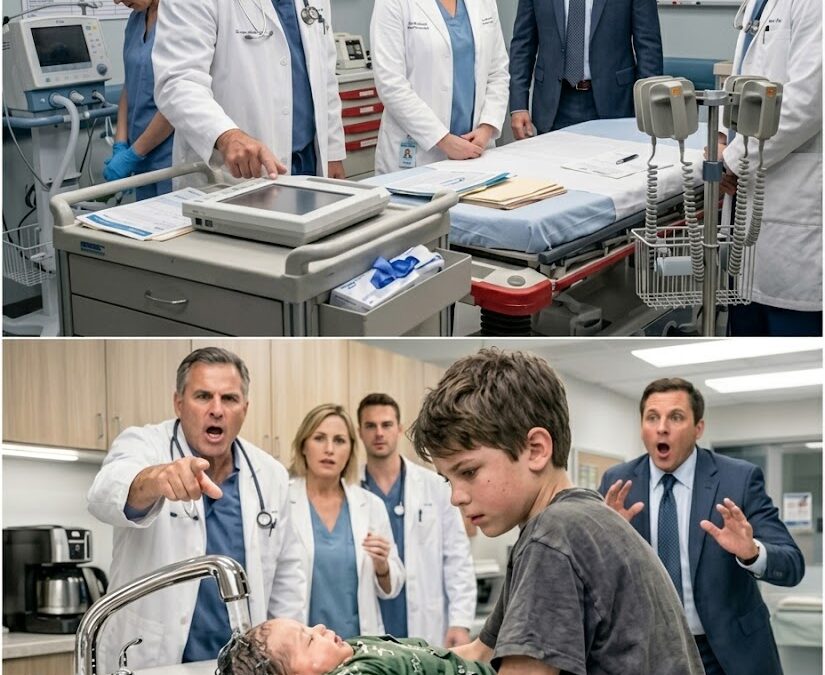
Chapter 1: The Boy Nobody Could Save
At exactly 9:43 p.m., the most respected pediatric specialist in New York walked out of the private hospital room, removed his glasses, and delivered the words that would destroy a billionaire’s world.
“I’m sorry, Mr. Anderson. We’ve tried everything we can. Your son’s condition is deteriorating, and we don’t know why.”
Richard Anderson stood motionless in the corridor.
At fifty-two, he was the founder of Anderson Global, a business empire worth more than twelve billion dollars. He owned luxury hotels, skyscrapers, private jets, and properties across three continents.
He could buy almost anything.
But he couldn’t save his eight-year-old son.
For six months, little Ethan Anderson had been in and out of hospitals. He suffered from mysterious episodes of weakness, confusion, and severe exhaustion. Sometimes he couldn’t stand. Other times, he would wake in the middle of the night screaming that the room was spinning.
The doctors had conducted countless tests.
Blood work. Brain scans. Neurological examinations.
Nothing had provided a clear explanation.
One specialist suspected an unusual neurological disorder. Another believed the symptoms might be caused by an autoimmune condition. A third recommended transferring Ethan to a research hospital overseas.
Richard had paid for every consultation.
He had flown in specialists from London, Zurich, and Boston. He had funded experimental evaluations and hired a team of private nurses.
Still, his son grew weaker.
Inside the hospital room, Ethan lay beneath a white blanket, his small face pale against the pillow.
Richard sat beside him and held his hand.
“Daddy?”
Richard leaned forward immediately.
“I’m here, buddy.”
“Am I going to die?”
The question struck him harder than any business defeat he had ever experienced.
“No,” Richard whispered. “You’re going to get better. I promise.”
Ethan looked at him with tired eyes.
“You always say that.”
Richard lowered his head.
For the first time in his life, he had no answer.
He had promised his late wife, Emily, that he would protect their son. Before she died of cancer two years earlier, she had made Richard swear that Ethan would never grow up feeling alone.
Now Richard had everything money could buy, yet he couldn’t keep the one promise that mattered most.
He pressed his son’s hand against his forehead.
“Please,” he whispered. “Someone, please help my boy.”
Outside the hospital, rain poured across the city.
And beneath the awning of a closed pharmacy across the street, a twelve-year-old homeless boy named Noah Bennett watched the hospital windows glow in the darkness.
He had no idea that, before sunrise, he would walk into that building and change the life of the richest man in the city.
Chapter 2: The Boy in the Torn Jacket
Noah Bennett had learned to survive without anyone’s help.
His mother had died when he was nine. His father had disappeared long before that, leaving him with distant relatives who eventually decided they could no longer care for him.
After several difficult placements, Noah ran away.
He had spent nearly a year moving between shelters, church basements, and doorways where strangers occasionally allowed him to sleep.
He owned two shirts, one jacket with a broken zipper, and a small backpack containing everything he had left of his mother.
Inside the backpack was a photograph of the two of them standing beside a public library.
His mother had been a nurse before becoming too ill to work.
She used to tell him something every night.
“People will sometimes look at your clothes and decide who you are before you open your mouth. Don’t let them decide who you become.”
Noah had never forgotten those words.
That rainy evening, he had gone to the hospital looking for a warm place to sit. The emergency department was crowded, and a security guard had told him to move away from the entrance.
But before leaving, Noah noticed a small boy sitting near a window inside the lobby.
The boy wore expensive pajamas and clutched a stuffed dinosaur.
He looked frightened.
Noah recognized that expression.
It was the look of someone who had been surrounded by adults but still felt completely alone.
A nurse approached the boy with a cup of water.
“Ethan, sweetheart, can you take a little sip?”
Ethan turned his head away.
“My stomach hurts.”
The nurse sighed sympathetically.
“Let’s try again in a few minutes.”
Noah watched carefully.
Something about the scene reminded him of his mother.
When she had worked at the hospital, she used to explain that helping someone didn’t always begin with medicine.
Sometimes it began with listening.
Noah approached the reception desk.
“Excuse me,” he said softly. “Can I talk to the little boy?”
The receptionist looked at his dirty shoes and worn jacket.
“Absolutely not. You can’t go into patient areas.”
“But he looks scared.”
“That’s not your concern.”
Noah lowered his eyes.
He had heard those words before.
He turned away, but as he walked toward the exit, he heard a faint voice behind him.
“Wait.”
Ethan was standing near the doorway, leaning against a nurse for support.
He was looking directly at Noah.
“Do you have a dinosaur?”
Noah stopped.
He reached into his backpack and pulled out a tiny wooden animal.
It wasn’t a dinosaur exactly. It was a small carved whale his mother had bought for him at a street market.
“Not a dinosaur,” Noah said. “But this guy is pretty brave.”
Ethan studied the whale.
“What’s his name?”
“Captain.”
Ethan smiled faintly.
“Can I see him?”
The nurse hesitated, but Ethan’s expression had changed. For the first time that evening, he looked interested in something.
She allowed Noah to approach the chair beside the window, where he handed Ethan the little wooden whale.
Ethan held it carefully.
Then he whispered something that made Noah’s smile disappear.
“I don’t want to sleep anymore. Every time I wake up, I feel like something terrible is going to happen.”
Noah sat beside him.
“Then I’ll sit here for a little while.”
And for the first time that day, Ethan stopped asking for his father.
Chapter 3: The Strange Thing Noah Noticed
Over the next twenty minutes, Noah told Ethan stories about Captain the whale.
He invented adventures about underwater kingdoms, friendly sea monsters, and a tiny whale who was afraid of the dark until he discovered that even the deepest ocean had stars.
Ethan listened with growing interest.
Eventually, the little boy laughed.
It was a small sound, but the nurse standing nearby nearly cried when she heard it.
She hadn’t heard Ethan laugh in weeks.
Then Ethan suddenly became quiet.
“My head hurts again.”
The nurse moved closer.
“Where does it hurt, sweetheart?”
Ethan pointed toward his forehead.
Noah watched him carefully.
Something about Ethan’s behavior seemed familiar, though he couldn’t explain why.
He remembered his mother caring for patients who had trouble describing their symptoms.
She always asked the same questions.
What happened before the pain started?
What did you eat?
What changed today?
Noah looked at Ethan.
“Does your head hurt every time you eat?”
The nurse turned toward him.
“What?”
Noah shrugged.
“I don’t know. I’m just asking.”
Ethan thought about it.
“Sometimes.”
“What did you eat today?”
“Breakfast. Some cereal.”
“And lunch?”
Ethan frowned.
“I don’t remember.”
The nurse gently touched his shoulder.
“You haven’t eaten much today, have you?”
Ethan shook his head.
Noah noticed a small medical chart clipped to the end of the bed. He couldn’t read all the technical words, but he recognized a familiar symbol beside one of the dietary notes.
His mother had once explained how some children became ill when they ate certain foods, even foods that seemed harmless.
Noah hesitated.
“Has anyone checked whether something in his food is making him sick?”
The nurse looked at him carefully.
“His doctors have reviewed his diet.”
“But does he get worse after certain meals?”
Before she could answer, Ethan suddenly grabbed his stomach.
“My head hurts,” he whispered. “And my legs feel funny.”
The nurse immediately called for assistance.
Within seconds, two clinicians entered the room.
Noah stepped backward.
He had not touched Ethan’s food. He had not given him anything to drink except the water the nurse had provided.
He had simply asked a question.
Yet as the medical team hurried to examine Ethan, Noah noticed something else.
A small paper cup stood on the bedside table beside a half-eaten snack.
The snack’s packaging was unfamiliar, but there was a long list of ingredients printed on the back.
Noah remembered his mother explaining that certain ingredients could trigger serious reactions in some people.
He pointed toward the cup.
“Could that be important?”
One of the doctors glanced at him.
“Who are you?”
“Noah.”
“Are you a relative?”
“No.”
“Then please step outside.”
Noah backed away.
But before he reached the door, Ethan called out.
“Don’t make him leave!”
Everyone paused.
Ethan looked at his father, who had just entered the room.
“Daddy, Noah made me feel better. Please let him stay.”
Richard Anderson looked at the homeless boy standing beside the wall.
His first instinct was to ask security to remove him.
But then he saw his son’s expression.
For months, Ethan had been withdrawn, frightened, and increasingly isolated.
Now he was desperately holding a small wooden whale and looking at a boy who had given him something no expensive specialist had managed to provide that evening.
Comfort.
Richard swallowed.
“Let him stay,” he told the nurse.
Then he turned to Noah.
“What did you notice?”
Noah looked down at his worn shoes.
“I don’t know if it means anything, sir. I just thought maybe his food was connected to how he feels.”
Richard looked toward the medical team.
“Please review it.”
The senior physician nodded, though his expression remained cautious.
“We’ll review all recent exposures and compare them with his symptom history. We can’t draw conclusions from a single observation.”
Richard looked back at Noah.
For the first time that evening, he felt a small flicker of hope.
Not because a diagnosis had been found.
But because someone had noticed a question worth asking.
Chapter 4: The Billionaire’s Promise
The following morning, Ethan’s medical team began reviewing his records again.
They examined the timing of his symptoms, his medications, his meals, and the environmental factors that might have contributed to his condition.
A pediatric specialist asked for a detailed account of what Ethan had eaten during the previous several days.
Another doctor ordered additional testing based on the new information.
Noah sat outside the room, waiting anxiously.
Richard found him there an hour later.
“You haven’t gone home?”
Noah shook his head.
“I wanted to know if Ethan was okay.”
Richard sat beside him.
“Why do you care so much about a boy you met only last night?”
Noah looked at him as though the answer were obvious.
“Because he was scared.”
Richard stared at the floor.
Those three words were painfully simple.
Because he was scared.
Richard had spent months demanding answers, questioning doctors, and throwing money at every possible solution. He had treated the illness like a business problem that could be solved with enough resources.
But Noah had approached Ethan without wanting anything in return.
He had seen a frightened child.
And he had stayed.
Richard cleared his throat.
“Where are your parents, Noah?”
The boy’s face changed.
“My mom died.”
“I’m sorry.”
“My dad isn’t around.”
“Where are you staying?”
Noah hesitated.
“Different places.”
Richard understood enough to know that the boy had no stable home.
He looked at Noah’s thin jacket and worn sneakers.
“How old are you?”
“Twelve.”
Richard closed his eyes briefly.
Twelve.
His son was eight, and Richard could hardly bear the thought of him spending one night without a safe place to sleep.
Yet this child had been surviving that way for months.
Richard reached for his wallet.
“I’d like to help you.”
Noah immediately shook his head.
“I don’t want money.”
Richard paused.
“Everyone needs money.”
“I know. But I don’t want you to think I stayed with Ethan because I wanted something.”
Richard studied him.
Then he put his wallet away.
“What would you like, then?”
Noah thought for a moment.
“A place to sleep tonight would be nice.”
Richard felt something tighten in his chest.
“Then we’ll arrange that.”
He called his family attorney and asked for help contacting a reputable child welfare organization. He made it clear that Noah’s safety and wishes had to come first.
Noah would not be taken to the mansion simply because a wealthy man had decided to help him.
Any placement would need to be appropriate, safe, and handled through the proper child welfare process.
Before the conversation could continue, the hospital room door opened.
The senior physician stepped into the corridor.
Richard stood immediately.
“Doctor?”
The physician looked serious.
“We’ve identified a possible explanation for some of Ethan’s symptoms, but we need additional testing before we can be certain.”
Richard’s heart began pounding.
“What is it?”
The doctor explained that the pattern suggested a possible metabolic or nutritional problem that had not been adequately investigated earlier. The team was reviewing the evidence and considering several possibilities.
“We cannot promise that this explains everything,” the doctor emphasized. “But we’ve found a direction worth pursuing.”
Richard looked at Noah.
The boy was standing perfectly still, his hands clasped around the straps of his backpack.
For the first time in months, Richard allowed himself to believe that his son might have a chance.
Chapter 5: The Diagnosis Nobody Expected
Three days later, the medical team gathered in Ethan’s hospital room.
Richard stood beside the bed, holding his son’s hand.
Noah sat in a chair near the window.
He had been allowed to visit under the hospital’s supervision, and Ethan had insisted that Captain the whale remain beside him throughout every examination.
The lead specialist entered carrying a folder.
“Mr. Anderson, we’ve completed the additional evaluations.”
Richard rose.
“And?”
The doctor took a breath.
“We believe Ethan has a rare metabolic disorder that affects how his body processes certain nutrients. It explains several of his symptoms, although we’re still investigating whether there are additional contributing factors.”
Richard stared at him.
“Can you treat it?”
“There are management options. We need to work with a specialist team to determine the safest and most effective approach for Ethan. Treatment will require monitoring, dietary adjustments, and follow-up testing.”
Richard’s knees nearly gave way.
“So he’s going to be okay?”
The doctor answered carefully.
“We are optimistic that we can improve his condition, but we cannot guarantee an outcome. The next several weeks will be important.”
Richard sat down beside his son.
Ethan looked up at him.
“Daddy?”
Richard brushed the boy’s hair away from his forehead.
“We have a plan, buddy.”
Ethan’s eyes filled with tears.
“Does that mean I can go home?”
“Not yet. But we’re getting closer.”
Ethan reached for Noah’s hand.
“Captain helped.”
Noah smiled.
“Captain is pretty good at listening.”
The physician looked toward the boy.
“I understand you raised a question about the timing of Ethan’s symptoms and his meals.”
Noah nodded nervously.
“I wasn’t sure.”
“You didn’t diagnose him,” the doctor said gently. “And we can’t know whether that question alone changed the outcome. But it reminded us to look carefully at a pattern that deserved closer attention.”
He turned toward Richard.
“Sometimes, useful observations come from unexpected places. What matters is that we investigate them properly.”
Richard nodded.
He understood.
Noah hadn’t performed a miracle.
He hadn’t replaced years of medical training.
He had done something much smaller, but deeply important.
He had paid attention.
And his question had helped the medical team reconsider a possibility that now offered Ethan a path forward.
Richard turned toward Noah.
“You helped my son.”
Noah shook his head.
“The doctors helped him.”
Richard smiled sadly.
“Both things can be true.”
For the first time since his wife died, Richard cried in front of someone without trying to hide it.
Ethan reached for his father’s hand.
And Noah quietly placed Captain the whale on the bedside table, where the little boy could see him.
Chapter 6: The Boy Who Refused a Reward
Over the next several weeks, Ethan began receiving specialized care.
His treatment plan was adjusted as the doctors learned more about his condition. His meals were carefully reviewed, his symptoms were documented, and his progress was monitored.
Some days were encouraging.
Others were difficult.
There were mornings when Ethan felt strong enough to sit by the window and watch the birds in the hospital garden. There were evenings when exhaustion returned and he needed extra rest.
But gradually, his family and medical team began to see improvements.
One afternoon, Ethan managed to walk a short distance down the corridor with a physical therapist.
When he returned to his room, he was smiling.
“Daddy! I walked all the way to the elevator!”
Richard hugged him carefully.
“I saw, buddy. You did great.”
Ethan looked toward Noah, who had come to visit.
“Did you see me?”
“I did.”
“Next time, I’m going to walk to the garden.”
Noah grinned.
“Then Captain will need sunglasses.”
Ethan laughed so hard that the nurse reminded him to catch his breath.
Richard watched them from the doorway.
He had spent millions searching for a way to save his son. Yet the moments that seemed to matter most were often the simplest ones: a joke, a walk, a boy who didn’t treat Ethan like a fragile object.
Later that afternoon, Richard asked Noah to meet him in a quiet room with a social worker present.
“I want to offer you something,” Richard said.
Noah looked wary.
“What?”
“I can fund your education, provide financial support, and make sure you have access to the resources you need.”
Noah lowered his eyes.
“Thank you, sir.”
“And if you want to become a doctor someday, I’ll help you pursue that dream.”
Noah was silent for a long time.
Then he asked, “Would I have to leave the people helping me now?”
Richard shook his head.
“No. Nothing would happen without a proper plan and your input. We would work with the people responsible for your care to make sure any support is appropriate.”
Noah thought carefully.
“I’d like to go to school. And I’d like to have a place where I don’t have to worry about getting moved every night.”
Richard nodded.
“Then those are the things we’ll focus on first.”
Noah looked up.
“But I don’t want people to say I helped Ethan just because you’re rich.”
Richard’s expression softened.
“Then we won’t make your help a transaction.”
He paused.
“You don’t owe me anything, Noah. Not your friendship. Not your time. Not your future.”
Noah’s eyes glistened.
For a moment, he looked like the little boy he had been before his mother died.
A child who wanted to believe that adults could keep their promises.
“Okay,” he whispered.
Richard extended his hand.
Noah shook it.
And for the first time in a long while, the boy began to imagine a future that wasn’t defined by survival.
Chapter 7: A Home for Two Boys
Six months later, Ethan returned home.
He still needed regular medical appointments, careful monitoring, and ongoing support, but his condition had improved enough for his doctors to approve the transition.
On the morning he arrived, Richard waited at the front door with a ridiculous balloon shaped like a dinosaur.
Ethan stared at it.
“Dad, I’m eight. Not three.”
Richard shrugged.
“I’m a billionaire. I can buy embarrassing balloons if I want.”
Ethan burst out laughing.
Noah stood beside him, carrying Captain the whale in his backpack.
Richard had worked with child welfare professionals for months to help Noah obtain stable housing and return to school. His support had been arranged around Noah’s best interests, with appropriate safeguards and ongoing involvement from the professionals responsible for his care.
Noah now lived in a safe, supervised placement while his longer-term arrangements were being finalized.
He had his own bed, clean clothes, regular meals, and a school to attend.
For the first time in nearly a year, he knew where he would sleep that night.
When Ethan saw him at the door, he ran forward.
“Noah!”
The boys embraced.
Then Ethan grabbed his friend’s hand and pulled him toward the garden.
“Come on! I have something to show you!”
Richard watched them run toward the lawn.
For months, his mansion had felt like a hospital with expensive furniture. Every room had been filled with quiet fear.
Now the sound of children’s laughter echoed through the hallways.
That evening, Richard sat with Noah on the back porch.
“Can I ask you something?”
Noah nodded.
“Why did you notice Ethan when so many other people walked past him?”
Noah looked toward the garden.
“My mom used to say that when people are hurting, they don’t always know how to ask for help.”
He turned the wooden whale between his fingers.
“She said you don’t have to be rich or important to be useful. Sometimes you just have to pay attention.”
Richard looked down.
His late wife had said something similar.
Emily had always believed that compassion wasn’t measured by the size of a gift but by the willingness to see another person’s pain.
Richard had forgotten that lesson while building his empire.
A homeless child had reminded him.
“Your mother sounds like she was a remarkable woman,” Richard said.
“She was.”
Noah smiled sadly.
“I wish she could have met Ethan.”
Richard placed a hand on the boy’s shoulder.
“I think she would have been proud of you.”
Noah looked away quickly, trying to hide his tears.
Richard didn’t press him to speak.
He simply stayed beside him.
Sometimes, he had learned, that was enough.
Chapter 8: The Promise That Changed Everything
One year after Ethan’s first hospitalization, Richard organized a small event at a community center.
He invited doctors, teachers, social workers, and representatives from organizations supporting children without stable housing.
He had established a foundation to support pediatric research, improve access to specialist care, and fund practical assistance for children and families facing difficult circumstances.
But he made one request before the event began.
He wanted Noah to stand beside him.
When the audience had settled, Richard stepped onto the stage.
“A year ago, I was told that my son was getting worse and that the doctors did not yet understand why. I had spent months searching for answers, convinced that if I spent enough money, I could solve the problem.”
He paused.
“I was wrong about one thing. Money can open doors, fund research, and provide access to care. But it cannot replace patience, compassion, or the simple act of listening.”
He looked toward Noah.
“This young man noticed that my son was frightened. He asked questions that encouraged us to look more closely at a pattern. His observations did not replace medical expertise, but they helped remind us that every detail deserves attention.”
Richard turned back to the audience.
“Noah did not save my son through magic. He helped us remember that behind every medical record is a human being who deserves to be heard.”
The room fell silent.
Then Richard invited Noah to speak.
The boy stepped toward the microphone, looking uncomfortable beneath the bright stage lights.
He glanced at Ethan, who was sitting in the front row with his father.
“I didn’t do anything special,” Noah began.
“I just didn’t want Ethan to be alone.”
He took a breath.
“When I was living on the street, there were days when people looked right through me. I started thinking that maybe I didn’t matter.”
His voice trembled.
“But my mom always said that being poor doesn’t mean you have nothing to give.”
He looked toward Richard.
“Ethan needed a friend. So I stayed.”
For several seconds, nobody moved.
Then the audience rose to its feet.
Noah stared at the crowd, overwhelmed by the applause.
Ethan ran onto the stage and hugged him.
“You’re my best friend,” Ethan whispered.
Noah hugged him back.
“And you’re mine.”
Richard turned away for a moment, wiping his eyes.
He had once believed his greatest achievement was building a twelve-billion-dollar empire.
Now he understood that his most important responsibility was helping people have a chance at a better life.
And that responsibility had begun with a boy nobody had noticed.
A boy who owned almost nothing.
A boy who had every reason to turn away from a world that had turned away from him.
Yet when he saw another child suffering, he stopped.
He listened.
And he asked a question.
Epilogue: The Little Whale
Three years later, Ethan stood on the stage of his school auditorium, delivering a speech about kindness.
He was healthy enough to participate in school activities, though he continued to attend medical appointments and follow his doctors’ recommendations.
Noah sat in the front row.
He was fifteen now, doing well in school and beginning to explore his interest in medicine.
In his backpack, he still carried the little wooden whale his mother had given him.
Ethan finished his speech with a sentence he had written himself.
“Sometimes, the person who changes your life isn’t the person with the most money, the most knowledge, or the most important job. Sometimes, it’s the person who notices you’re hurting when everyone else is too busy to look.”
The audience applauded.
Afterward, the boys walked outside into the afternoon sunlight.
Richard waited beside the car.
“How did it go?”
Ethan grinned.
“I think Mom would have liked it.”
Richard’s smile softened.
“Your mother would have been proud of you.”
Ethan looked toward Noah.
“And Noah helped me write the last part.”
Richard nodded.
“I know.”
Noah looked embarrassed.
“I only suggested a few words.”
Ethan laughed.
“You suggested half the speech.”
They climbed into the car, still arguing playfully.
As Richard watched them, he remembered that terrible night in the hospital corridor when he had believed he was about to lose everything that mattered.
He had entered the hospital as a billionaire desperate to purchase a miracle.
He had left with something he could never have bought.
A renewed understanding of compassion.
A friendship between two boys from completely different worlds.
And the knowledge that hope sometimes begins with the smallest act of kindness.
Noah had not needed a fortune to help Ethan.
He had needed only the courage to notice, the humility to ask, and the kindness to stay.
And Richard Anderson would spend the rest of his life making sure that children like Noah were no longer invisible.
Because the greatest wealth in the world is not what you own. It’s what you choose to give when someone else has nothing.
THE END.
You Might Also Enjoy



Manchester United finalising deal to appoint Mauricio Pochettino as Carrick replacement

Single Dad Took Two Bullets Saving the Army General’s Daughter — “Move, I’ll Handle This!”

They Tried to Take the Stray Puppy—Then the Quiet Nurse Realized Why the K9 Needed Him



