Everyone Ignored the CEO’s Deaf Twin Daughters—Then a Single Dad Signed “Hello”
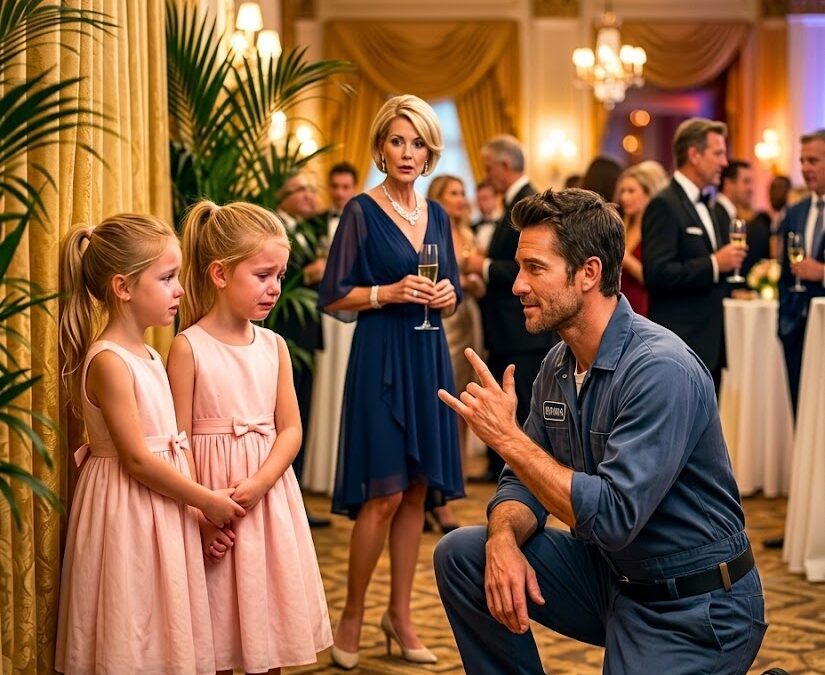
Everyone at the charity gala wanted something from the billionaire CEO. Everyone, that is, except the single father who noticed two little girls sitting alone in the corner.
The ballroom glittered beneath enormous crystal chandeliers. Waiters carried silver trays between tables, cameras flashed, and wealthy guests laughed over glasses of champagne.
At the center of it all stood Alexander Whitmore, the powerful CEO of Whitmore Industries. His name appeared on skyscrapers, hospital wings, and university buildings across the country. He was a man accustomed to commanding attention.
Yet tonight, the most important people in his life were being ignored.
His six-year-old twin daughters, Emma and Sophie, sat beside a tall window overlooking the city. Emma wore a pale blue dress, while Sophie had chosen a pink one decorated with tiny silver stars.
Both girls were deaf.
They communicated through sign language, expressive faces, and the little gestures they had developed together since birth. Their father had hired excellent caregivers and arranged the best education money could provide, but he had never been able to buy the one thing his daughters wanted most.
Friends.
At previous events, adults smiled awkwardly at the girls before turning away. Other children tried to speak to them, grew confused when they received no spoken response, and wandered off to find someone else.
Tonight was no different.
A little girl approached Emma and Sophie, stared at their moving hands, and asked her mother why they were waving strangely.
The mother quickly pulled her daughter away.
Emma lowered her hands.
Sophie looked at her sister and signed, “Let’s go home.”
Emma nodded.
Across the ballroom, Alexander saw the exchange. His jaw tightened, but before he could reach his daughters, a board member stopped him to discuss an important acquisition.
“Alexander, we need to talk about the Singapore deal.”
He glanced toward the window.
“I’ll be back in a minute.”
But in a room full of people who wanted his attention, that minute stretched into ten.
And then something unexpected happened.
A man in a slightly worn black suit entered the ballroom with a young boy holding his hand. He wasn’t dressed like the wealthy executives or polished investors surrounding the stage. His shoes were clean but old, and his jacket had clearly been repaired near one sleeve.
His name was Daniel Carter.
Daniel was a single father who worked as a maintenance technician at a nearby community center. He had been invited because the center was one of the organizations receiving donations from the gala. His eight-year-old son, Noah, had begged to attend after learning there would be a children’s art exhibition.
Daniel had almost declined the invitation. He couldn’t afford a new suit, and he knew very little about wealthy people’s social rules.
But Noah had worked hard on a painting for the charity auction.
So Daniel had come.
As they crossed the ballroom, Noah noticed the twin girls sitting alone.
“Dad,” he whispered, “why aren’t those girls playing with anyone?”
Daniel followed his son’s gaze.
He watched Emma sign something to Sophie. Sophie responded with a quick movement of her hands, and both girls smiled briefly before falling silent again.
Daniel stopped walking.
He recognized their language.
Years earlier, his younger sister Lily had lost her hearing after a serious illness. Daniel had spent years learning sign language so he could communicate with her. Even after Lily moved away for university, he continued practicing because he never wanted to forget how to speak with her in the language that made her feel understood.
He looked at Noah.
“Would you like to say hello to them?”
Noah nodded.
Daniel walked toward the window, keeping his movements slow so he wouldn’t startle the girls.
Then he crouched to their eye level.
He raised one hand and signed a simple greeting.
“Hello. My name is Daniel.”
Emma froze.
Sophie turned so quickly that the ribbon in her hair slipped over her shoulder.
For a moment, neither girl moved.
They stared at the man in front of them as if they couldn’t believe what they were seeing.
Then Emma lifted both hands.
“You know sign language?”
Daniel smiled and signed back.
“A little. But I’m still learning.”
Sophie immediately began signing a question.
“Does your son know it too?”
Daniel glanced at Noah, who was watching curiously.
“He knows some,” Daniel signed. “Would you like to teach him more?”
The girls exchanged a look.
Then something happened that Alexander Whitmore hadn’t seen at a single social event in six years.
His daughters laughed.
Not the polite little smiles they offered adults who tried to communicate with them. Not the quiet laughter they shared when they were alone in their bedroom.
This was genuine, unrestrained happiness.
Noah sat down beside them and opened his sketchbook. He showed them a drawing of a dragon wearing a crown.

Emma signed that the dragon looked ridiculous.
Sophie signed that it looked like their father’s morning hair.
Daniel laughed so hard that he had to cover his mouth.
Noah didn’t understand every sign, but he understood the laughter. He pointed at the drawing and declared that the dragon was a king, so its hair was supposed to look magnificent.
The girls laughed again.
Across the ballroom, Alexander finally noticed.
He excused himself from the board members and walked toward the window.
When he arrived, he found a stranger sitting on the carpet beside his daughters while his son showed them drawings.
For a few seconds, Alexander simply watched.
Emma was talking with her hands faster than he had ever seen her do with someone outside their family. Sophie was leaning forward, completely absorbed in Noah’s story.
Then Emma noticed her father.
She immediately signed, “Daddy! He speaks our language!”
Alexander looked at Daniel.
“You know sign language?”
Daniel stood politely.
“Yes, sir. My sister is deaf. I learned when we were children.”
Alexander extended his hand.
“Alexander Whitmore. These are my daughters.”
Daniel shook his hand.
“I know who you are, sir.”
Alexander gave a small, embarrassed smile.
“I imagine you do.”
Then he looked back at the girls.
“Are you having fun?”
Sophie signed enthusiastically.
“Daniel understands us!”
Emma added, “And Noah wants to learn!”
Alexander felt something tighten in his chest.
He had spent years paying for specialists, private tutors, accessible classrooms, and every resource he could find. He had fought insurance companies and challenged school administrators when they failed to accommodate his daughters.
He loved them fiercely.
But in that moment, he realized something painful.
He had worked so hard to protect them from a world that didn’t understand them that he had sometimes forgotten how desperately they wanted to be part of it.
Money had given them comfort.
It hadn’t guaranteed connection.
And a man whose suit was worth less than the cost of Alexander’s watch had given his daughters something priceless with just one word.
Hello.
Over the following weeks, Alexander found himself thinking about Daniel and Noah more often than he expected.
He learned that Daniel worked long shifts maintaining buildings at the community center. He raised Noah alone after his wife died from an illness several years earlier.
Daniel never spoke about his hardships unless someone asked. He packed Noah’s lunch every morning, helped with homework after work, and spent weekends volunteering at a program that introduced children to sign language.
He wasn’t wealthy, influential, or particularly well connected.
But he had something Alexander admired: the ability to notice people whom everyone else overlooked.
Alexander eventually invited Daniel and Noah to visit his home for lunch.
Daniel almost refused.
“I appreciate the invitation,” he told Alexander over the phone, “but I don’t want you to feel obligated to repay me for being kind to your daughters.”
Alexander was quiet for a moment.
“Daniel, I’m not inviting you because I owe you something. I’m inviting you because my daughters haven’t stopped talking about Noah since the gala.”
That was enough to change Daniel’s mind.
When Daniel and Noah arrived at the Whitmore residence, Emma and Sophie were waiting at the front door.
They ran toward Noah, signing greetings so quickly that he could barely follow.
Noah grinned and held up both hands.
“I learned something new!”
He signed, a little clumsily, “I am happy to see you.”
Emma applauded.
Sophie corrected the position of his fingers, and Noah tried again.
Daniel watched them with a quiet smile.
For the first time in a long while, the Whitmore home was filled with the kind of excitement that couldn’t be scheduled or purchased.
The children spent the afternoon drawing, playing board games, and teaching one another new signs. Alexander watched from the doorway as his daughters moved freely between spoken conversation, gestures, and laughter.
Later, while the children played in the garden, Alexander found Daniel standing beside the kitchen window.
“I need to tell you something,” Alexander said.
Daniel turned.
“Of course.”
“I’ve spent most of my life believing that if I worked hard enough, I could solve almost any problem. If something was broken, I fixed it. If a company was failing, I rebuilt it. If my daughters needed something, I found the best people and the best resources.”
He paused, looking toward the garden.
“But I couldn’t figure out how to make people see them the way I see them.”
Daniel listened without interrupting.
Alexander continued.
“I thought I was giving them every opportunity. And I was. But I never realized how often people stopped trying to communicate with them simply because it was unfamiliar.”
Daniel nodded gently.
“Sometimes people aren’t cruel, Mr. Whitmore. Sometimes they’re just uncomfortable with what they don’t understand. The problem is that your daughters are the ones who end up paying for that discomfort.”
Alexander lowered his eyes.
“That’s exactly what I’ve been afraid of.”
Daniel placed a hand on his shoulder.
“Then help them understand. Don’t make your daughters feel like they have to apologize for being different.”
Those words stayed with Alexander long after Daniel and Noah went home.
Three months later, Whitmore Industries announced a new partnership with local schools and community organizations to expand access to sign-language education.
The company funded free introductory classes for families, supported accessible children’s programs, and worked with deaf educators to develop resources for teachers and students.
At the announcement, reporters asked Alexander why he had chosen to support the initiative.
He could have mentioned business strategy, community investment, or corporate responsibility.
Instead, he told them about two little girls sitting alone beside a window.
He told them about a single father who had noticed them when an entire ballroom had looked past them.
And he told them about one small greeting that had changed the way he thought about inclusion.
“We often talk about giving people a voice,” Alexander said. “But sometimes, the first thing we need to do is learn how to listen. And sometimes listening means learning a language that someone else can use to meet us halfway.”
Daniel attended the event with Noah, sitting quietly near the back of the room.
When Alexander finished speaking, Emma and Sophie hurried onto the stage.
They took their father’s hands and signed something to him.
Alexander smiled, his eyes growing moist.
A reporter asked what the girls had said.
He looked at his daughters.
“They said they’re happy their friends are here.”
Noah waved from the audience.
Emma and Sophie waved back.
Then, together, the three children signed a message for the cameras.
“Everyone belongs.”
Years later, Emma and Sophie would remember many things about their childhood: the beautiful house, the family holidays, the school celebrations, and the countless opportunities their father had worked so hard to provide.
But when someone asked them about the moment they first realized the world could be a little kinder than they had imagined, they always remembered the charity gala.
They remembered the crowded ballroom.
The adults who smiled briefly before walking away.
The children who didn’t know how to talk to them.
And the man who walked across the room, crouched beside them, and signed one simple word.
“Hello.”
He hadn’t arrived with a business proposal.
He hadn’t asked their father for a favor.
He hadn’t cared about their last name or their family’s fortune.
He had simply seen two children who wanted someone to talk to.
And he had chosen to be that person.
In the end, Daniel Carter didn’t change the world with his wealth, influence, or power.
He changed a little piece of it by making two girls feel that they belonged.
And sometimes, that is where every meaningful change begins.
Because the most powerful thing you can give another person isn’t always money, opportunity, or advice. Sometimes, it’s the simple reassurance that they are worth the effort of being understood. ❤️
You Might Also Enjoy



Manchester United finalising deal to appoint Mauricio Pochettino as Carrick replacement

Single Dad Took Two Bullets Saving the Army General’s Daughter — “Move, I’ll Handle This!”

They Tried to Take the Stray Puppy—Then the Quiet Nurse Realized Why the K9 Needed Him