My Pregnant Wife Gave Me Everything in Our Divorce, Until Our Six-Year-Old Son Walked Into Court
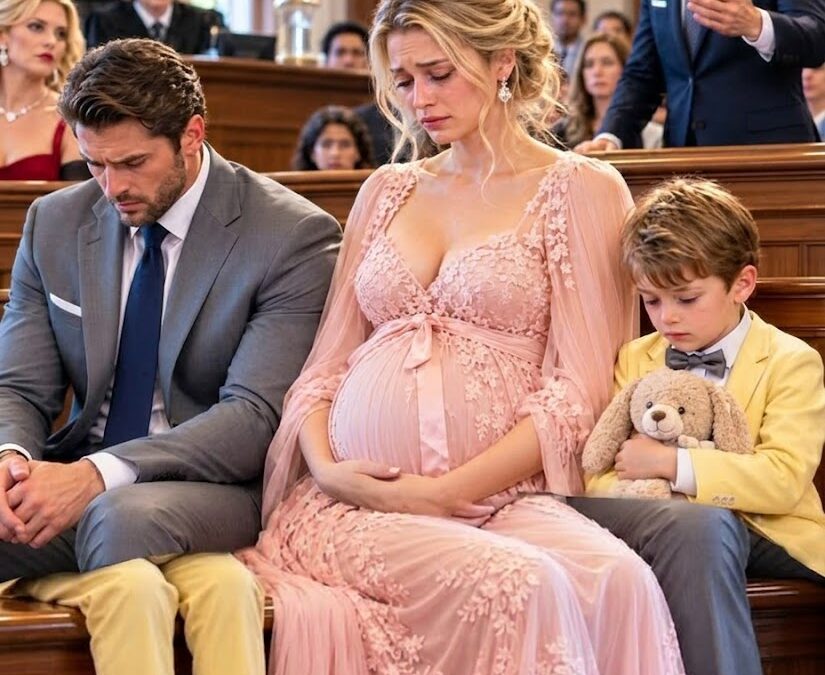
My Pregnant Wife Gave Me Everything in Our Divorce, Until Our Six-Year-Old Son Walked Into Court
The day my wife gave me everything, I thought I had won.
I was wrong.
The divorce hearing began at 9:00 a.m. on a cold Monday morning. Outside the courthouse, rain slid down the tall windows, turning the city into a blur of gray buildings and headlights.
Inside Courtroom 304, I sat beside my attorney in a suit that cost more than most people earned in a month.
Across the aisle sat my wife, Emily.
She was thirty-four weeks pregnant.
Her hands rested gently over her swollen belly. She wore a simple blue dress, flat shoes, and no jewelry except the thin gold wedding band she had refused to remove until that morning.
She looked exhausted.
But what disturbed me most was that she didn’t look angry.
She didn’t even look sad.
She looked as though she had already said goodbye.
My attorney leaned toward me.
“Everything is going according to plan, Daniel. The house, the investment accounts, the company shares—she’s agreed to leave all of it to you.”
I glanced at Emily.
For seven years, she had been my wife. She had stood beside me when I started my construction company in a rented garage with three employees and a mountain of debt.
She had helped me manage the books, entertained clients when I couldn’t afford a professional team, and sold her grandmother’s diamond earrings to keep our business alive during its first difficult year.
Now I was a millionaire.
And I was divorcing her.
Not because she had betrayed me.
Not because she had stopped loving me.
But because I had convinced myself that I deserved a different life.
A younger woman named Vanessa had entered my world eight months earlier. She was charming, ambitious, and always impressed by the things Emily had long ago stopped mentioning: my car, my watch, my business, my money.
With Vanessa, I felt successful.
With Emily, I felt reminded of the years when I had been nobody.
And instead of being grateful to the woman who had loved me when I had nothing, I began resenting her for remembering it.
When Emily discovered the affair, she didn’t scream.
She didn’t throw my clothes into the street.
She simply asked me one question.
“Daniel, if we lost everything tomorrow, would you still want to be married to me?”
I couldn’t answer.
Three days later, she asked for a divorce.
And now, in the courtroom, she was giving me everything.
The judge adjusted his glasses.
“Mrs. Carter, I want to make sure you understand the terms of this agreement. You’re relinquishing your claim to the marital residence, the majority of the financial assets, and your husband’s business interests.”
“Yes, Your Honor.”
“You understand that you may be entitled to a substantial portion of these assets?”
“Yes.”
“Then why are you agreeing to this arrangement?”
Emily glanced at me.
For a moment, I thought she might finally tell the court what I had done.
Instead, she answered quietly.
“Because I don’t want to spend the rest of my life fighting someone who no longer wants to be my husband.”
I shifted in my seat.
The judge wasn’t satisfied.
“And what about your children? You have a six-year-old son, and you’re expecting another child.”
“I want our children to have stability,” she said. “I want them to know they are loved. That’s all.”
My attorney smiled faintly.
The judge did not.
“Very well. Before I approve this agreement, I want to confirm that both parties understand their obligations regarding custody and child support.”
My attorney stood.
“We have reached a proposed agreement, Your Honor. My client is willing to provide support for both children.”
Emily’s lawyer rose slowly.
“Your Honor, my client has one additional request.”
The judge looked toward her.
“What is it?”
“She would like her six-year-old son to address the court.”
I frowned.
Our son?
Noah was supposed to be at school.
“What?” I whispered to my attorney.
He looked equally surprised.
“I wasn’t informed of this.”
Across the courtroom, Emily finally looked nervous.
Not for herself.
For Noah.
The courtroom doors opened.
And my six-year-old son walked in.
He wore his little navy school uniform, white sneakers, and a red backpack that looked almost too big for his small shoulders.
Our housekeeper, Mrs. Wilson, followed behind him.
Noah looked around the room until he found me.
“Daddy?”
I stood instinctively.
“What are you doing here, buddy?”
He didn’t answer.
He walked toward the judge’s bench, holding a folded piece of paper in both hands.
When he passed his mother, he stopped.
Emily reached for him.
Noah hugged her around the waist, careful not to press against her belly.
Then he whispered something in her ear.
She closed her eyes.
And began to cry.
I had seen Emily cry only twice in seven years.
The first time was when her father died.
The second was when our son was born prematurely and spent eleven days in intensive care.
I had never seen her cry like this.
Noah turned toward the judge.
“Excuse me, sir,” he said in a small voice. “My mommy told me I shouldn’t interrupt grown-ups. But I need to ask something before you let my daddy take everything.”
The entire courtroom fell silent.
The judge leaned forward.
“Of course, son. What’s your name?”
“Noah Carter.”
“And what would you like to ask?”
Noah looked at me.
Then he unfolded the paper.
It was a drawing.
A crooked little house stood in the middle of the page. Three stick figures stood outside it: a tall man, a woman with a round belly, and a small boy holding both their hands.
Above them, in uneven blue letters, Noah had written:
OUR FAMILY.
He held it up.
“My daddy says this house belongs to him now,” Noah began. “And Mommy says that’s okay because she wants us to be happy.”
My throat tightened.
“But I don’t understand something.”
The judge waited.
“If Daddy gets the house, does that mean Mommy has to leave?”
“Noah,” Emily whispered, “sweetheart—”
He shook his head.
“Mommy, you said I could tell the truth.”
Then he faced the judge again.
“My mommy sleeps in my room sometimes because she says the baby kicks too much at night. And when Daddy doesn’t come home, she tells me he’s working hard to take care of us.”
He paused.
“But I heard Daddy on the phone last week.”
I felt every muscle in my body go rigid.
Noah continued.
“He said he didn’t want to pay for two families.”
My attorney lowered his eyes.
I stared at my son, unable to speak.
“I don’t know what two families means,” Noah said. “But I know Mommy cries in the bathroom when she thinks I’m asleep.”
Emily covered her mouth.
“And I know she sold her pretty necklace last month because she said we needed to save money.”
I remembered the necklace.
It had belonged to her grandmother.
I had asked where it went.
Emily had told me she had put it away.
I had never asked again.
Noah looked down at his drawing.
“I don’t care who gets the big house, Your Honor. I don’t care about Daddy’s cars or his office.”
He lifted his head.
“I just want my mommy to have a home where she doesn’t have to cry.”
The courtroom became so quiet that I could hear the rain against the windows.
Then Noah said the words that would haunt me for the rest of my life.
“And if Daddy doesn’t want Mommy anymore, can I give her my room?”
I couldn’t breathe.
My son was six years old.
He should have been worrying about spelling tests, scraped knees, and whether he would get a bicycle for Christmas.
Instead, he was standing in a courtroom trying to protect his pregnant mother from the consequences of my choices.
The judge removed his glasses.
“Mr. Carter,” he said, looking directly at me, “would you like to respond?”
I stood.
For the first time in years, I had no prepared answer.
No negotiation strategy.
No attorney whispering the right words in my ear.
I looked at Emily.
She was crying silently, one hand on her belly and the other reaching toward our son.
I looked at Noah.
He was waiting for me to explain why the family he had drawn was disappearing.
And I realized something terrible.
I had spent months convincing myself that Emily wanted my money.
That she was holding on to the marriage because of the lifestyle I provided.
That she would be better off with a generous settlement and a clean break.
But she had just offered me everything.
And our six-year-old son was the only person in the room who understood how little that meant.
I turned toward the judge.
“Your Honor, I need to withdraw my agreement.”
My attorney grabbed my sleeve.
“Daniel, don’t do this without discussing it with me.”
I gently pulled my arm free.
“I said I need to withdraw it.”
The judge’s expression hardened.
“This court is not a place for emotional theatrics, Mr. Carter. What exactly are you asking for?”
I looked at Emily.
“I want the agreement reviewed. I want her to have independent legal advice about what she’s giving up. And I want to make sure our children are provided for fairly.”
Emily stared at me as though she no longer recognized my face.
Perhaps she didn’t.
I barely recognized myself.
Then I turned to Noah.
“Buddy, can I tell you something?”
He nodded.
“I was wrong to make you think that your mommy had to leave because of me.”
His lower lip trembled.
“Is Mommy going to lose the house?”
I knelt in front of him.
“No. And you should never have had to worry about that.”
He studied my face.
“Are you still going to marry Vanessa?”
The question struck harder than anything the judge could have said.
I looked at my son.
Then at the woman who had carried him, raised him, and protected him even when I had given her every reason to stop protecting me.
“No,” I whispered. “I’m not.”
Noah didn’t smile.
He didn’t throw his arms around me.
He simply returned to his mother and took her hand.
That hurt more than if he had shouted at me.
Because my son hadn’t stopped loving me.
He had simply learned that loving someone didn’t mean trusting them.
And I had taught him that lesson.

The Secret Emily Had Never Told Me
The judge postponed the hearing and ordered both parties to obtain independent legal advice before proceeding with the proposed settlement.
Afterward, I found Emily sitting alone in a small room outside the courtroom.
Noah was with Mrs. Wilson in the hallway.
Emily looked up when I entered.
“Please don’t make this harder than it already is, Daniel.”
I sat across from her.
“Why were you giving me everything?”
She looked toward the window.
“Because I wanted to leave without another fight.”
“That’s not an answer.”
“It’s the only one I have.”
“Emily, you built this company with me. You sacrificed everything when we had nothing. Why would you walk away with nothing now?”
She gave a tired smile.
“Because I don’t want our children growing up watching their parents destroy each other over money.”
I swallowed.
“You could have asked for half.”
“I know.”
“You could have taken the house.”
“I know.”
“You could have made me pay for what I did.”
At that, she finally looked at me.
“Daniel, you think the worst thing you did was have an affair.”
I said nothing.
“But the worst thing you did was make me feel that eleven years of loving you were worth less than eight months of being admired by someone who barely knew you.”
I lowered my head.
She continued.
“When I found out about Vanessa, I waited for you to tell me the truth. I waited for you to apologize. I waited for you to remember the person you were before money became more important than everything else.”
Her eyes filled with tears.
“But you came home and told me I was being unreasonable.”
I remembered that conversation.
I had told her that every successful man had distractions. I had told her that she should be grateful for the life I provided.
I had actually used those words.
The life I provide.
As if our life had been a gift I had given her rather than something we had built together.
Emily wiped her cheek.
“I didn’t want your money, Daniel. I wanted my husband.”
For a long time, neither of us spoke.
Then she reached into her handbag and removed a small envelope.
“There is something you should know.”
Inside was a photograph from a medical appointment.
A tiny face appeared on the ultrasound image.
Our unborn child.
Beneath it was a handwritten note from the doctor confirming that the pregnancy required additional monitoring.
I stared at the image.
“Is something wrong with the baby?”
“Not necessarily. The doctor wants me to rest and attend regular appointments. But I’ve been under a lot of stress.”
“Why didn’t you tell me?”
She gave me a look that answered the question before she spoke.
“When was the last time you asked how I was feeling and waited long enough to hear the answer?”
I couldn’t remember.
Not honestly.
“I was going to tell you about the appointment,” she continued. “Then you said you had an important meeting. I saw the photograph of Vanessa that evening.”
I closed my eyes.
The appointment had been on a Thursday.
I remembered that day.
I had been celebrating a business deal with Vanessa at a restaurant across town.
Emily had called twice.
I had sent her to voicemail.
“I didn’t know,” I whispered.
“You didn’t ask.”
Those three words stayed between us.
You didn’t ask.
I had spent seven years asking the world to admire me.
I had forgotten to ask the woman who loved me whether she was all right.
Six Months Later
Our daughter, Grace, was born on a quiet Sunday morning in April.
I was in the hospital when it happened.
Not because Emily had forgiven me.
Not because we had reconciled.
But because she had agreed that I could be present for the birth, provided I respected her boundaries.
When the nurse placed Grace in Emily’s arms, I stood beside the bed and cried.
She was tiny, with dark hair and a furious little cry.
Noah stood on a chair beside his mother, staring at his sister in wonder.
“She’s so small,” he whispered.
Emily smiled.
“That’s because she’s a baby.”
“Can I hold her?”
“Of course. Sit down first.”
The nurse helped him settle into a chair, then carefully placed Grace in his arms.
Noah looked at her with the seriousness of someone who had been given the most important responsibility in the world.
“Hi, Grace,” he whispered. “I’m your big brother.”
Then he looked at me.
“Daddy, are you going to stay?”
The room went still.
I could have promised him everything.
I could have told him that I would never leave again, that I would make every mistake right, that our family would be whole.
But I had learned that promises were easy.
Keeping them was the difficult part.
“I’m going to keep showing up,” I said. “Even when it’s hard. Even when Mommy and I disagree. And even when I don’t get what I want.”
Noah considered that.
Then he looked down at his sister.
“Okay.”
It wasn’t forgiveness.
It was an opportunity.
And I knew I had to earn it.
Emily and I did not get back together that spring.
We continued working through our divorce with separate attorneys. We arranged a parenting schedule, established financial support for both children, and agreed that neither of us would use them to punish the other.
I moved into a smaller house closer to Noah’s school.
I attended his soccer games.
I learned how to make his favorite pancakes.
I took Grace to her pediatric appointments when it was my turn, and I learned that babies did not care how much money their fathers made.
They cared whether someone came when they cried.
Some days, Emily and I spoke easily.
Other days, we could barely manage a conversation without remembering what had happened.
I stopped asking when she would forgive me.
I stopped buying expensive gifts to make up for the things I had done.
And I stopped telling myself that providing money was the same as being a good father.
One afternoon, nearly a year after the courtroom hearing, I arrived at Emily’s house to pick up the children.
Noah ran to the door carrying a drawing.
“Daddy! Look!”
It was another picture of our family.
This time, there were four people.
Emily.
Me.
Noah.
And little Grace, drawn as a tiny pink circle in her mother’s arms.
But something was different.
Between Emily and me, Noah had drawn a dotted line.
I stared at it.
“What’s this, buddy?”
He shrugged.
“That’s where you live at your house and Mommy lives at hers.”
My chest tightened.
“Do you like it?”
He thought for a moment.
“I like when you both come to my school things.”
I nodded.
“Me too.”
Then he took my hand.
“You’re still my daddy, even if you don’t live with us, right?”
I knelt and pulled him into my arms.
“Always.”
He hugged me tightly.
And for the first time, I understood that being a family did not always mean getting the ending you wanted.
Sometimes it meant accepting the consequences of what you had done, protecting the people you had hurt, and learning to love them without demanding that they return to the life you had broken.
Emily had given me everything in our divorce because she believed peace was worth more than possessions.
Our six-year-old son had walked into court because he believed his mother deserved a home where she could stop crying.
I had entered that courtroom thinking I was the winner.
I left understanding that I had nearly lost the only things that had ever made my life meaningful.
And although Emily never promised to take me back, she gave me something I had not earned but desperately needed:
The chance to become a father my children could trust.
The day my son walked into court, he didn’t save my marriage. He saved me from believing that money, success, and winning an argument mattered more than the people who loved me.
And that was the first day I began to understand what it really meant to be a husband, a father, and a man.
=
You Might Also Enjoy



Manchester United finalising deal to appoint Mauricio Pochettino as Carrick replacement

Single Dad Took Two Bullets Saving the Army General’s Daughter — “Move, I’ll Handle This!”

They Tried to Take the Stray Puppy—Then the Quiet Nurse Realized Why the K9 Needed Him



