The Mafia Boss Called His Wife’s Scarf a “Rag” and Had It Torn Apart—Then She Left Him Forever
The Mafia Boss Called His Wife’s Scarf a “Rag” and Had It Torn Apart—Then She Left Him Forever
Chapter 1: The Scarf He Destroyed
The night Alessandro Moretti destroyed his wife’s scarf, he had no idea he was destroying the last piece of love she had left for him.
The grand ballroom of the Moretti mansion glittered beneath crystal chandeliers. Hundreds of guests had gathered for Alessandro’s thirty-eighth birthday celebration. Politicians, businessmen, and powerful figures from New York’s underworld filled the room, laughing over expensive champagne while armed guards watched every entrance.
At the center of it all stood Alessandro Moretti, the city’s most feared mafia boss.
Tall, handsome, and dressed in a perfectly tailored black suit, he carried himself like a man who had never been denied anything in his life.
Beside him stood his wife, Isabella.
She wore a simple midnight-blue dress and a delicate silver necklace. Unlike the other women in the ballroom, she had chosen no extravagant diamonds, no designer gown covered in crystals, and no jewelry that screamed for attention.
Around her neck was a faded cream-colored scarf.
It was old.
The edges were slightly frayed, and a tiny patch near one corner showed where someone had carefully repaired it by hand.
But Isabella treasured it more than all the diamonds in Alessandro’s vault.
It had belonged to her mother.
Her mother had knitted it during the final winter of her life, when money was scarce, the heating in their small apartment barely worked, and Isabella was still a little girl who believed her mother’s embrace could protect her from anything.
Before she died, her mother had wrapped the scarf around Isabella’s neck and whispered, “Whenever you feel alone, sweetheart, remember that someone loved you enough to make this with her own hands.”
Isabella had carried those words through every difficult year of her life.
And on the night she married Alessandro, she had worn the scarf beneath her wedding veil.
It was the only thing she had from the woman who raised her.
Unfortunately, Alessandro had never understood its importance.
He glanced at it as Isabella greeted an elderly guest.
Then he frowned.
“Isabella.”
She turned toward him.
“Yes, darling?”
“What on earth are you wearing?”
She instinctively touched the scarf.
“My mother’s scarf. You know that.”
Alessandro looked at it with open disgust.
“It’s my birthday, and you walk into my ballroom wearing that thing?”
A few nearby guests fell silent.
Isabella’s smile faltered.
“It’s cold outside. I thought—”
“You thought what?” he interrupted. “That this is some little family gathering?”
She lowered her voice.
“Please, Alessandro. Not here.”
He laughed bitterly.
“Look around you, Isabella. Do you see anyone else wearing rags?”
The word struck her harder than she expected.
Rags.
For three years, she had endured his dismissive remarks, his canceled dinners, and the nights he returned home smelling of expensive whiskey while refusing to explain where he had been.
She had told herself that he was under pressure.
That his business was dangerous.
That beneath his cold exterior was the man who had once held her hand beneath a streetlamp and promised that she would never have to feel alone again.
She had made excuses for him because she loved him.
But tonight, surrounded by strangers, he had called the last gift from her dead mother a rag.
“Alessandro,” she whispered, “please don’t insult something you don’t understand.”
His expression hardened.
“Don’t tell me what I can and cannot say in my own house.”
He turned toward two security guards standing nearby.
“Take that thing off her.”
Isabella stared at him.
“What?”
“You heard me.”
The guards hesitated.
One of them glanced at Isabella, clearly uncomfortable.
Alessandro’s voice rose.
“Now!”
With trembling fingers, Isabella reached for the scarf.
But before she could remove it, Alessandro grabbed one end.
“Let me show you what belongs in this house.”
He yanked it from her neck.
The sudden movement made her stumble backward.
“Alessandro, please!”
He ignored her.
Holding the scarf between two fingers as though it were contaminated, he turned toward his guards.
“Get rid of it.”
One guard stepped forward.
“Sir, perhaps we should—”
Alessandro’s eyes flashed.
“Did I ask for your opinion?”
The guard took the scarf.
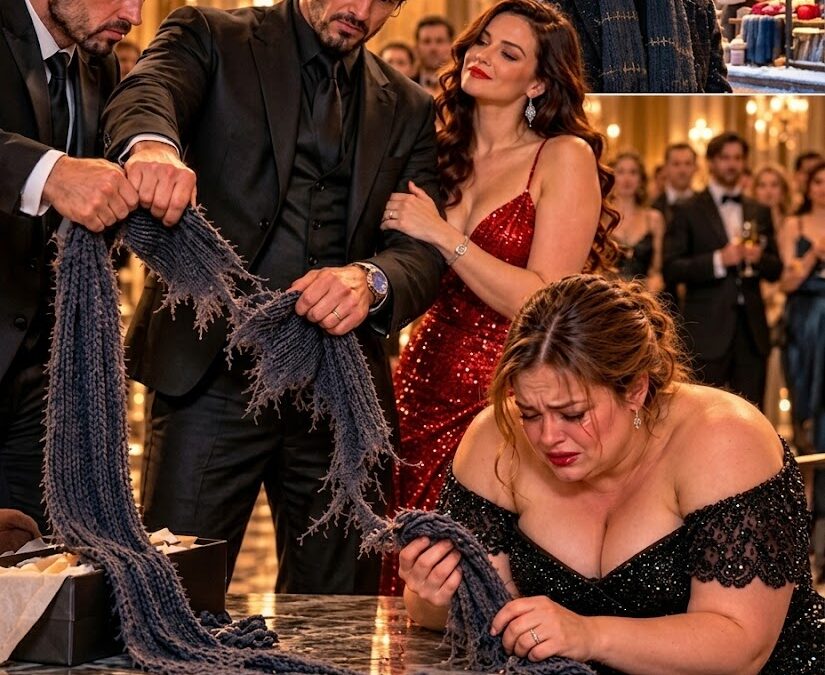
Then, under the horrified gaze of the guests, he pulled at the delicate fabric while another guard helped tear it apart.
The old stitches gave way.
The repaired corner ripped.
A tiny wooden button that Isabella’s mother had sewn into one end fell to the marble floor.
And then the scarf was destroyed.
Isabella stood motionless.
She couldn’t hear the music anymore.
She couldn’t hear the whispers spreading through the ballroom.
All she could see was the torn cream-colored fabric lying beneath the crystal chandelier.
Her mother’s last gift.
Gone.
Alessandro turned back toward her, apparently satisfied.
“There. Now you look appropriate.”
Isabella slowly lifted her eyes.
For the first time in three years, she didn’t look at him with affection.
She didn’t look at him with disappointment, either.
She looked at him as though she had finally met a stranger.
“Thank you,” she whispered.
Alessandro frowned.
“For what?”
She bent down, picked up the small wooden button, and closed her fingers around it.
“For showing me who you really are.”
Then she walked out of the ballroom.
And for the first time that night, Alessandro felt something he couldn’t explain.
A strange, uncomfortable sensation in his chest.
But he dismissed it.
He was Alessandro Moretti.
Men feared him. Women admired him. Everyone eventually came back when he called.
His wife would be no different.
Or so he believed.
Chapter 2: The Empty Bedroom
At midnight, Alessandro returned to the master bedroom expecting to find Isabella waiting for him.
She wasn’t there.
Her jewelry remained on the dressing table. Her perfume stood beside the mirror. The white roses he had ordered for her that morning were still arranged in a crystal vase.
But her side of the wardrobe was empty.
Alessandro stopped.
He opened the closet again.
Every dress was gone.
Every pair of shoes.
Every handbag.
Even the old photographs she used to keep beside her bed had disappeared.
“What the hell?”
He stormed into the hallway.
“Marco!”
His right-hand man appeared almost immediately.
“Yes, boss?”
“Where is my wife?”
Marco hesitated.
“Mrs. Moretti left about forty minutes ago.”
“Left where?”
“She took a car to the train station.”
Alessandro stared at him.
“The train station?”
“Yes, sir.”
“Why didn’t you stop her?”
Marco’s expression remained carefully neutral.
“Because she asked us not to.”
Alessandro’s face darkened.
“She asked you not to?”
“She said she didn’t want anyone to get into trouble.”
For several seconds, Alessandro said nothing.
Then he laughed.
It was a cold, disbelieving sound.
“She expects me to chase her?”
Marco didn’t answer.
Alessandro grabbed his phone and called Isabella.
It rang.
Once.
Twice.
Then the call went to voicemail.
He called again.
Nothing.
He sent a message.
Come home. We’re going to discuss your behavior tonight.
No reply.
Another message followed.
Isabella, stop acting like a child.
Still nothing.
At one-thirty in the morning, he called her for the fifth time.
Her phone was switched off.
Alessandro threw his phone onto the bed.
“She’ll be back tomorrow.”
Marco remained silent.
Alessandro pointed toward the door.
“Get out.”
The older man obeyed.
But as he walked away, he glanced at the empty bedroom and felt a deep sadness he couldn’t explain.
He had worked for Alessandro for fifteen years.
He had seen him threaten powerful men, destroy businesses, and walk away from gunfights without showing fear.
But he had never seen his boss look so unsettled over an empty room.
Because Marco knew something Alessandro did not.
Isabella had not left in anger.
She had left after making a decision.
And a woman who finally stops begging to be loved is sometimes far more difficult to bring back than one who leaves screaming.
The next morning, Alessandro woke up alone.
At first, he didn’t care.
He dressed for work, drank his coffee, and reviewed the reports waiting on his desk.
Then he noticed the small wooden jewelry box Isabella had kept beside the mirror.
It was gone.
He remembered the button she had picked up from the floor.
For some reason, the image irritated him.
He called the household manager.
“Where did Isabella put her belongings?”
“She packed them herself, sir.”
“Did she leave a note?”
The manager hesitated.
“Yes.”
“Where is it?”
“On your desk.”
Alessandro found a single white envelope beneath his business papers.
His name was written on the front in Isabella’s elegant handwriting.
He opened it.
Inside was a short letter.
Alessandro,
I loved you when you had nothing but a small apartment, a dangerous reputation, and a dream of becoming someone your father could never control.
I loved you when you were frightened, when you doubted yourself, and when you sat beside me at night and admitted that you were tired of being feared.
I loved you when you had no money to buy me gifts and no power to protect me from the world.
I never needed your diamonds. I never needed your mansion. I never needed to be the most important woman in the room.
I only wanted the man who once promised that my heart would always be safe with him.
Last night, you destroyed the last gift my mother ever gave me.
But the scarf was not what broke my heart.
It was the way you looked at me while you destroyed it.
I finally understood that the man I married would never have treated the woman he once loved that way.
Do not look for me because you are angry that I left.
If you ever look for me, I hope it is because you finally understand why I had to go.
Goodbye, Alessandro.
Isabella.
He read the letter once.
Then again.
His jaw tightened.
“Dramatic nonsense.”
He folded the paper and dropped it onto the desk.
“She’ll regret this.”
But that evening, when he entered the dining room and found only one place set at the table, he didn’t touch his food.
And when he went to bed, he found himself staring at the empty pillow beside him.
For the first time in years, the mansion felt unbearably large.
Chapter 3: The Woman Who Started Again
Isabella moved into a small apartment in a quiet town outside Boston.
It had two bedrooms, a narrow kitchen, and windows that looked out onto a little garden.
The heating rattled.
The stairs creaked.
The kitchen cabinets needed repainting.
And for the first time in three years, Isabella felt she could breathe.
She found a job at a local community center, helping organize meals for elderly residents and activities for children whose parents worked long hours.
She didn’t tell anyone that she had once been married to one of the most powerful men in New York.
She simply introduced herself as Isabella.
At first, she struggled.
She missed the familiarity of the mansion, even though it had become a place where she constantly felt lonely.
She missed the man Alessandro had been when they first met.
She missed the way he used to smile at her when she made terrible jokes.
But whenever she began to doubt her decision, she remembered the ballroom.
The laughter.
The torn fabric.
The way he had looked at her as though her mother’s love were something shameful.
And she reminded herself that missing someone didn’t mean she had made the wrong choice.
Three weeks after leaving, Isabella received a call from an unknown number.
She almost ignored it.
Then she answered.
“Hello?”
“Isabella.”
Her heart stopped.
Alessandro.
His voice was unmistakable.
“What do you want?”
There was a long silence.
“Where are you?”
“Somewhere you don’t need to know about.”
“Come home.”
She closed her eyes.
“No.”
“Isabella, I’m not asking you to spend the rest of your life away from me. I’m asking you to come home so we can talk.”
“We talked for three years, Alessandro. You simply never listened.”
His breathing changed.
“I was angry that night.”
“You were cruel.”
“I didn’t mean to hurt you.”
“But you did.”
She heard him exhale sharply.
“It’s a scarf, Isabella.”
The words fell between them like a stone.
For a moment, she couldn’t speak.
Then she answered quietly.
“No, Alessandro. It was my mother.”
He said nothing.
“She knitted it when she could barely afford to keep our apartment warm. She finished it while she was sick because she wanted me to have something that would last after she was gone.”
Isabella wiped away a tear.
“I told you that story on our first Christmas together. You held my hand and said you understood.”
“I remember.”
“Then you called it a rag and ordered your men to destroy it in front of everyone.”
“I was wrong.”
“Yes,” she whispered. “You were.”
He seemed to struggle with his next words.
“Tell me what I have to do to make this right.”
Isabella looked out the window.
A little girl was running through the garden, laughing as her father chased her.
For a moment, she thought of the future she had once imagined with Alessandro.
Then she remembered how lonely she had felt beside him.
“You cannot make it right by giving me another scarf,” she said. “You cannot make it right by buying me a house or filling my wardrobe with diamonds.”
“Then what do you want?”
“I want a life where I don’t have to beg someone to treat me with kindness.”
Her voice trembled.
“I want to be able to love someone without wondering when they’ll humiliate me again.”
“Isabella—”
“Please don’t call me again.”
She ended the call.
Then she sat on the edge of her bed and cried until she could breathe again.
Not because she wanted to go back.
But because walking away from someone you love can hurt even when staying would hurt more.
Chapter 4: The Birthday Gift He Never Opened
A month passed.
Then two.
Alessandro buried himself in work.
He attended meetings, negotiated contracts, and dealt with the endless problems that came with running his organization.
But the mansion had changed.
He no longer heard Isabella singing softly in the kitchen.
No one reminded him to take his medication.
No one left a warm cup of tea beside his desk when he worked late.
No one asked whether he had eaten.
At first, he told himself these things were insignificant.
Then he began noticing them everywhere.
The chair she used to sit in by the window.
The book she had been reading.
The little ceramic bird she had bought at a street market because it reminded her of her childhood home.
He found himself remembering details he had once ignored.
How she always gave the first piece of bread to someone else.
How she remembered the birthdays of his employees’ children.
How she had once stayed up all night beside his mother when the older woman was recovering from surgery.
Isabella had never demanded recognition for any of it.
She had simply loved people.
And he had mistaken that love for something he could take for granted.
One evening, Marco entered his office carrying a small package.
“This arrived at the mansion before Mrs. Moretti left. It was in storage.”
Alessandro opened it.
Inside was a birthday card Isabella had purchased for him months earlier.
The message was simple.
To the man who once made me believe that even the coldest heart could become a home.
I hope this year brings you peace, Alessandro. Not the kind that comes from controlling everything around you, but the kind that comes from finally being at peace with yourself.
I love you.
He sat motionless.
Marco watched him carefully.
“Boss?”
Alessandro’s fingers tightened around the card.
“She wrote this before the party.”
“Yes, sir.”
“She was still planning to stay.”
Marco lowered his eyes.
“Yes.”
Alessandro looked at the empty doorway.
For the first time, he understood that Isabella hadn’t left because she suddenly stopped loving him.
She had left because she had loved him for so long that she had forgotten what it felt like to be loved in return.
And by the time she finally chose herself, there was nothing he could say to make her forget the years she had spent feeling alone.

Chapter 5: The Scarf in the Window
Six months after Isabella left, Alessandro received an invitation to a charity exhibition in Boston.
The event supported a local organization that provided food, clothing, and housing assistance to families in crisis.
He nearly declined.
Then he noticed the name of the organizer.
Isabella Moretti.
He stared at the invitation for a long time.
She was using her married name.
Not because she wanted to return to him, but because she had built something meaningful and refused to let her past dictate what she could accomplish.
Alessandro attended the event without informing her.
The community center was modest compared with his mansion, but it was full of life.
Children painted pictures at small tables. Volunteers prepared food in the kitchen. Elderly residents sat together near the windows, laughing over cups of tea.
And there, near the entrance, stood Isabella.
She wore a simple green dress.
Her hair was pinned loosely behind her head, and she was smiling as she spoke to an elderly woman.
Alessandro hadn’t seen that smile in months.
It was the same smile she had worn when they first met.
Only now, it looked lighter.
Freer.
Then he saw the scarf.
A new cream-colored scarf hung in a glass display beside the entrance.
It wasn’t the original.
The fabric was slightly different, but the edges had been carefully repaired in the same way.
A small wooden button had been sewn into one corner.
Beneath it was a handwritten note:
Made in memory of my mother, who taught me that love is something we give freely, never something we use to control another person.
Alessandro’s chest tightened.
He approached slowly.
Isabella saw him.
Her smile faded, but she didn’t look frightened.
“Alessandro.”
“Isabella.”
For a moment, they simply stood there.
Then she glanced toward the display.
“I made a new one.”
He nodded.
“I can see that.”
“Some of the women here taught me how to work with old fabric. We use donated materials to make scarves for people who need warm clothing in winter.”
She paused.
“My mother would have liked that.”
Alessandro looked at the scarf.
“I destroyed something precious to you.”
“Yes.”
“I told myself it was just a piece of fabric.”
She waited.
“But it wasn’t just fabric,” he continued. “It was your mother. Your childhood. Everything she gave you when she had almost nothing.”
Isabella’s eyes softened slightly, but she said nothing.
Alessandro swallowed.
“I am sorry.”
The words sounded unfamiliar in his mouth.
Not because he had never apologized before.
But because this time, he wasn’t asking for anything in return.
“I know I cannot undo what I did,” he said. “And I know that saying sorry doesn’t mean you have to forgive me.”
Isabella looked at him carefully.
“Why did you come here?”
He could have told her that he missed her.
That the mansion felt empty.
That he couldn’t sleep without thinking about her.
All of those things were true.
But they weren’t the reason he deserved to stand in front of her.
“Because I wanted to see what you were building,” he answered. “And because I wanted to tell you that I’m glad you found somewhere you can be happy.”
Her eyes filled with tears.
For a moment, she looked as though she might say something more.
Then a volunteer called her name from the kitchen.
“I have to go.”
Alessandro nodded.
“Of course.”
She took a step away.
He didn’t stop her.
And that, more than anything, made her pause.
For the first time since she had left him, he wasn’t ordering her to stay.
He wasn’t demanding another chance.
He was letting her go.
Isabella looked back.
“Goodbye, Alessandro.”
He forced himself to smile.
“Goodbye, Isabella.”
She walked toward the kitchen, where children were waiting to help her prepare dinner.
Alessandro remained by the display for several minutes.
Then he left.
He didn’t ask his men to follow her.
He didn’t demand her address.
He didn’t call her that night.
For the first time, he understood that loving someone meant accepting that they could choose a life without you.
And sometimes, the most sincere apology is the one that doesn’t ask for a reward.
Chapter 6: The Man Who Finally Changed
A year later, Alessandro’s mother invited him to dinner.
When he arrived, she was sitting beside the fireplace, knitting a scarf.
He stared at the needles in her hands.
“What are you making?”
“A scarf.”
He looked down.
The yarn was cream-colored.
His mother smiled sadly.
“Your father once called my knitting a waste of time. He thought anything that couldn’t be bought for a high price was worthless.”
Alessandro sat beside her.
“Did you forgive him?”
“Eventually. But forgiveness didn’t mean pretending he hadn’t hurt me. It meant deciding what I needed in order to live peacefully.”
She paused.
“Tell me about Isabella.”
Alessandro looked away.
“I saw her in Boston.”
“And?”
“She seemed happy.”
His mother nodded.
“I’m glad.”
He turned toward her.
“Don’t you want me to bring her home?”
His mother shook her head.
“I want you to become a man who would make a woman feel safe coming home. Whether that woman is Isabella or someone else is not for me to decide.”
Alessandro stared into the fire.
For years, he had believed that being powerful meant making people stay.
Now he understood that love without freedom was simply another kind of prison.
He began making changes.
He removed people from his household staff who had been encouraged to intimidate others.
He established clearer boundaries between his legitimate businesses and his criminal operations.
He began attending counseling sessions, something he had once dismissed as weakness.
And whenever he felt the urge to control a situation through anger, he remembered the ballroom.
The torn scarf.
Isabella’s quiet voice.
Thank you for showing me who you really are.
He couldn’t change the man he had been.
But he could decide what kind of man he would become.
Chapter 7: The Last Letter
Two years after Isabella left, a letter arrived at the Moretti mansion.
It had no return address.
Alessandro recognized the handwriting immediately.
He opened it with trembling fingers.
Alessandro,
I heard about the changes you’ve made. I hope you continue making them, not for me, but because you finally understand that other people are not yours to command.
I have learned a great deal since I left.
I have learned that being alone is not the same as being unwanted.
I have learned that a quiet home can be warmer than a mansion filled with people who are afraid to speak.
I have learned that I can remember the good things about our marriage without pretending the bad things never happened.
And I have learned that I can still love the man you once were while choosing not to return to the man you became.
I don’t hate you, Alessandro.
But I am no longer waiting for you to become the person I need.
I hope you find peace.
Isabella.
He read the letter twice.
Then he folded it carefully and placed it in the drawer beside his desk.
For a long time, he sat alone.
He had spent years believing that if he offered enough money, enough protection, or enough promises, he could repair anything he broke.
But some things could not be bought back.
Trust.
Time.
The quiet confidence of knowing that the person beside you would never deliberately humiliate you.
And sometimes, the consequence of hurting someone was that they learned how to live without you.
Alessandro stood and walked to the window.
Outside, the garden was covered in fresh snow.
He remembered Isabella’s cream-colored scarf, its frayed edges and tiny wooden button.
He remembered the night he had torn it apart because he thought it made her look small.
Now he understood that the scarf had represented something he had never learned to value.
A kind of love that did not need to be expensive to be precious.
A kind of loyalty that could not be demanded.
A kind of dignity that no amount of power could replace.
He closed his eyes.
“I’m sorry, Isabella,” he whispered.
No one heard him.
No one answered.
And for the first time, he didn’t expect the world to forgive him simply because he regretted what he had done.
Epilogue: She Never Came Back
Five years later, Isabella was still living in Boston.
The community center had grown into a respected local charity, providing warm clothing, meals, and emergency assistance to hundreds of families each winter.
Every year, just before the first snowfall, Isabella organized a small gathering where volunteers made scarves for children and elderly residents who couldn’t afford warm clothing.
Above the entrance hung a simple wooden sign:
NO ONE SHOULD HAVE TO EARN KINDNESS.
On the wall inside was a framed photograph of her mother.
Beside it hung the cream-colored scarf she had made all those years ago.
The original had been destroyed.
But Isabella had spent months reconstructing its pattern from memory, using old photographs and the small wooden button she had saved that night.
It wasn’t identical.
Some stitches were uneven.
The fabric was softer, and the edges had been repaired more than once.
But it was hers.
One winter evening, as Isabella wrapped a scarf around a little girl who had arrived without a coat, the child looked up at her.
“Will I have to give it back?”
Isabella smiled.
“No, sweetheart. It’s yours.”
“Even if I get it dirty?”
“Even then.”
“Even if it gets old?”
Isabella gently tucked the scarf beneath the girl’s chin.
“Especially then.”
The girl smiled and ran toward her mother.
Isabella watched them leave, feeling a quiet warmth in her chest.
She had once believed that losing Alessandro meant losing the future she had dreamed of.
Instead, she had discovered a different future—one built from small acts of kindness, honest friendships, and the freedom to be herself.
Far away in New York, Alessandro Moretti continued living with the consequences of his choices.
He had become less cruel, more thoughtful, and more careful with the people who depended on him.
But Isabella never returned.
And eventually, he stopped waiting for her to do so.
Because he finally understood that her leaving had not been a punishment.
It had been her salvation.
The night Alessandro called his wife’s scarf a rag, he believed he was proving his power.
Instead, he destroyed the last thread connecting her to a life in which she had forgotten her own worth.
And when Isabella walked away, she did not leave because she had stopped loving him.
She left because she finally understood that love should never require her to abandon herself.
She left him forever.
And this time, she chose herself.
THE END.
You Might Also Enjoy



Manchester United finalising deal to appoint Mauricio Pochettino as Carrick replacement

Single Dad Took Two Bullets Saving the Army General’s Daughter — “Move, I’ll Handle This!”

They Tried to Take the Stray Puppy—Then the Quiet Nurse Realized Why the K9 Needed Him



