TIME MAY HAVE PROVED XABI ALONSO RIGHT: Real Madrid Begin to Question Their Decision to Back Vinícius Júnior
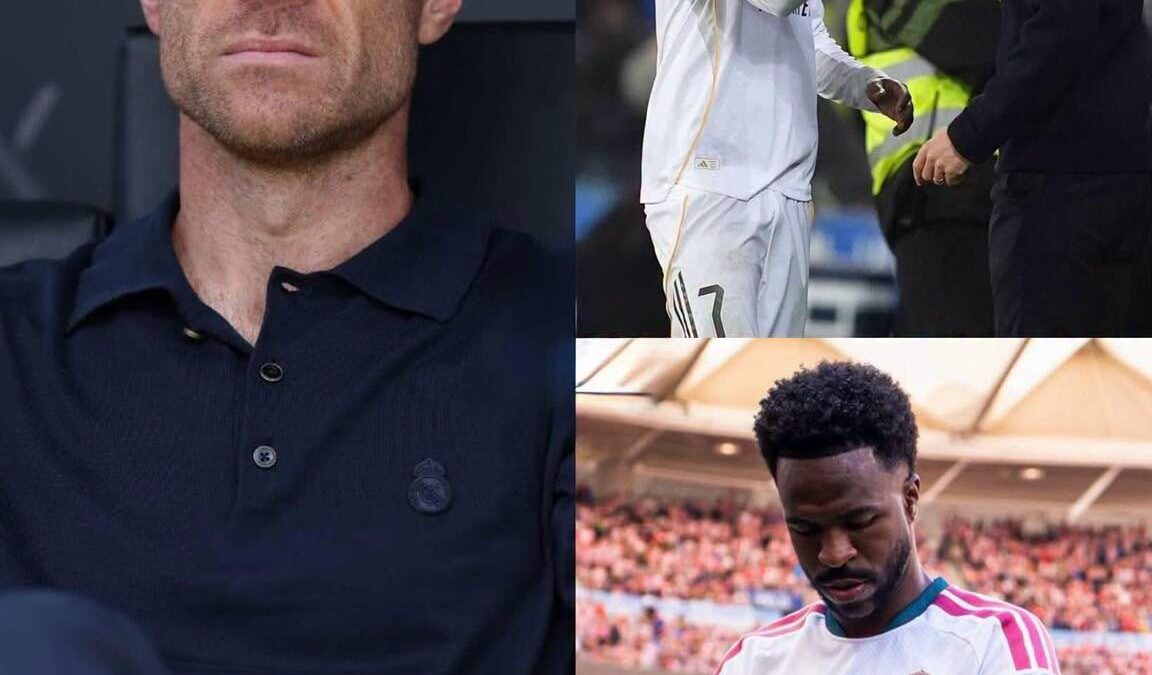
The decision to back Vinícius Júnior over Xabi Alonso may now be attracting renewed scrutiny at Real Madrid, with fresh reports suggesting that concerns about the Brazilian forward’s performances have grown inside the club.
When Alonso reportedly considered dropping Vinícius, the disagreement was about more than one player’s place in the starting lineup. It raised a fundamental question about how Real Madrid should balance the authority of their head coach with the influence and status of one of their biggest stars.
According to El Mundo, people within the club defended Vinícius at the time, arguing that his performances did not justify leaving him on the bench. The club’s hierarchy ultimately sided with the Brazilian, creating a reported rift that contributed to the pressure surrounding Alonso’s position and, eventually, his departure.
Now, the debate has taken on a different meaning.
If the concerns described in the report reflect a wider shift in the club’s thinking, Real Madrid may be reconsidering whether backing the player over the manager was the right decision.
And that puts Alonso’s approach back under the spotlight.
Alonso’s Main Argument Was About Standards, Not Star Power
Alonso’s approach was built around a principle familiar to elite managers: no player should be guaranteed a starting position simply because of his reputation.
During the 2025–26 season, the Spanish coach repeatedly rotated Vinícius and challenged the idea that established stars should be exempt from competition for places. His decisions reflected a desire to improve the team’s tactical balance and ensure that every player contributed to the collective effort.
Vinícius, however, remained one of Madrid’s most dangerous attacking players. His ability to beat defenders, create chances and change a match in a single moment made him an invaluable asset.
That was precisely what made the situation so complicated.
Alonso needed to maintain discipline and tactical structure, while the club had strong reasons to protect a player whose individual talent could decide major matches. The conflict was not simply about whether Vinícius was good enough to play. It was about how much authority a coach should have over a superstar.
The Clásico That Exposed the Tension
The conflict reached a public turning point during the Clásico against Barcelona on October 26, 2025.
When Alonso substituted Vinícius, the Brazilian reacted angrily, protested the decision and headed toward the tunnel. His response intensified questions about the relationship between the player and his manager, as well as the club’s handling of the situation.
The episode mattered because it turned an internal disagreement into a public test of authority.
If a manager cannot make a substitution without triggering a major confrontation, questions inevitably arise about the balance of power inside the dressing room.
For Alonso, the challenge was not only to select the right team. It was also to establish that tactical decisions had to be respected, regardless of a player’s reputation.
Alonso’s Departure Changed the Debate
Real Madrid officially announced on January 12, 2026, that Alonso’s time as first-team coach had ended by mutual agreement.
+1
His departure did not, by itself, prove that his assessment of Vinícius had been correct. The team’s wider performances and results also formed part of the context surrounding his exit.
Nevertheless, the timing of the decision ensured that the conflict with Vinícius would remain part of the discussion about Alonso’s short spell at the club.
The question now is whether Madrid’s approach to managing its biggest stars has delivered the balance the club needs.
Vinícius Still Has the Talent to Answer His Critics
It would be premature to conclude that Vinícius is no longer capable of performing at the highest level.
A player’s output can fluctuate because of tactical changes, confidence, fitness, competition for positions and the quality of the team’s overall attacking play. Goals and assists matter, but they do not tell the whole story of a forward’s contribution.
The important issue is whether Madrid can turn Vinícius’ exceptional individual qualities into consistent collective success.
If his performances remain below expectations while he continues receiving a central role, scrutiny of the club’s decisions will inevitably increase. If he rediscovers his best form, the argument for backing him will become much stronger.
That is why the situation is more complicated than simply declaring Alonso right and Vinícius wrong.
The Bigger Question: Who Has the Final Say at Real Madrid?
Real Madrid’s challenge is to protect both its competitive standards and its most valuable players.
A manager needs sufficient authority to select the team, enforce tactical discipline and hold every player accountable. At the same time, the club must recognize the importance of its stars and manage disagreements without allowing them to destabilize the squad.
When those responsibilities come into conflict, the consequences can extend far beyond one player’s place in the starting eleven.
Alonso’s experience has therefore raised a question that remains relevant at the Bernabéu: can Real Madrid build a team in which even its biggest stars are accountable to the same standards as everyone else?
Time may yet strengthen Alonso’s argument. But the clearest verdict will come from what happens on the pitch: whether Vinícius delivers consistently, whether Madrid performs as a cohesive team, and whether the club can maintain a healthy balance between individual brilliance and collective discipline.
For now, the controversy serves as a reminder that having world-class talent is not enough on its own. At a club with Real Madrid’s ambitions, managing that talent may be just as important as possessing it.
You Might Also Enjoy



Manchester United finalising deal to appoint Mauricio Pochettino as Carrick replacement

Single Dad Took Two Bullets Saving the Army General’s Daughter — “Move, I’ll Handle This!”

They Tried to Take the Stray Puppy—Then the Quiet Nurse Realized Why the K9 Needed Him



